Build Alpha Introduces Prop Firm Simulator to Revolutionize Quantitative Trading Evaluations and Payout Optimization

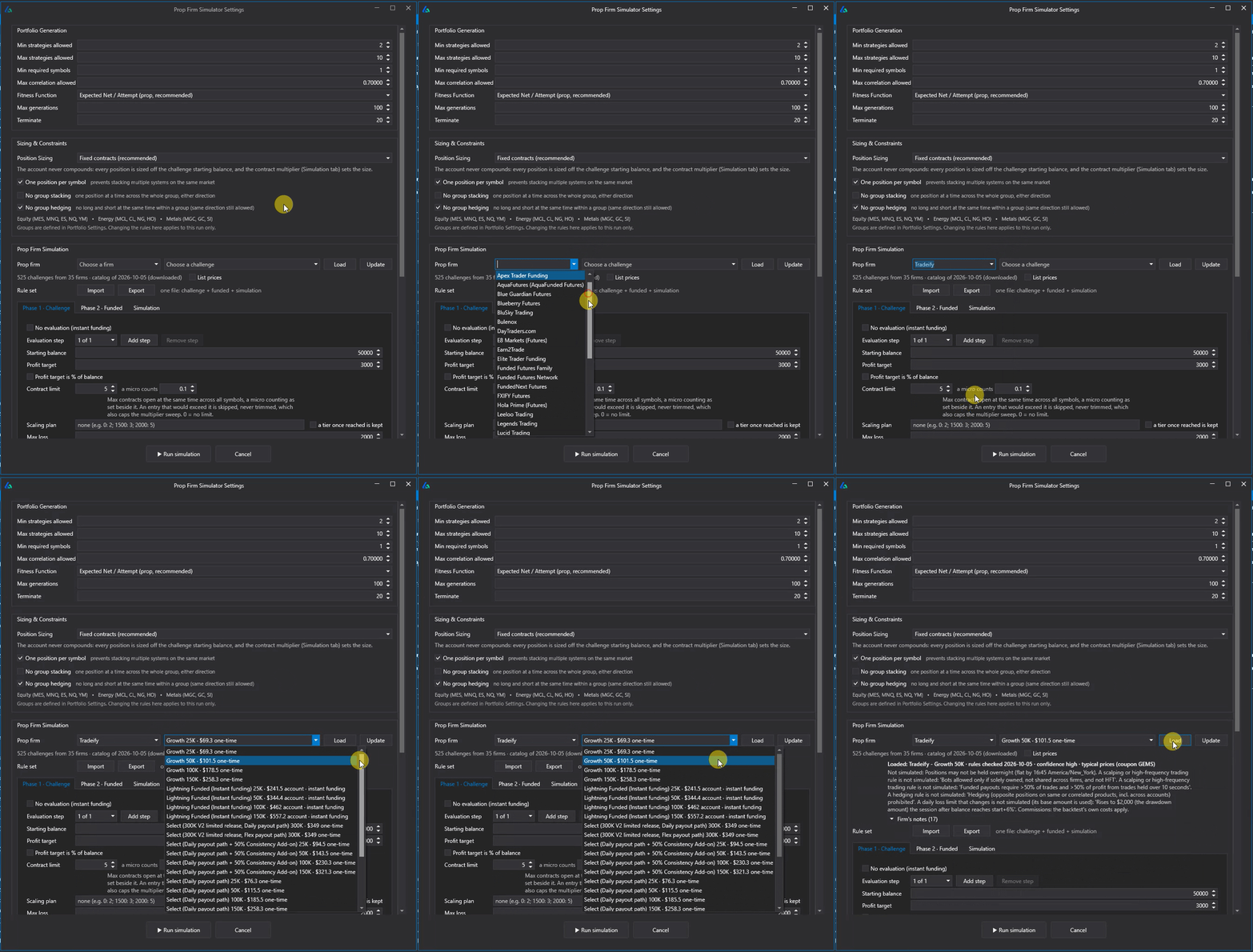
The quantitative trading landscape has undergone a profound structural shift over the past decade, driven largely by the proliferation of proprietary trading firms offering funded accounts to retail and independent algorithmic traders. While these programs have democratized access to institutional-grade capital, they have simultaneously introduced an intricate web of complex evaluation metrics, trailing drawdown rules, daily loss limits, and payout gates that fundamentally alter the economics of algorithmic strategies. In response to these evolving industry dynamics, quantitative development platform Build Alpha has officially launched its Prop Firm Simulator, a specialized tool engineered to replay trading portfolios bar by bar through historical challenge and funded-account rules.
Traditional backtesting methodologies have long relied on evaluating strategies based purely on net profit, maximum drawdown, and standard Sharpe ratios. However, institutional developers and advanced retail traders increasingly recognize that passing a proprietary firm’s evaluation phase is merely an initial hurdle. The true determinant of commercial viability within the prop trading ecosystem is the expected cash payout relative to total evaluation fees, a metric frequently obscured by conventional performance metrics. Build Alpha’s newly introduced simulator addresses this critical analytical gap by calculating the precise probability of a payout and the expected net return per challenge attempt.
The Mechanics of Prop Firm Economics and Asymmetric Risk Profiles
To understand the necessity of specialized simulation tools, one must examine the distinct financial mechanics governing proprietary trading accounts versus personal capital deployment. When trading personal funds, a strategist absorbs the entirety of a strategy’s left-tail risk—the severe, infrequent losses that can devastate an account. Conversely, proprietary trading firms cap a trader’s financial downside at the cost of the evaluation or monthly subscription fee, effectively absorbing the remainder of the adverse market distribution.
This structural asymmetry can dramatically alter a strategy’s expected value. For instance, a negatively skewed strategy characterized by frequent small gains and occasional large losses may exhibit a negative expected value when traded with personal capital. Yet, when filtered through the capped downside of a prop firm fee structure, the same strategy can yield a positive expected return per attempt. Build Alpha’s simulator models this dynamic explicitly, evaluating portfolios not on raw profitability, but on Expected Net per Attempt—a proprietary metric factoring in pass probability, funded account net profit, and average evaluation fees.
Bridging the Gap Between Evaluation Passes and Actual Payouts
A central revelation highlighted by the development of the Prop Firm Simulator is the distinct divergence between passing a challenge and successfully securing a withdrawal. Industry data consistently demonstrates that many trading portfolios optimized strictly for high evaluation pass rates perform poorly when subjected to the subsequent rules of a funded account.
Proprietary firms typically enforce rigorous secondary constraints, including consistency scores, minimum trading days, profit splits, drawdown locks, and payout ceilings. A portfolio that clears an evaluation phase rapidly via outsized volatility may subsequently violate consistency rules or fail to accumulate sufficient cushion above a trailing drawdown limit to request a payout.
Build Alpha’s simulator allows users to model Phase 1 (Challenge) and Phase 2 (Funded) environments concurrently. By replaying historical market data from multiple chronological start dates, the system accounts for real-world trading calendar idiosyncrasies, market regime clustering, and order execution constraints. Notably, the software incorporates specific risk parameters, such as treating micro futures contracts as fractional components of aggregate contract limits and rejecting orders that breach concurrent position ceilings rather than arbitrarily trimming trade sizes.
Comprehensive Database and Algorithmic Integration
Designed for seamless integration into quantitative workflows, the Build Alpha platform features an extensive, regularly updated database cataloging hundreds of active challenges across dozens of futures and foreign exchange proprietary firms. Supported by automated intelligence updates to monitor shifting industry terms—such as recent structural modifications implemented by major entities like Topstep—the simulator ensures that evaluation parameters reflect contemporary market realities.
The software introduces four primary prop-specific fitness functions to guide algorithmic strategy searches: Expected Net per Attempt, Prop ROI, Pass Probability, and Survival Prop. Rather than forcing developers to manually test isolated hypotheses, the platform’s portfolio generator scans vast pools of candidate strategies across diverse asset classes and timeframes, assembling optimized combinations designed specifically to clear institutional payout gates.
Furthermore, the analytical capabilities extend to granular visual diagnostics via the Account Paths module. Rather than relying solely on aggregate statistical summaries, traders can inspect individual equity trajectories for every historical start date, visualizing how specific withdrawal events interact with drawdown thresholds and payout floors over time. Once an optimal portfolio configuration is established, the platform facilitates the direct export of executable code embedded with the validated prop firm constraints, ensuring seamless transition from simulation to live operational deployment.
Broader Implications for the Quantitative Community
The launch of the Prop Firm Simulator reflects a broader maturation within the retail and independent quantitative trading sectors. As proprietary trading firms continually refine their risk-management algorithms and payout policies to protect institutional capital, retail participants must adopt increasingly sophisticated analytical frameworks.
By shifting the strategic focus from superficial evaluation pass rates to robust, fee-adjusted payout expectations, tools like Build Alpha’s simulator provide a rigorous empirical foundation for navigating the modern proprietary trading ecosystem. As automated trading strategies continue to evolve, the integration of multi-phase rule simulation into standard development pipelines is expected to become an indispensable standard for professional and independent strategists alike.