Designing Reliable Memory Systems for AI Agents: A Comprehensive Engineering Guide

As artificial intelligence agents transition from simple, stateless query responders to autonomous systems capable of multi-step reasoning, the architecture of their memory systems has emerged as the critical bottleneck for reliability. In this article, you will learn how to design robust memory systems for AI agents, covering the patterns that work and the common architectural mistakes that cause persistent, hard-to-trace failures.
The evolution of agentic memory represents a shift from static prompt engineering to dynamic state management. When an AI agent operates within a single, isolated context, it relies entirely on its immediate prompt window. However, once information must persist across separate interactions, the paradigm shifts entirely. An agent requires a sophisticated memory architecture to maintain continuity, avoid the redundancy of repeated questions, filter out noise, and prevent stale information from triggering recursive logic errors.
The Evolution of Agentic Memory
Historically, the industry treated "memory" as synonymous with "context window." However, as of late 2025 and early 2026, researchers and engineers have distinguished between the short-term context—the immediate, volatile input—and the long-term memory, which serves as a persistent repository for state, facts, and past decisions. Failing to build a structured memory layer forces the agent to "start from zero" with every execution, leading to significant latency and diminished user trust. Conversely, a poorly implemented memory system can lead to "memory pollution," where inaccurate or outdated information is retrieved, causing the agent to hallucinate or act on false premises.
Defining the Taxonomy of Memory
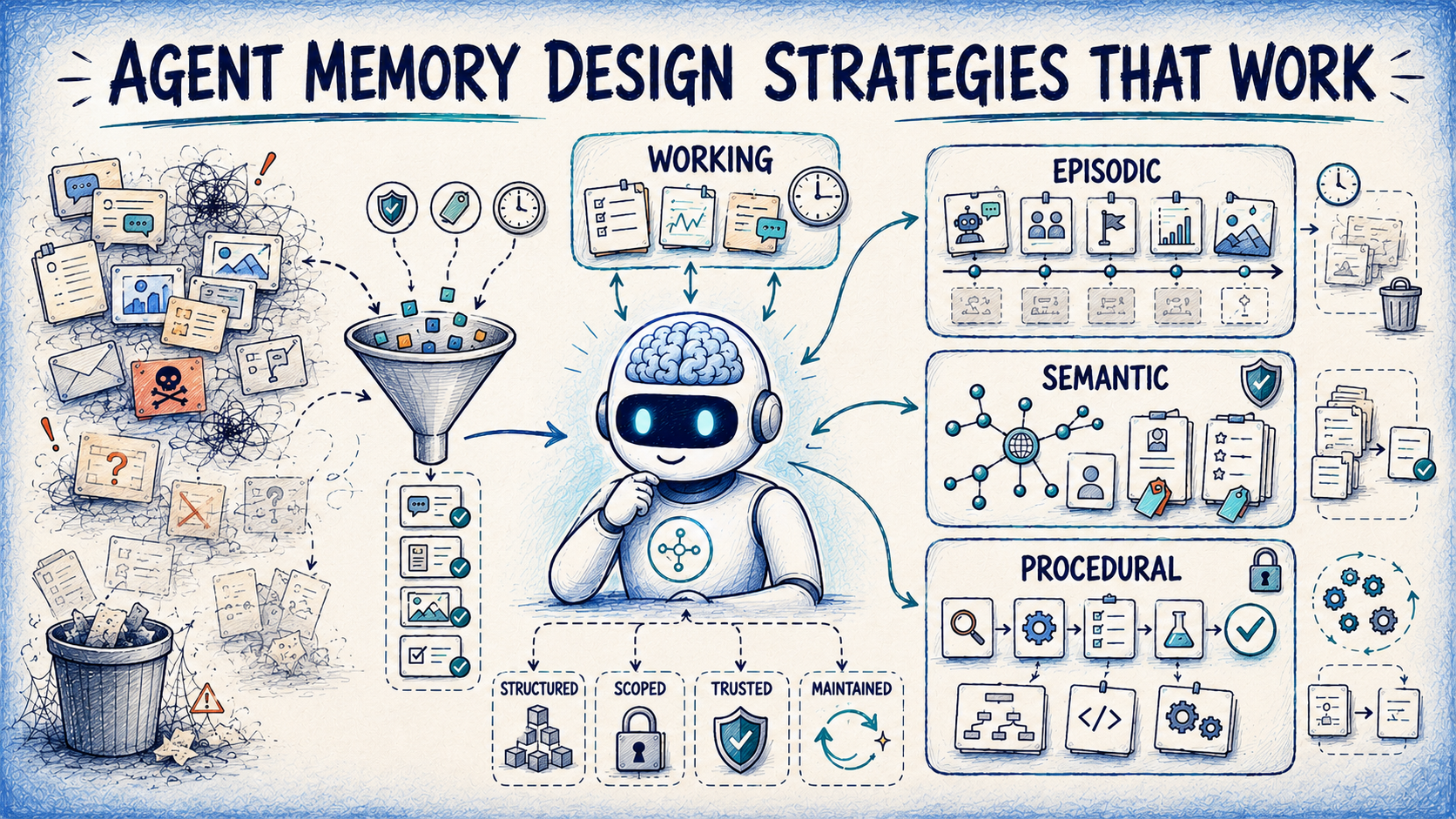
To build a production-grade system, developers must move beyond a monolithic data structure. In contemporary agentic architectures, memory is classified into four distinct categories, each requiring a specific storage strategy and retrieval mechanism:
- Episodic Memory: This encompasses the historical record of what has happened, including past interactions, task runs, and decision logs. It is typically housed in a vector database to facilitate semantic similarity searches.
- Semantic Memory: This holds the agent’s "worldview"—fixed facts, user preferences, and domain knowledge that evolves over time. This layer is often managed through a combination of vector stores and traditional key-value databases to ensure exact retrieval when needed.
- Procedural Memory: This represents the "how-to" layer, containing successful action patterns and refined workflows. This is often implemented through structured rule-sets or prompt-injected templates.
- Working Memory: This is the scratchpad of the agent, holding intermediate results and temporary state values during a single execution flow. This layer must be volatile and low-latency, typically using in-memory caches.
The Importance of Scoring and Hierarchical Storage
A common pitfall in early agent development is the "store everything" approach. Storing every interaction increases operational costs exponentially and degrades retrieval accuracy due to signal-to-noise ratio issues. The industry standard is shifting toward hierarchical memory, where an importance scoring mechanism dictates whether data is preserved.
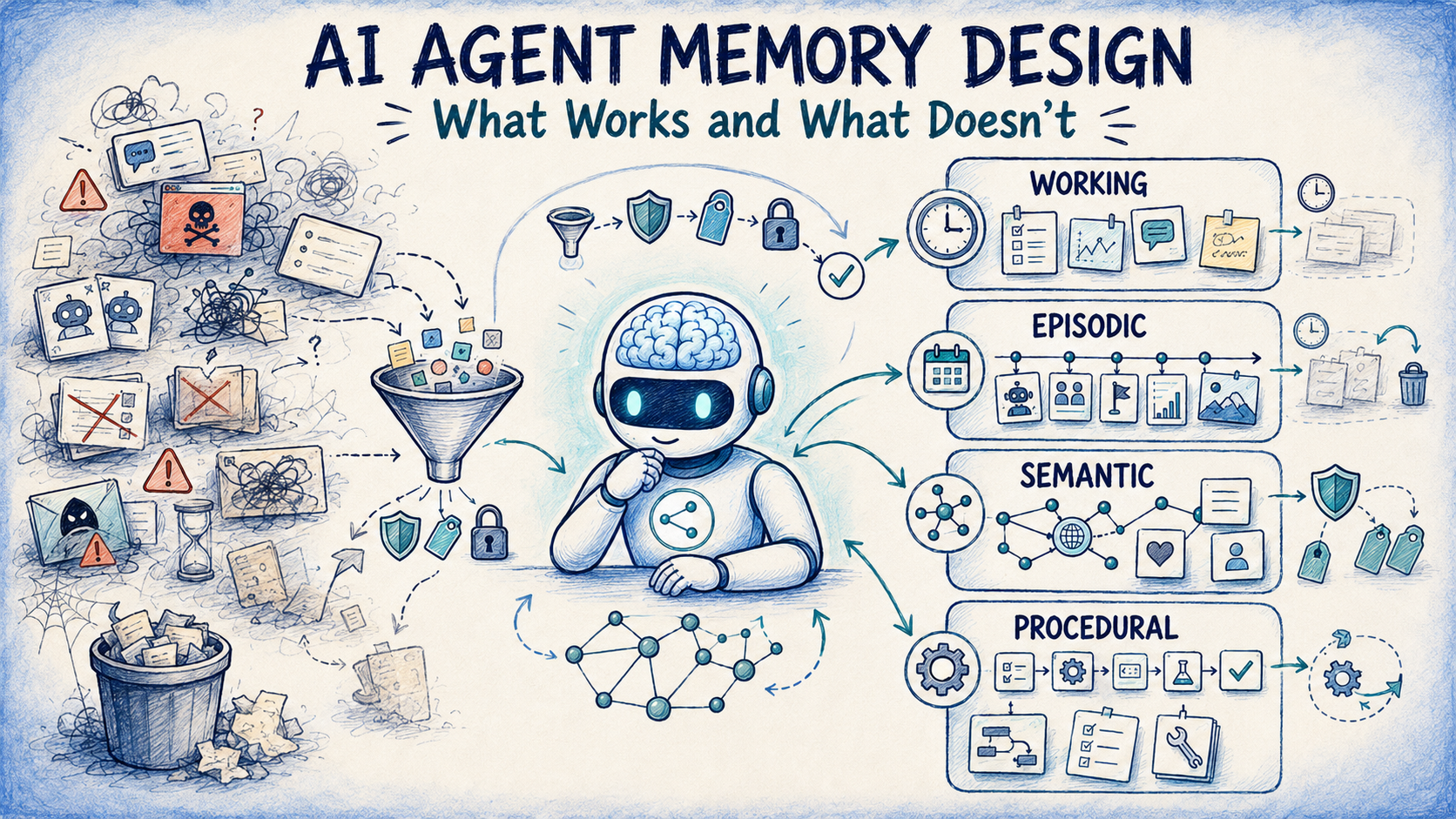
Engineers are now implementing MemoryEntry schemas that include timestamps, confidence scores, and tags. By setting an "importance threshold," the system only writes to persistent storage if the information provides long-term value. For example, a fleeting observation about a user’s current mood might be assigned low importance and eventually purged, while a confirmed constraint regarding a project deadline is tagged with high importance, ensuring it remains part of the agent’s persistent knowledge.
Multi-Agent Coordination and Scoping
In complex systems, a single, shared memory store is increasingly viewed as a structural liability. Research indicates that when a "Research Agent" and an "Execution Agent" access the same global memory, cross-contamination occurs. The Execution Agent may misinterpret notes intended for the Research Agent, leading to cascading failures.
The modern solution is "Namespace Scoping." By enforcing strict read-write permissions based on the agent’s specific role, architects ensure that the orchestrator maintains global oversight, while sub-agents operate within isolated domains. This prevents the "silent pollution" of memory, where one agent’s error is propagated across the entire system.
The Criticality of Write-Back Policies
A significant architectural failure occurs when systems only commit to memory upon successful task completion. If a process fails midway, the system loses the state of its progress, forcing a complete restart. Best practices now dictate that agents must commit results to working memory after every atomic step. This allows for "resumption," where an agent can pick up a task from the point of failure. Only once a task is verified as successful is the information promoted to the episodic memory layer. This ensures that the persistent store remains clean and free of incomplete, potentially misleading task fragments.
Addressing Memory Poisoning and Security
As agents become more autonomous, they are increasingly vulnerable to "Memory Grafting" attacks. This occurs when an agent processes external, untrusted content—such as a malicious webpage or a user input containing hidden instructions—and saves it into long-term memory. Future retrievals treat this malicious input as legitimate ground truth, effectively allowing an attacker to inject permanent behavioral changes into the agent.
To mitigate this, developers must implement a "Trust-Level Filter" on every write operation. Content from internal, trusted sources is treated differently than content from public web queries. Before writing to long-term memory, an intermediary "Sanitization Agent" or a rule-based validator should check for embedded directives. If the content contains potential prompt-injection attempts, it is discarded before it can ever be indexed.
The Failure of Free-Form Summarization
A common, yet flawed, technique for managing long context windows is the use of automated summarization. While compressing history into a summary seems efficient, it introduces two major failure modes: the loss of critical detail and the compounding of hallucinations.
When a model summarizes a conversation, it inevitably discards constraints or specific values that may be vital for future tasks. If an agent hallucinates a fact during a session, and that hallucination is captured in a summary, the error is effectively "hard-coded" into the agent’s future knowledge. The solution is to move away from unstructured prose summaries and toward structured fact extraction. By using strict schemas, the agent is forced to extract verifiable data points into a database, rather than re-writing a vague paraphrase of past events.
The Path Forward: Maintenance and Lifecycle Management
Memory is not a static asset; it is a dynamic component that requires active maintenance. Without routine deduplication, confidence decay, and TTL (Time-To-Live) expirations, a memory system will inevitably become bloated and noisy.
The industry is currently moving toward a standard of "Confidence Decay," where the reliability score of a fact decreases over time unless it is periodically reaffirmed. This ensures that the agent is not relying on outdated information, such as a user’s old phone number or a deprecated API configuration.
Conclusion: Engineering for Resilience
The development of reliable agentic memory requires moving away from simple, monolithic vector databases toward multi-layered, structured, and policy-driven architectures. By prioritizing provenance—tracking exactly which agent created a memory and why—and by enforcing strict access scopes, developers can build agents that are not only more capable but also more predictable and secure.
As these systems continue to evolve, the focus must remain on the quality of the information being stored rather than the quantity. The objective is not to build an agent that remembers everything, but one that remembers the right things, at the right time, with the necessary level of skepticism required to navigate an uncertain digital environment.