Quantitative Analysis of SEC Form 4 Insider Purchase Filings Reveals Short Term Market Sensitivity and Long Term Uncertainty


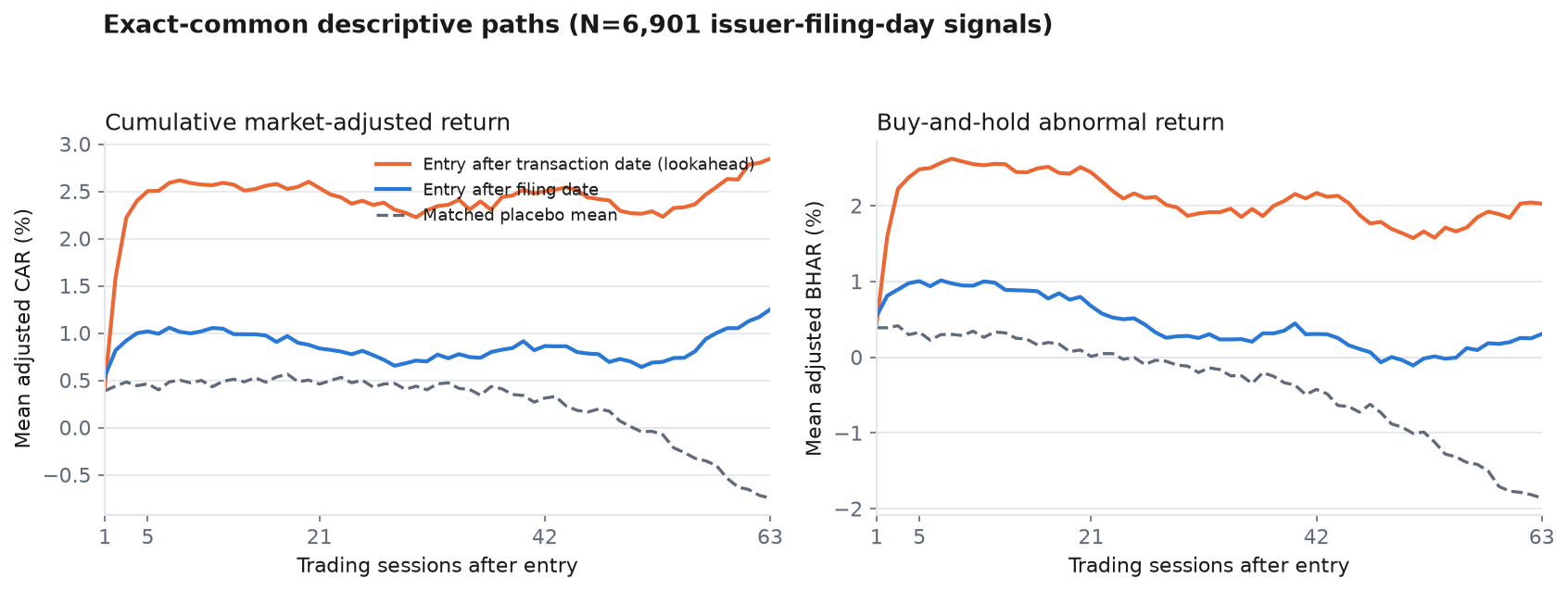
The regulatory architecture of the United States equity markets relies heavily on the transparency provided by Form 4 filings, a mandatory disclosure document that records changes in beneficial ownership for corporate officers, directors, and significant shareholders. While these documents are frequently mined by quantitative researchers seeking to identify "smart money" signals, a comprehensive analysis of over 1.3 million non-derivative transaction rows from January 2022 through June 2026 suggests that the predictive power of these filings is largely concentrated in the immediate aftermath of disclosure. This study, which aggregated 7,406 distinct issuer-day signals, indicates a statistically significant cumulative abnormal return (CAR) of +0.534% for the next trading session and +1.009% over five sessions, though the signal loses its distinctiveness over 21-day and 63-day horizons.
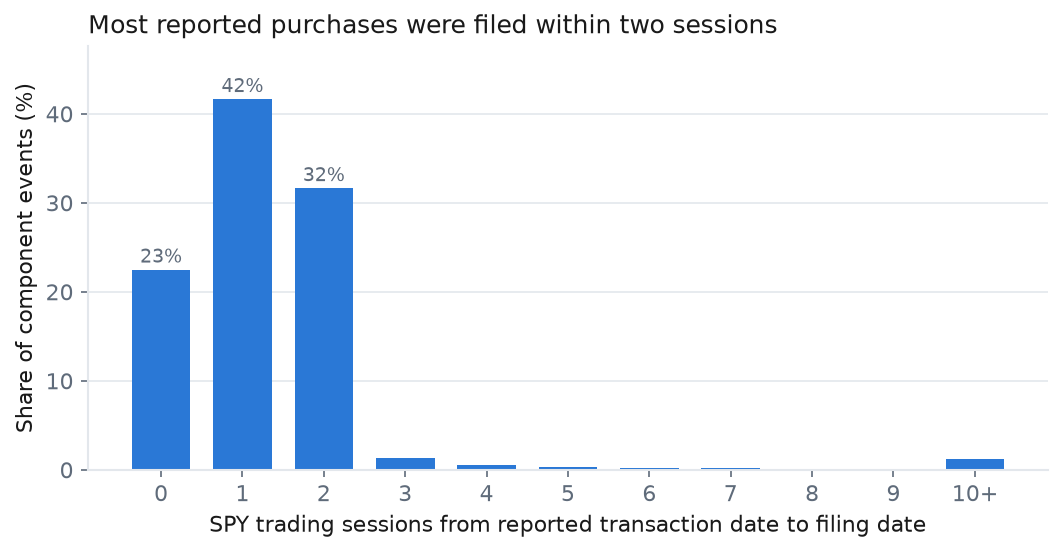
Understanding the mechanics of these disclosures is essential for distinguishing between informative insider behavior and routine administrative filings. Under Section 16 of the Securities Exchange Act of 1934, corporate insiders must report transactions within two business days. However, the data reveals that interpreting these filings is far more complex than the binary "insider buys" narrative often touted in retail trading circles. A single filing may contain multiple transaction tranches, joint ownership disclosures, and varying security classes, all of which can obfuscate the true intent behind a purchase.
The Anatomy of Insider Disclosure and Data Integrity
The study utilized a rigorous filtering funnel to distill 1,345,036 raw transaction rows into a clean, actionable dataset. By isolating "Code P" (open-market or private purchase) transactions and excluding derivative exercises, equity swaps, and Rule 10b5-1 plan trades, researchers were able to create a more focused sample. Notably, the introduction of the Rule 10b5-1 checkbox on April 1, 2023, provided a critical layer of clarity, allowing for the exclusion of pre-scheduled transactions that are less likely to reflect idiosyncratic informational advantages.
The methodology addressed several common pitfalls in financial data engineering. For instance, multi-owner joint filings were excluded to prevent the double-counting of signals, and "Form 4/A" amendments were removed to avoid the bias of supersession. Furthermore, by anchoring the analysis to the filing date rather than the transaction date, the research successfully eliminated lookahead bias—a common flaw in many historical insider trading studies that conflates private transaction timing with the public dissemination of that information.
Empirical Findings: The Short-Term Alpha
The data presents a clear picture of market reaction. The primary SPY-adjusted mean CAR of +0.534% for the next session, supported by a two-way clustered t-statistic of 6.460, suggests that the market efficiently incorporates the information contained in Form 4 purchases almost immediately. This reaction is consistent with the hypothesis that, while insiders may possess non-public information, the competitive nature of market participants ensures that price discovery occurs rapidly following disclosure.
However, the efficacy of the signal diminishes significantly as the time horizon extends. At 21 sessions, the adjusted CAR remains positive at +0.980%, but the confidence intervals begin to widen, crossing the zero threshold and rendering the result statistically indistinguishable from noise. By the 63-session mark, both CAR and Buy-and-Hold Abnormal Returns (BHAR) show no persistent drift, with the median BHAR actually dipping into negative territory (-3.605%). This suggests that while insider purchases may act as a catalyst for immediate price adjustment, they do not constitute a reliable indicator of long-term outperformance.
The Role of Market-Model Sensitivity
While the primary adjusted CAR results suggest a modest short-term impact, the use of a standard market model—which adjusts for beta-sensitive market movements—yields larger estimates, with 63-session CARs reaching +6.560%. This discrepancy highlights the sensitivity of event studies to methodological choices. Much of the "drift" observed in market-model results is driven by negative pre-event alphas, which mechanically inflate residuals over time. Consequently, the study cautions against interpreting market-model results as definitive proof of long-term informational advantage, preferring the more conservative adjusted CAR and BHAR benchmarks as the primary metrics for performance.
Methodological Rigor and Placebo Testing
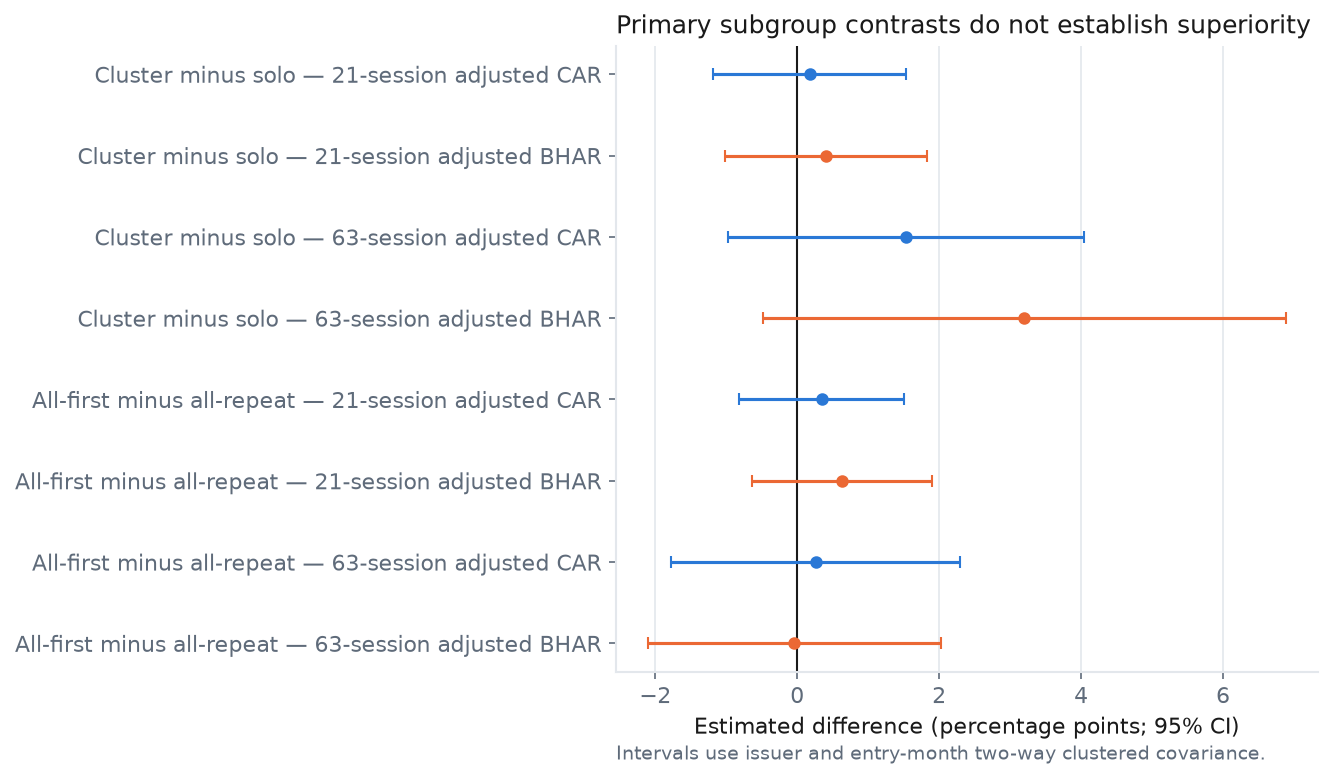
To validate the findings, the study employed a matched-placebo methodology, comparing real filing events against synthetic ones matched by ticker, volatility, and momentum. The honest-minus-placebo contrasts failed to provide conclusive evidence of long-term alpha. Specifically, the two-way clustered intervals for 21-session and 63-session BHAR consistently crossed zero, suggesting that the observed returns are not necessarily a product of the insider’s unique insight but could be influenced by broader market conditions or sector-specific trends.
These results carry significant implications for institutional investors and data scientists. The lack of subgroup superiority—where "first-time" buyers failed to outperform "repeat" buyers—indicates that the market does not differentiate between the frequency of insider activity. Furthermore, the liquidity footprint analysis reveals that in nearly 10% of cases, the insider’s purchase volume exceeded 100% of the median daily dollar volume, highlighting that these signals often occur in illiquid environments where execution costs and market impact would likely erode any theoretical returns.
Implications for Regulatory and Market Participants
The findings offer a sobering reminder of the limitations inherent in public-data analysis. While Form 4 filings remain a gold standard for transparency, they are not a substitute for proprietary alpha generation. The research underscores the necessity for rigorous data cleaning—specifically the normalization of ticker symbols, the handling of stock splits, and the exclusion of "noise" filings—to ensure that event studies reflect market reality rather than data artifacts.
For regulatory bodies, the study reinforces the importance of the two-day reporting deadline. The swift market reaction observed within the first session suggests that the current disclosure regime is highly effective at ensuring that information reaches the public domain rapidly. Any further tightening of these deadlines might yield diminishing returns, given that the market currently processes and prices these disclosures with high efficiency.
Conclusion and Future Research
The evidence provided by this analysis suggests that while corporate insiders are indeed "in the know," the information they provide via Form 4 filings is quickly absorbed by the broader market. The observed +0.534% one-session return is a testament to the speed of modern information processing. However, the absence of persistent long-term outperformance cautions against the use of simple insider-tracking strategies.
For future research, the focus should shift toward identifying the characteristics of the "opportunistic" trader versus the "routine" trader, potentially by incorporating more granular data on the specific roles of the insiders or the macroeconomic environment surrounding the transactions. As the financial industry continues to refine its use of alternative data, the ability to replicate and cross-validate such studies—as demonstrated by the release of the companion code and data manifest—will remain the hallmark of high-quality quantitative research. Ultimately, the study concludes that while insider purchases are a valuable signal, their utility is finite, requiring a disciplined approach to event study design and a healthy skepticism toward long-horizon performance claims.