Build a Multi-Modal RAG Pipeline in Python to Retrieve and Reason Over Text and Images in Complex Documents.

The proliferation of enterprise data in PDF format—often containing a complex mixture of dense prose, intricate data tables, and high-value embedded imagery—has long posed a significant challenge for traditional Retrieval-Augmented Generation (RAG) systems. While standard RAG architectures have matured significantly in their ability to process and retrieve plain text, they remain fundamentally limited when confronted with visual intelligence. When a system ignores the context buried in a financial chart or a technical schematic, it inevitably provides an incomplete, and potentially inaccurate, answer to a user’s query.
To bridge this gap, engineers are increasingly turning to multi-modal RAG, a sophisticated architectural pattern that treats images as first-class citizens within the retrieval process. By leveraging the combined power of the LangChain framework, the Unstructured document processing library, and OpenAI’s GPT-4o vision capabilities, developers can now build pipelines that "see" and "read" documents with a level of human-like comprehension previously thought impossible for automated systems.
The Evolution of Document Intelligence
The history of document retrieval has progressed from simple keyword-based search to dense vector embeddings. In the early 2020s, the adoption of RAG allowed LLMs to look up relevant snippets of text to reduce hallucinations. However, this relied on the assumption that a document could be flattened into a linear stream of characters.
In reality, business-critical documents like quarterly earnings reports, technical manuals, and medical records are inherently non-linear. Data is frequently locked inside images or tables that do not parse correctly when subjected to traditional text-chunking algorithms. According to recent industry surveys, nearly 40% of critical information in corporate PDF documentation is contained within non-text elements, highlighting a massive blind spot in standard AI-driven knowledge management.
Technical Prerequisites and Environment Configuration
Implementing a robust multi-modal RAG pipeline requires a precise orchestration of software dependencies. The core of the document parsing process relies on the unstructured library, which requires the poppler-utils system dependency to perform accurate image extraction from PDF files.
To initialize the development environment, developers should execute the following installation command:
pip install langchain langchain-openai unstructured[pdf] chromadb pillow
apt-get install -y poppler-utils
Once the environment is configured, the system requires an active OpenAI API key, which must be exported as an environment variable to ensure secure access to the GPT-4o model. This model is essential because it possesses the native vision-language processing capabilities required to translate visual input into meaningful, searchable semantic descriptions.
Step 1: Intelligent Document Parsing
The first phase of the pipeline is the decomposition of the document. Unlike standard scripts that extract text as a singular string, the partition_pdf() function from the unstructured library classifies each element of the PDF by its structural role. This functionality allows the developer to isolate paragraphs, tables, and image blocks into distinct, manageable data types.
By setting infer_table_structure=True, the system can maintain the integrity of complex data grids, while the extract_image_block_types=["Image"] configuration ensures that embedded graphics are saved as individual files in a local directory. This separation is the cornerstone of the multi-modal approach: it ensures that the retriever does not confuse the caption of an image with the actual content of the visual data.
Step 2: The Multi-Vector Retrieval Architecture
The most critical innovation in this pipeline is the transition from a single-vector store to a multi-vector store. In a standard setup, the document chunks and the vectors are identical. In a multi-modal setup, however, there is a mismatch: a vector database cannot perform similarity searches on a raw image file.
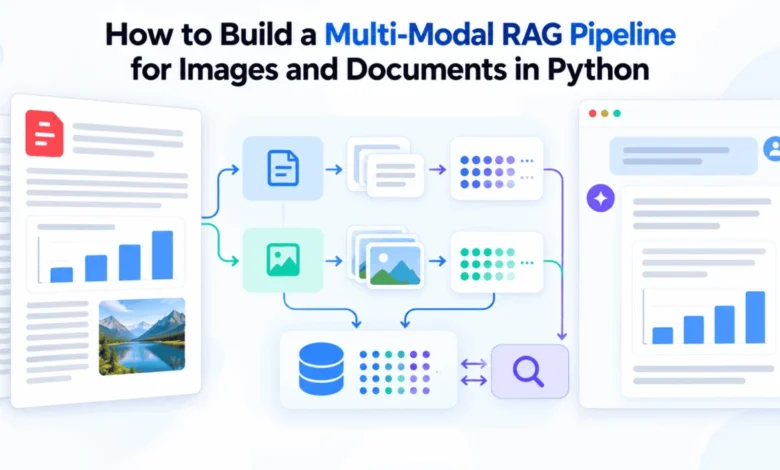
To solve this, the pipeline generates a text-based summary for every image using GPT-4o. This summary serves as a high-fidelity "proxy" for the image. When a user inputs a query, the system performs a similarity search against these textual summaries. Once the relevant summary is identified, the system uses a unique identifier (a UUID) to retrieve the corresponding raw image file from the document store.
Step 3: Chronology of the Retrieval-Generation Cycle
The workflow follows a strict chronological order to ensure accuracy:
- Indexing: Documents are parsed into text chunks and image assets.
- Summarization: Images are passed to GPT-4o to generate descriptive metadata.
- Storage: Both text chunks and image summaries are embedded into a vector store (e.g., ChromaDB), while the raw content is stored in an
InMemoryStoremapped to the embeddings. - Retrieval: A natural language query triggers a search across the unified vector space.
- Synthesis: The system retrieves both the raw text and the raw image, sending both as a multimodal payload to GPT-4o, which then produces a final, grounded answer.
Implications and Business Impact
The shift toward multimodal retrieval has profound implications for enterprise AI. By enabling LLMs to interpret charts and diagrams, companies can automate the processing of complex documentation that was previously reserved for human analysts. For example, in the financial sector, a system capable of cross-referencing a text-based market analysis with a visual graph of revenue trends can provide far more reliable summaries than a text-only model.
However, developers must be mindful of the operational costs associated with this approach. Every image extracted from a document triggers a request to the GPT-4o API for summarization. In large-scale deployments, it is recommended to implement a filtering layer that ignores small, insignificant assets like logos or decorative icons, thereby optimizing both latency and API expenditure.
Future Perspectives: Beyond Parsing
While this architecture represents the current state-of-the-art for API-driven pipelines, the field is moving toward native vision-language models like ColPali. These models treat the document page as a single image, effectively bypassing the need for complex parsing and chunking altogether. By embedding the visual representation of a page directly into a vector space, these models promise to further reduce the overhead of document management.
For now, the multi-vector approach remains the most practical and scalable solution for businesses looking to unlock the full potential of their existing documentation. By treating text and images as equal components of the knowledge graph, organizations can ensure that their AI systems are no longer blind to the most critical information hidden within their files. As we move forward, the integration of these multimodal pipelines will likely become the standard requirement for any enterprise-grade retrieval system.