Court-Ordered Domain Transfer Seizes Radaris.com Amid Enforcement of New Jersey Privacy Legislation


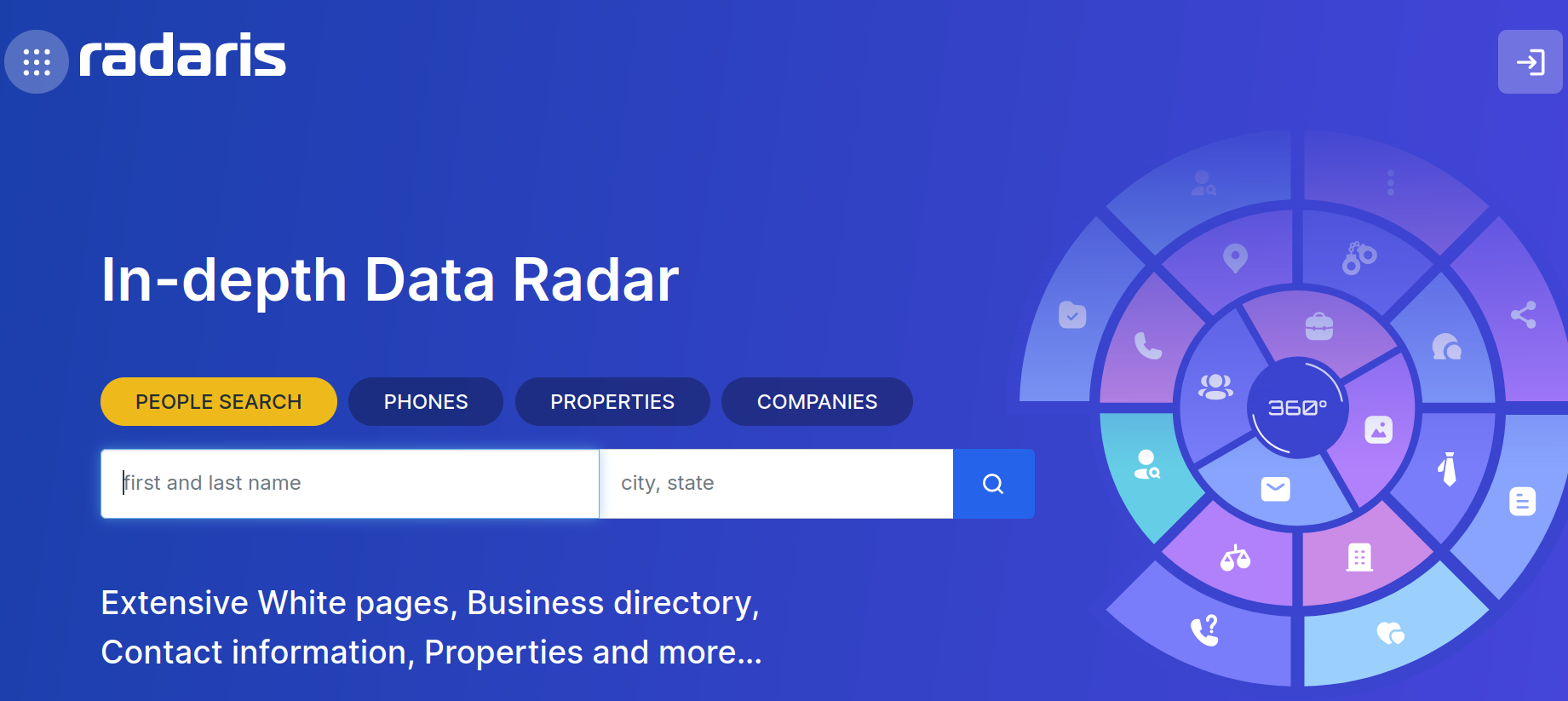
The controversial consumer data broker Radaris.com has lost control of its primary web address and more than a dozen associated domains following a landmark default judgment in New Jersey. The enforcement action stems from persistent non-compliance with state privacy protections designed to shield law enforcement personnel, judges, and government officials from commercial people-search exploitation. In a rare and aggressive legal remedy, a New Jersey court ordered the transfer of fourteen core domains belonging to the Radaris network to the plaintiffs, Atlas Data Privacy Corp. This unprecedented action highlights the growing friction between state-level privacy mandates and the lucrative, highly evasive digital data-brokerage industry.
Background and Origins of the Dispute
For years, Radaris operated as a prominent fixture in the online people-search ecosystem, harvesting and publishing detailed personal profiles culled from public registries, social media, and commercial databases. The platform developed a reputation for systematically ignoring individual takedown requests, a standard practice among numerous consumer data aggregators. This operational model collided with reality when Atlas Data Privacy Corp initiated a lawsuit in February 2024. The litigation alleged that Radaris systematically violated New Jersey’s Daniel’s Law, a strict privacy statute enacted in the wake of a tragic family shooting involving a federal judge.
Daniel’s Law specifically empowers judges, prosecutors, law enforcement officers, and other designated public officials to demand the complete removal of their personal information—such as home addresses and phone numbers—from commercial directories. Crucially, the statute includes punitive financial mechanisms, levying fines of $1,000 per violation against companies that disregard lawful removal orders. Faced with what it perceived as systemic disregard for state boundaries and official safety mandates, Atlas launched a comprehensive campaign to hold the operators legally and financially accountable.
Chronology of Evasion and Corporate Shell Games
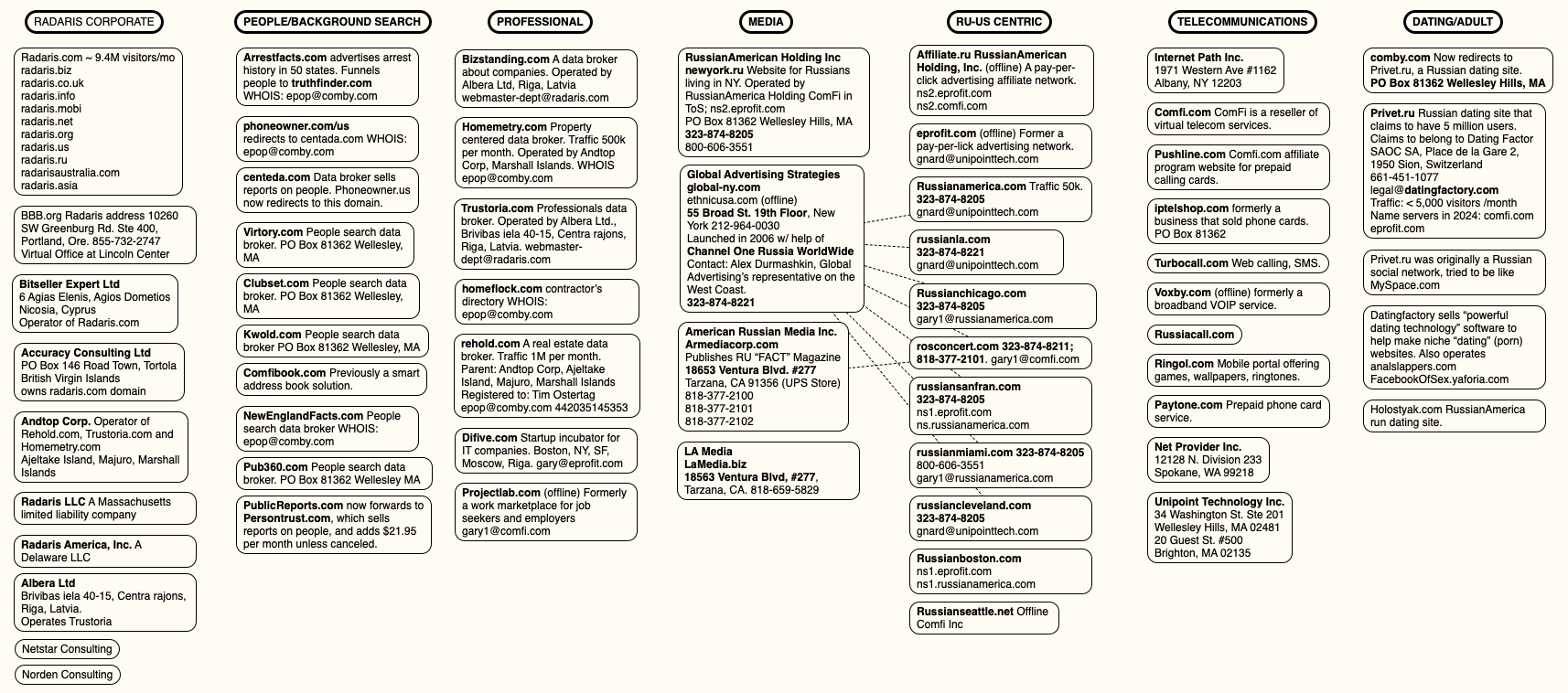
The legal battle exposed a complex corporate labyrinth designed to obscure ultimate ownership and frustrate regulatory oversight. Investigative reporting later identified the masterminds behind the Radaris empire as Igor and Dmitry Lubarsky, Russian-born brothers residing in Massachusetts. The siblings reportedly managed an expansive portfolio of people-search properties, affiliate programs, and foreign-registered entities while actively concealing their control.
Throughout the litigation, the defendants utilized a shifting array of corporate structures and jurisdictional shell games to delay proceedings. According to court filings and statements from Atlas leadership, the operation routinely engaged in what attorneys termed an "island-hopping phase." As legal pressure mounted in domestic courts, corporate entities associated with the network were ostensibly transferred to offshore tax havens, including the Marshall Islands, the British Virgin Islands, and Seychelles.
In some instances, corporate registry checks revealed that newly designated managing entities introduced in corporate terms of service did not legally exist at the time of their designation. Furthermore, the defense previously deployed a fictitious executive, "Gary Norden," to project corporate legitimacy while soliciting investor capital, an admission later made by the network’s legal counsel, Val Gurvits of the Boston Law Group. When default judgments approached, defense attorneys routinely challenged service of process, arguing that the actual foreign parent companies—such as Cyprus-registered Bitseller Expert Limited or Marshall Islands-based Andtop Company—had not been appropriately named, thereby executing a protracted strategy of attrition that had successfully protected the platform for a decade.
Supporting Data and Interconnected Revenue Streams
Discovery materials and over 10,000 internal documents secured by Atlas during the litigation illuminated the sheer scale and financial mechanics of the Radaris network. Far from being a decentralized collection of independent platforms, the document corpus demonstrated that at least twenty-five distinct people-search domains operated as a unified enterprise managed by a tight-knit Boston-area group.
Administrative, financial, and technical infrastructure for legal vehicles—including Radaris America Inc., Digital Orbit Corp., Core Solutions Group Inc., and Veripages Inc.—consolidated around a shared set of banking channels, virtual offices, and administrative mail domains. Financial data extracted from the documents indicated substantial commercial revenues. Radaris.com alone generated an estimated $42,000 monthly, while sister property Veripages.com pulled in approximately $45,000 per month through strategic data-sharing partnerships with marketing conglomerates such as the Lifetime Value Company, which operates consumer brands like PeopleLooker, PeopleSmart, NumberGuru, and Bumper.

Intriguingly, the evidentiary record also revealed commercial entanglements with reputation-management firms. The Radaris family of websites reportedly drew up to $25,000 monthly from partnerships with Onerep, a privacy service that assists individuals in scrubbing data from search engines, illustrating an operational loop where entities simultaneously profited from the exposure and the suppression of personal data.
Official Responses and Legal Defense
The defendants have vigorously contested the legality of the recent judicial actions. Attorney Victor Worms, representing the respondents in ongoing proceedings, argued that the New Jersey court erred fundamentally by transferring a web domain associated with a non-legal entity.
"We have made a motion to vacate that default judgment on the grounds that it is void since a non-entity has no legal capacity to sue or be sued," Worms stated, adding that the defense intends to pursue appeals asserting that the seizure of radaris.com constitutes an unconstitutional forfeiture. Prior counsel Val Gurvits had similarly maintained that the court’s actions violated due process protections afforded to the actual foreign entities holding domain registration rights.
Conversely, plaintiffs’ counsel and Atlas executives defended the necessity of the seizure. Raj Parikh of PEM Law noted that while foreign actors historically relied on jurisdictional distance and procedural exhaustion to defeat plaintiffs, the severe security risks posed to New Jersey law enforcement necessitated an uncompromising expenditure of legal resources. Following the court order, visitors attempting to access radaris.com are no longer met with searchable personal dossiers; instead, the homepage displays an official notification detailing the court-ordered domain transfer.
Broader Impact and the Future of Federal Privacy Regulation
The Radaris seizure unfolds against a backdrop of sweeping legislative and constitutional challenges. While at least fourteen other states have enacted statutes modeled after Daniel’s Law, the broader data broker industry has mounted a coordinated counter-offensive. More than 150 data-broking firms have challenged the constitutionality of Daniel’s Law in federal court, arguing that sweeping restrictions on publishing publicly available records infringe upon First Amendment protections. In August 2025, a federal district court ruled West Virginia’s iteration of the law facially unconstitutional, setting the stage for what legal analysts expect to be an eventual showdown before the U.S. Supreme Court.
Privacy experts argue that state-level statutes, while impactful for targeted public servants, serve as incomplete stopgaps against an industry built on systemic data harvesting. Justin Sherman, a privacy researcher and author examining the data broker ecosystem, emphasizes that commercial aggregators thrive precisely because federal law lacks comprehensive baseline privacy protections. Existing state regulations routinely exempt public records—such as voting registries, property deeds, marriage licenses, and motor vehicle databases—leaving vast reserves of personal information legally accessible for commercial exploitation.
Without unified federal legislation governing how data brokers, artificial intelligence platforms, and commercial entities collect and monetize digital footprints, privacy advocates warn that legal battles will remain piecemeal. As high-profile security incidents, such as massive driver’s license database compromises, continue to underscore the vulnerability of personal records, the pressure on federal lawmakers to enact modern data protection standards intensifies. For now, the successful seizure of the Radaris domain network stands as a milestone in accountability, signaling that aggressive enforcement can temporarily pierce the corporate veil of transnational data brokers.