FinovateSpring 2026 Highlights Pivotal Fintechs Powering the Complexities of Product Launch and Scale


Launching and successfully scaling new products in the dynamic financial technology sector is an intricate endeavor, extending far beyond the initial development and deployment of a new tool. The journey from conception to market dominance is fraught with multifaceted challenges, encompassing stringent governance and compliance frameworks, sophisticated marketing and social engagement strategies, rigorous consumer testing and surveying, proactive vulnerability identification and remediation, and diligent post-launch consumer follow-up. These critical auxiliary functions often dictate the ultimate success or failure of an innovation, transforming a promising concept into a market leader or an overlooked offering.
The landscape of financial services is undergoing an unprecedented transformation, driven by rapid technological advancements, evolving consumer expectations, and an increasingly complex regulatory environment. In this context, financial institutions (FIs) – from global banks to regional credit unions – are under immense pressure to innovate at an accelerated pace while simultaneously mitigating risks and ensuring seamless customer experiences. The traditional, often protracted, product development cycles are no longer sustainable in an era demanding agility and continuous improvement. This necessitates a robust support ecosystem capable of streamlining the operational overhead associated with product launches, thereby allowing FIs to focus on their core competencies and strategic objectives.
Recognizing this critical need, FinovateSpring 2026, a premier event in the global fintech calendar, is set to convene in San Diego, showcasing a curated selection of five groundbreaking fintech companies. These innovators are at the forefront of enabling this crucial next phase of product launches, providing essential capabilities that address the ancillary, yet vital, tasks involved in bringing new financial solutions to market. Finovate events, known for their unique demo-focused format, provide a vital platform for emerging and established fintechs to present their innovations directly to an audience of financial executives, investors, and industry analysts. Since its inception, Finovate has served as a bellwether for the fintech industry, identifying trends and spotlighting companies that are shaping the future of finance. The Spring edition, in particular, often sets the tone for the year’s innovation trajectory, attracting participants eager to discover solutions that can confer a competitive edge. Attendees at FinovateSpring 2026 will have the opportunity to delve into the diverse capabilities offered by these featured companies, understanding how their solutions facilitate smoother, more compliant, and more effective product rollouts.
The Evolving Landscape of Fintech Product Launches

The contemporary financial market demands not only innovative products but also flawless execution. A product’s lifecycle is no longer linear; it is an iterative process of development, launch, feedback, refinement, and scaling. Each stage presents its own set of challenges. For instance, regulatory compliance, often an afterthought in the early stages of product ideation, has become a front-and-center concern. Regulators globally, from the Office of the Comptroller of the Currency (OCC) and the Federal Reserve in the U.S. to the European Banking Authority (EBA), are increasingly scrutinizing how financial products are developed, deployed, and managed, especially concerning data privacy, consumer protection, and the ethical use of advanced technologies like Artificial Intelligence (AI).
Moreover, achieving product-market fit is a perpetual challenge. Without robust consumer testing and feedback mechanisms, even the most technologically advanced product can fail to resonate with its target audience. The rapid proliferation of digital channels also means that marketing and social campaigns must be highly targeted, engaging, and compliant with advertising standards. Simultaneously, the pervasive threat of cyberattacks necessitates ironclad security protocols, from the foundational code to API integrations and data storage, making vulnerability management a continuous, high-stakes endeavor. Addressing these complexities requires specialized tools and expertise, which are often beyond the internal capabilities of many financial institutions, particularly community banks and credit unions that may have limited resources compared to their larger counterparts.
Spotlight on Innovation: Addressing Key Launch Challenges
The five fintechs featured at FinovateSpring 2026 represent a cross-section of solutions designed to tackle these critical challenges, offering specialized expertise to streamline the product launch and scaling process.
PentEdge: Navigating AI Governance in Financial Services
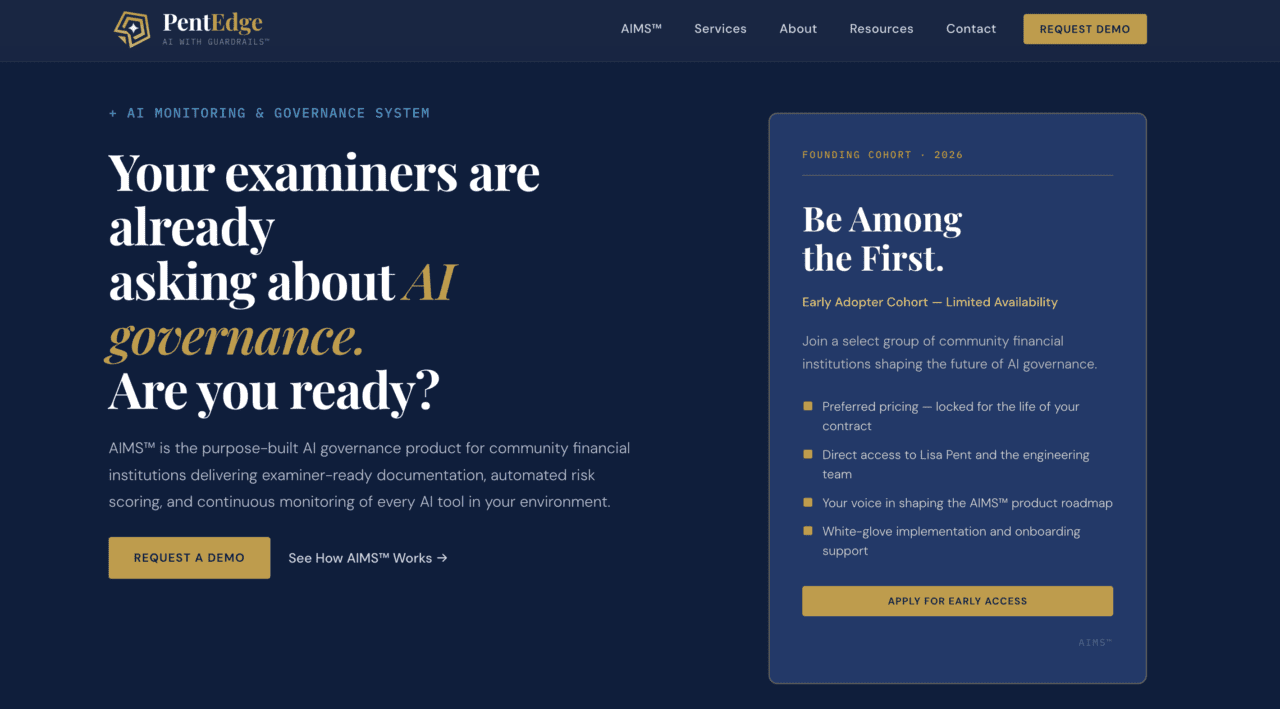
Founded in 2025 and based in North Creek, New York, PentEdge is poised to address one of the most pressing concerns in modern finance: the governance of Artificial Intelligence. Its flagship product, AIMS (AI Management System), provides community banks and credit unions with an examiner-ready AI governance platform. This solution is purpose-built for institutions ranging from $500 million to $100 billion in assets, specifically designed to help them navigate the complex and evolving federal AI risk guidance issued by regulatory bodies.
The adoption of AI in financial services is accelerating, promising enhanced efficiency, personalized customer experiences, and sophisticated risk management. However, this transformative potential comes with significant risks, including algorithmic bias, data privacy concerns, model explainability issues, and potential for regulatory non-compliance. Federal regulators are increasingly demanding robust governance frameworks to ensure AI models are fair, transparent, secure, and accountable. PentEdge AIMS directly addresses this by offering a real-time scoring dashboard that provides a comprehensive view of AI exposure across an institution’s entire portfolio. This holistic perspective is crucial for identifying potential high-risk areas before they escalate. Furthermore, AIMS provides pre-built vendor AI risk profiles, significantly reducing the burden on institutions to independently assess third-party AI solutions. This feature is particularly valuable given the growing reliance on external vendors for AI capabilities. Crucially, the platform also generates audit-ready PDFs, simplifying the preparation for regulatory examinations and demonstrating an institution’s proactive approach to AI risk management. In an environment where the penalties for non-compliance can be substantial, and the reputational damage severe, a solution like PentEdge AIMS is not just beneficial but becoming essential for responsible AI adoption in finance. Industry reports indicate that over 60% of financial institutions are either exploring or implementing AI, yet only a fraction have comprehensive governance frameworks in place, highlighting the vast market need PentEdge aims to fulfill.
Intention.ly: Empowering Financial Advisors with Brand Building
Headquartered in King of Prussia, Pennsylvania, Intention.ly, founded in 2021, tackles the challenge of brand differentiation and client acquisition for financial advisors. Its Advisor Brand Builder (ABB) platform is designed to help firms establish a distinctive brand identity, develop a professional website, and implement a robust content engine within a matter of days. In a highly competitive wealth management landscape, where advisors often struggle to stand out, ABB empowers them to attract ideal clients and outpace competitors by cultivating a strong, authentic digital presence.
The financial advisory sector is increasingly crowded, with over 300,000 financial advisors in the U.S. alone. Differentiating oneself through expertise and personalized service is no longer enough; a compelling digital footprint is paramount. Many independent advisors and smaller firms lack the resources or expertise to build and maintain sophisticated marketing operations. Intention.ly addresses this gap by offering a range of engagement options, including a diagnostic assessment to pinpoint specific needs, access to a fractional Chief Marketing Officer (CMO) and Chief Operating Officer (COO) for strategic guidance, and an outsourced marketing team for hands-on execution. This flexible approach allows advisors to access high-level marketing expertise without the prohibitive cost of a full-time in-house team. The platform streamlines the creation of engaging content, optimizes websites for search engines, and develops consistent brand messaging, all critical components for client acquisition and retention in the digital age. By providing advisors with the tools to effectively communicate their unique value proposition, Intention.ly is helping to democratize access to sophisticated marketing strategies, leveling the playing field against larger, more established institutions.

PwC’s Customer Link: De-risking Product-Market Fit with Synthetic Customers
PwC, a global consulting giant founded in 1998 and headquartered in New York, brings its significant expertise to the product validation stage with Customer Link. This innovative offering provides banks with a set of "synthetic customers" that can be used to rigorously test new products, pricing models, and overall customer experiences. The ability to simulate market reactions before a full-scale launch is invaluable, allowing firms to iterate rapidly and refine their offerings based on data-driven insights.
Traditional consumer testing often involves lengthy and costly focus groups, surveys, and pilot programs, which can be time-consuming and may not always yield fully representative data. Customer Link leverages advanced analytical techniques to create digital representations of customer segments, complete with their behaviors, preferences, and likely responses to various product attributes. By engaging these synthetic customers, banks can quickly generate quantitative data on product viability, pricing sensitivity, and experience design. The results can then be transformed into clear, segment-specific growth actions, enabling banks to make informed decisions and accelerate their time to market. This approach minimizes the risk of launching products that fail to meet customer needs or market demands, a common pitfall that can lead to significant financial losses and reputational damage. The use of synthetic data also opens up possibilities for testing sensitive products or scenarios without exposing real customer data, enhancing privacy and security. As financial product development cycles shorten, the demand for agile and efficient validation tools like Customer Link is expected to grow significantly, offering a powerful mechanism for de-risking innovation.
Rezliant: Fortifying Fintech Security Against Evolving Threats
From Mesa, Arizona, Rezliant, founded in 2023, addresses the critical need for robust cybersecurity in the fintech ecosystem. Its Maestro Pulse platform is designed to help fintechs, payment providers, and small financial institutions automatically identify and fix security vulnerabilities within their codebases, Personally Identifiable Information (PII) data flows, and API integrations. In an era where cyberattacks are growing in sophistication and frequency, and the financial sector remains a prime target, Rezliant offers a vital line of defense.

The financial industry faces an onslaught of cyber threats, from sophisticated phishing campaigns to ransomware attacks and data breaches. Regulatory bodies impose strict requirements for data protection and system security, with non-compliance leading to hefty fines and loss of customer trust. Maestro Pulse provides contextualized triage of fintech vulnerabilities, prioritizing threats based on their severity and potential impact. Crucially, it automates the remediation of multiple critical flaws simultaneously, dramatically reducing the manual effort and time typically required for security patching. The platform’s ability to deliver effortless two-click fixes directly from email notifications further streamlines the security workflow, enabling developers and security teams to act swiftly. This proactive and automated approach to vulnerability management is essential for maintaining continuous security posture, preventing data breaches, and ensuring regulatory adherence. Given that over 70% of cyberattacks exploit known vulnerabilities, and the average cost of a data breach in the financial sector can exceed $5.7 million, Rezliant’s solution offers significant value by mitigating these risks and protecting sensitive financial and personal data.
Kato: Streamlining Lending Operations with Compliance-First Automation
Kato, a San Francisco-based company founded in 2024, focuses on helping lenders scale their operations through compliance-first automation. The lending industry, while a cornerstone of finance, is often burdened by manual processes, high servicing costs, and complex regulatory requirements. Kato’s technology is engineered to alleviate these pain points, enabling lenders to operate more efficiently and effectively.
The process of loan servicing, from origination to collection, involves numerous intricate steps that are often manual and prone to error. Moreover, lenders must navigate a labyrinth of federal and state regulations, including consumer protection laws, fair lending practices, and data security mandates. Compliance failures can lead to severe penalties, litigation, and reputational damage. Kato’s automation platform is designed with compliance embedded at its core, ensuring that all automated processes adhere to the latest regulatory standards. By automating routine and repetitive tasks, the technology helps firms reduce servicing costs by up to 80%, a significant operational improvement that directly impacts profitability. Furthermore, by streamlining collections and other post-origination processes, Kato can help increase recoveries by 1%, contributing directly to the lender’s bottom line. Critically, by offloading low-value, repetitive tasks to automation, Kato frees up human agents to focus on high-value work, such as complex problem-solving, customer relationship management, and strategic initiatives. This not only enhances operational efficiency but also improves employee satisfaction and retention. The demand for such solutions is underscored by the global digital lending market, which is projected to grow substantially, necessitating scalable and compliant operational frameworks.
The Strategic Imperative for Financial Institutions

The collective impact of these innovations underscores a vital strategic imperative for financial institutions: the need to embrace a comprehensive approach to product lifecycle management that extends beyond mere development. While the ideation and creation of new financial products are undoubtedly challenging, the reality is that the subsequent phases – execution, market validation, compliance, security, and scaling – are where most initiatives ultimately succeed or fail.
Banks are increasingly expected to accelerate their pace of innovation, developing new offerings more frequently and delivering superior customer experiences. However, achieving this agility requires navigating a complex web of compliance requirements, rigorously validating product-market fit, fortifying systems against ever-present cyber threats, and effectively bringing products to a competitive market. The platforms showcased at FinovateSpring 2026 are not merely tools; they are strategic enablers that support these critical adjacent functions. By leveraging such solutions, financial institutions can significantly reduce the friction that often slows down product launches, moving from idea to execution with greater efficiency and minimized risk. This ensures alignment with stringent regulatory expectations and positions them for sustained growth. In an environment where both speed and precision are paramount, investing in the right infrastructure around product launches is not just an operational enhancement but a saving grace that can transform a nascent product from a potential failure into a resounding success, fostering innovation while maintaining stability and trust.
Broader Implications for the Fintech Ecosystem
The innovations presented by PentEdge, Intention.ly, PwC, Rezliant, and Kato at FinovateSpring 2026 carry broader implications for the entire fintech ecosystem. They signify a maturing industry that is moving beyond foundational digital transformations to address the nuanced challenges of operational excellence, risk management, and market penetration. The emphasis on AI governance reflects the industry’s increasing recognition of ethical considerations and responsible innovation. The focus on advisor brand building highlights the ongoing shift towards personalized, digital-first engagement models in wealth management. The adoption of synthetic customers signals a future where product development is more data-driven and less reliant on traditional, slower methods. Enhanced security automation underscores the non-negotiable importance of trust and data protection in financial services. Finally, compliance-first lending automation points to a future where operational efficiency and regulatory adherence are seamlessly integrated, creating more resilient and scalable financial services. These advancements collectively contribute to a more robust, secure, and customer-centric financial landscape, ultimately benefiting consumers through more innovative, reliable, and accessible financial products.
Attendees eager to witness these transformative solutions firsthand and engage with the innovators shaping the future of finance are encouraged to secure their participation. A special offer of 40% off is available this week only with code FKV2794ART, expiring April 17, at https://informaconnect.com/finovatespring/purchase/select-package/?vip_code=FKV2794ART.