Unlocking Intraday Alpha: How Event Conditioned Trading Signals are Transforming Algorithmic Strategy Development

The modern landscape of algorithmic trading is undergoing a structural evolution, moving away from static, single-bar indicators toward dynamic, context-aware frameworks. In this shifting paradigm, quantitative researchers are increasingly focusing on how specific intraday events dictate subsequent price action. By isolating distinct market windows—such as the opening range, midday pivots, or the final hour of a prior trading session—traders can capture actionable intelligence and carry it forward into entirely separate trading intervals. This methodology forms the core of event-conditioned signal generation, a sophisticated approach to quantitative finance that bridges the gap between raw market data and robust, testable strategies.
Understanding the Mechanics of Event-Conditioned Signals
Traditional technical indicators are inherently myopic, typically describing only the specific price bar on which they currently sit. Moving averages, relative strength indices, and momentum oscillators generally react to immediate inputs without retaining the broader context of earlier session dynamics. In contrast, event-conditioned trading signals are designed to record a specific market state at a precise moment in time and carry that information forward to influence subsequent decision-making.
This separation in time is the foundational design principle of event-conditioned strategies. The underlying premise is straightforward: what happens during one phase of a trading session—such as early morning price discovery or late-day institutional positioning—often provides vital clues about the behavior of participants later in the day or during the following session. By decoupling the conditioning event from the execution window, quantitative developers can construct cleaner, more logical hypotheses that avoid the circular reasoning often found in standard indicator libraries.
Central to this capability in advanced platforms like Build Alpha is the "Value When" function. This custom analytical tool operates by evaluating two primary inputs: a specified condition and a target value. Whenever the defined condition is met, the function captures and stores the corresponding value. On all subsequent bars, it persistently returns that last captured value until the condition is met once more. This allows traders to anchor critical data points—such as the opening bell price, the exact VWAP reading at midday, or the closing price of the previous day’s final hour—and utilize those anchors dynamically throughout the trading day.
Chronology and Implementation: The Four-Step Architecture
Deploying event-conditioned signals within a systematic framework generally follows a disciplined four-step operational sequence:
- Defining the Event Window: The process begins by selecting a specific historical or intraday time bracket. Common examples include the final hour of regular trading hours, the initial opening range of the equity session, or a specific midday checkpoint.
- Capturing the Metric: Utilizing conditional functions, the system stores the price, volatility reading, or structural indicator value precisely when the event occurs.
- Comparative Analysis: The captured value is then evaluated against a dynamic threshold, a moving average, or a historical benchmark—determining whether it is higher, lower, above, or below a specified parameter.
- Execution in a Separate Window: The trade is finally initiated in a completely distinct temporal window, such as the market open of the following morning, the final hour of the current session, or over the course of the remaining trading day.
This structured chronology ensures that the quantitative model operates on pre-determined context rather than reactive noise. Market participants utilizing platforms equipped with automated feature engineering can scale this process significantly, transforming abstract market observations into systematic rules without writing complex lines of traditional code.
Core Setups and Practical Applications
To illustrate the practical utility of event-conditioned architecture, quantitative strategists frequently point to several foundational setups tailored for US equity index hours, utilizing standard Eastern Time markers:
- Setup 1: Prior Session Close Momentum to Morning Follow-Through. This setup investigates whether late-day institutional accumulation carries over into the next morning’s open. By storing the price at 16:00 and 17:00 on the previous day, the system evaluates whether the final hour closed higher. If confirmed, the model buys at the 9:30 open and exits during the first hour of trading, capitalizing on overnight sentiment carryover.
- Setup 2: Opening Range Dominance and Late-Day Drift. Here, traders assess whether a robust opening range predicts sustained directional momentum into the closing bell. By establishing the opening parameters between 9:30 and 10:00, the system evaluates the directional bias by 10:30, executing a long position at 16:00 and liquidating at the 17:00 close if the opening range finished positively.
- Setup 3: Midday VWAP Positioning as an Afternoon Filter. Price positioning relative to the Volume Weighted Average Price (VWAP) at the 12:00 midday checkpoint provides a clear indicator of institutional control. Storing the distance between the close and the VWAP at noon allows traders to filter or initiate afternoon trades, particularly targeting the final hour of liquidity.
- Setup 4: Volatility Expansion Filters for Breakouts. Traditional opening range breakouts (ORB) often fail during choppy, low-volatility sessions. By conditioning the ORB strategy using a "Value When" comparison—requiring today’s opening range to exceed the physical range of yesterday’s final hour—traders can effectively filter out low-energy environments and only deploy capital when volatility expansion is statistically favored.
- Setup 5: Scaling Against Historical Daily Ranges. Expanding upon volatility filters, this setup compares today’s opening range directly against the total daily range of the preceding session. If the initial price discovery represents a significant percentage threshold of yesterday’s entire range, it signals an expanding regime where breakouts possess sufficient runway to trend through the close.
Integration with Signal Pools and Genetic Algorithms
While individual event-conditioned signals offer distinct edge potential, their true utility is maximized when integrated into comprehensive trading signal pools. Modern algorithmic software leverages genetic algorithms to test, validate, and optimize thousands of signal combinations simultaneously.
Rather than relying on a single isolated rule, quantitative developers can stack multiple event conditions—such as requiring both a bullish prior close and an expanding opening range—while layering macro regime filters, such as moving average boundaries or volatility thresholds. Furthermore, these event-based metrics are not restricted solely to trade entries; they serve equally well as dynamic exit signals or risk-management circuit breakers. If the final hour of a session exhibits sudden structural weakness, an event-conditioned exit can liquidate open swing positions before the closing bell, mitigating overnight exposure.
Overcoming Overfitting and Ensuring Robustness
The capability to optimize countless time checkpoints, window lengths, and numerical thresholds introduces a significant risk inherent to quantitative finance: strategy overfitting. When researchers test hundreds of minor variations in time and price thresholds, certain parameter combinations will inevitably display exceptional historical performance purely by chance.
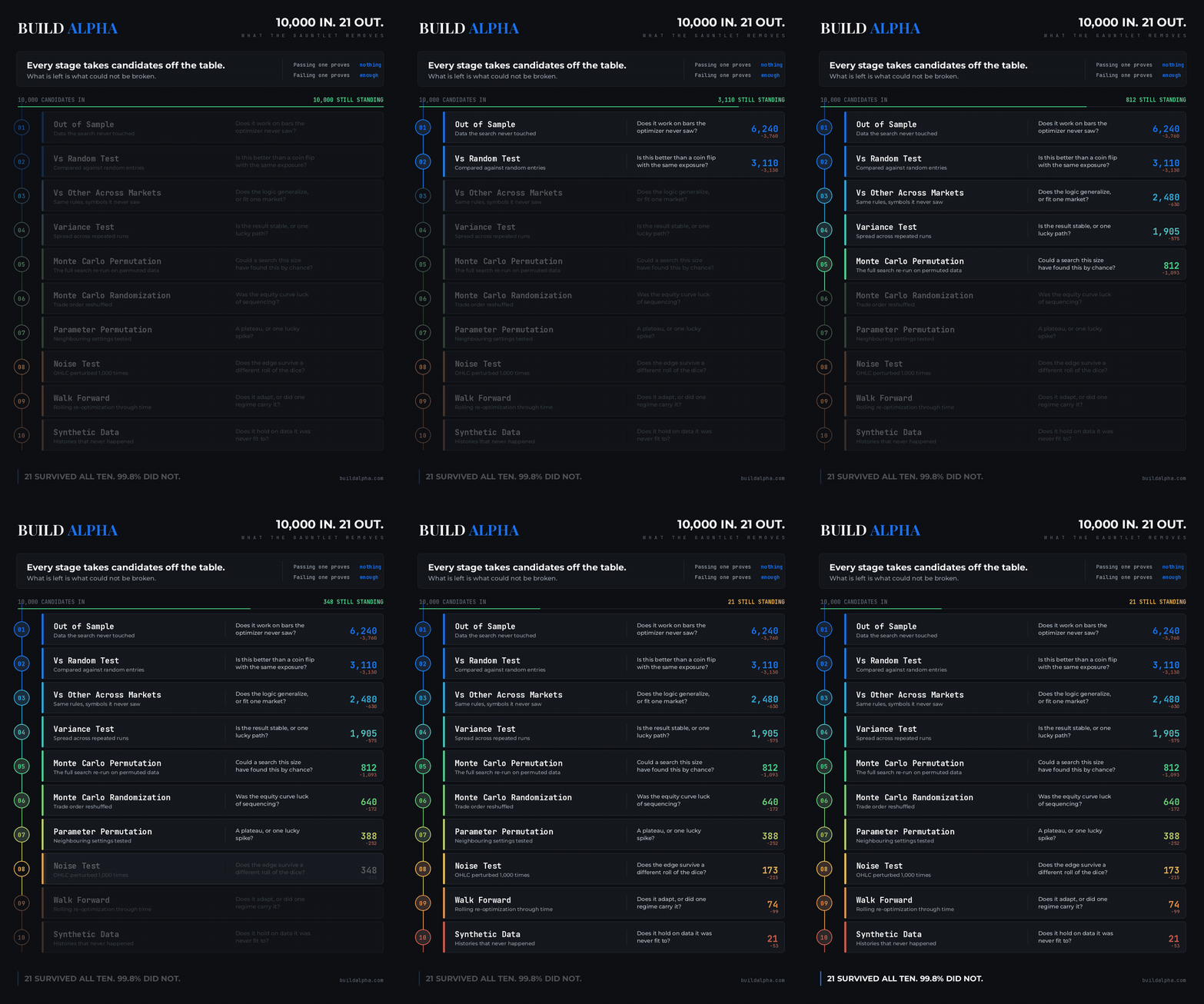
To counter this search-space vulnerability, rigorous validation protocols are mandatory. Robust event-conditioned signals must demonstrate performance stability across a "plateau" of neighboring parameters rather than relying on a single isolated optimum. Advanced systematic platforms incorporate automated robustness testing tools—including parameter permutation tests, noise injections, and out-of-sample walk-forward analyses—to eliminate fragile strategies before they ever reach live deployment.
Broader Market Implications and Future Horizons
The adoption of event-conditioned signal engineering marks a maturing of retail and institutional algorithmic trading alike. By moving beyond basic technical oscillators and embracing time-separated structural context, developers can better mirror the actual behavioral patterns of institutional order flow.
Future developments in this domain point toward intermarket event conditioning—such as utilizing closing strength in primary equity indices like the S&P 500 to condition systematic execution in correlated technology contracts or commodity pools on the subsequent day. As natural language processing and prompt-to-signal technologies continue to lower the technical barriers of entry, the ability to conceptualize, test, and deploy sophisticated event-driven frameworks will remain a defining competitive advantage in modern systematic trading.