How to Contribute to the Global Expansion of Bitcoin.org Through Language Translation

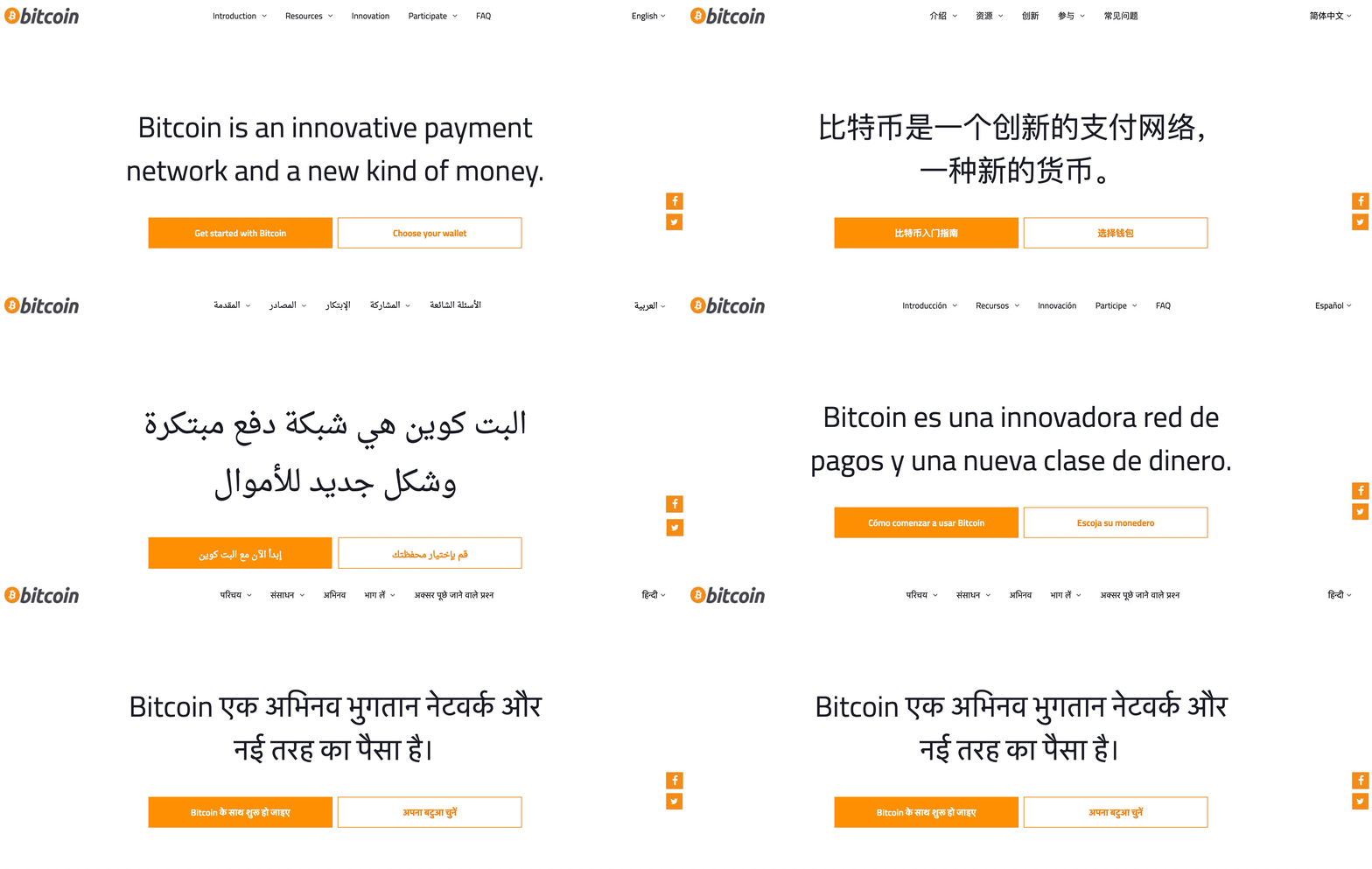
The digital architecture of the global financial revolution relies not just on code, but on the accessibility of information. Bitcoin.org, the foundational domain of the Bitcoin network, has long served as the primary gateway for newcomers seeking to understand the protocol. To ensure this educational resource reaches the widest possible audience, the platform maintains a robust, community-driven translation initiative. As of late 2018, this project has successfully localized the site into 25 languages, relying on a distributed network of nearly 1,000 contributors. For fluent or native speakers of languages other than English, the opportunity to bridge the information gap remains a vital component of the Bitcoin ecosystem’s ongoing growth.
A Legacy of Decentralized Governance
To understand the importance of the translation project, one must first look at the unique governance model of Bitcoin.org. Originally registered by Satoshi Nakamoto and Martti Malmi in the earliest days of the protocol, the site was designed to function as an independent, non-partisan resource. When Nakamoto stepped away from the project, the domain was transitioned to a group of trusted community members, effectively decoupling the site from the core development team.
This decision was deliberate. By diversifying ownership, the early architects of Bitcoin ensured that no single entity, corporation, or government could exert undue influence over the information presented to new users. Today, Bitcoin.org operates as a privately owned but open-source entity. The codebase, hosted on GitHub, reflects this ethos of collective stewardship; with over 3,200 commits from 180 unique contributors, the site is a testament to the power of decentralized collaboration. This same spirit of community ownership extends to the translation team, which operates without a centralized corporate hierarchy.
The Mechanism of Localization: Transifex
The technical backbone of the Bitcoin.org translation initiative is Transifex, a cloud-based platform designed to streamline the localization of software and web content. Transifex allows for a sophisticated workflow where text strings can be managed, reviewed, and updated in real-time.
For prospective translators, the process begins by creating an account and requesting access to the Bitcoin.org project. The platform provides a user-friendly interface that displays the original English text alongside the corresponding translation field. This setup is crucial for maintaining consistency; because financial terminology—such as “hash rate,” “private key,” or “ledger”—can be notoriously difficult to translate, the platform allows for a shared glossary. This ensures that a specific term remains identical across all pages, preventing confusion among non-English speaking users.
Structuring the Volunteer Hierarchy
The translation team is organized into four distinct tiers, each serving a specific function to ensure the accuracy and integrity of the content.
Team Leaders: These individuals are responsible for the high-level management of specific language groups. Currently, figures such as George (known as “BitcoinTranslations”) and Hendrawan (“khendraw”) serve as central points of contact. Their role involves recruiting new translators, managing disputes, and ensuring that the project adheres to the site’s overall mission. They act as the bridge between the core site maintainers and the linguistic teams.
Coordinators: Often acting as project managers for specific languages, coordinators oversee the day-to-day workflow. They are responsible for assigning tasks, managing the priority of page translations, and monitoring the quality of contributions. In languages where a coordinator is currently absent, the project often stalls; consequently, the recruitment of active, reliable coordinators is a primary objective for the leadership team.
Reviewers: The accuracy of information regarding a decentralized currency is paramount. Reviewers are senior members of the language teams tasked with verifying the work of translators. They check for grammatical fluency, cultural nuances, and, most importantly, technical accuracy. A mistranslation in a guide about securing a wallet could have real-world consequences, making the role of the reviewer a critical security layer.
Translators: These are the primary contributors who perform the heavy lifting of converting English documentation into native languages. They are expected to follow the style guides provided by the team leaders and participate in the community forums to discuss terminology.
The Chronology of Growth
The project has seen a steady trajectory since its inception. By mid-2018, the translation project had hit a significant milestone: 950 individual translators had successfully localized the site into 25 different languages. This expansion has followed a pattern consistent with the geographic adoption of Bitcoin itself. As interest in the protocol spiked in regions like Latin America, Southeast Asia, and Eastern Europe, the translation teams for those languages saw a commensurate influx of volunteers.
The initiative is not merely about direct translation; it is about keeping pace with the rapid updates to the Bitcoin protocol. Every time a new feature is added to Bitcoin.org, or a section of the site is rewritten for clarity, the translation teams must update their respective versions. This requires a perpetual state of vigilance, turning the translation project into a continuous operational cycle rather than a one-time effort.
Broader Implications and Global Reach
The importance of this project cannot be overstated. Bitcoin is a global phenomenon, yet the majority of its most technical documentation originated in English-speaking academic and development circles. If Bitcoin is to function as a truly global store of value and medium of exchange, the educational barrier to entry must be lowered for non-English speakers.
When a user in a non-English speaking country visits Bitcoin.org, their experience is vastly improved by the ability to read technical explanations in their native tongue. This leads to better understanding of wallet security, the mechanics of transaction fees, and the philosophical underpinnings of the blockchain. Furthermore, localized content serves as a bulwark against misinformation. By providing an authoritative, community-vetted source in dozens of languages, Bitcoin.org effectively displaces scam sites or poorly translated third-party blogs that might misguide users.
Challenges and Future Directions
Despite the successes, the project faces challenges. The primary issue is maintaining consistency and activity levels over long periods. Volunteer fatigue is a common reality in open-source projects. To combat this, the leadership has emphasized the need for better onboarding processes for new contributors.
Furthermore, the integration of new languages remains a priority. As Bitcoin gains traction in emerging markets, there is an increasing demand for translations into languages that are currently underrepresented on the platform. The project leaders continue to solicit help from the community, encouraging those with linguistic expertise to reach out via the official channels, including the Telegram channels managed by the team leads.
Conclusion
The Bitcoin.org translation project serves as a compelling case study in how decentralized, community-led initiatives can support the infrastructure of a global financial system. By providing the tools for volunteers to contribute their linguistic skills, the project ensures that the fundamentals of Bitcoin remain accessible, accurate, and culturally relevant to users worldwide. As the Bitcoin network continues to evolve, the necessity for this work will only grow, cementing the role of the volunteer translator as an essential architect of the digital economy. Those interested in contributing are encouraged to visit the official Transifex page and coordinate with the existing language teams to ensure their efforts align with the project’s established quality standards.