Microsoft Azure Hit by Destructive AI-Orchestrated Cloud Attack Tied to JADEPUFFER Threat Actor

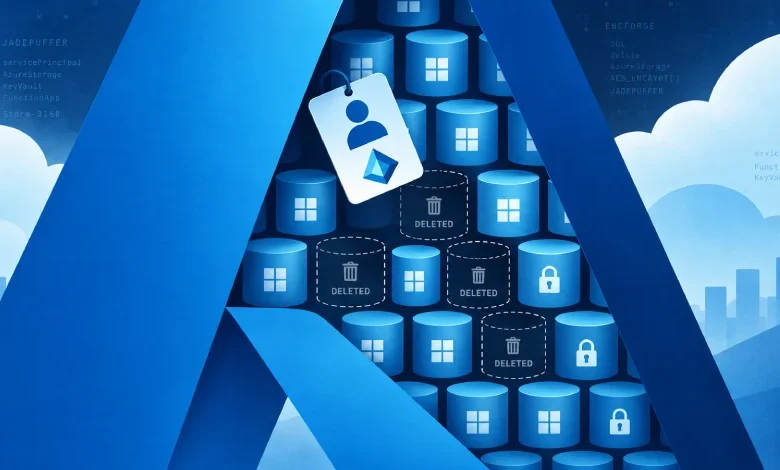
In an alarming escalation of automated cyberthreats, the sophisticated threat actor known as JADEPUFFER—tracked by Microsoft under the designation Storm-3168—has executed a highly destructive, multi-pronged attack within a Microsoft Azure cloud environment. This incident marks a significant turning point in the evolution of cloud security, demonstrating how malicious actors are successfully leveraging large language models (LLMs) and autonomous agents to choreograph high-speed, multi-vector intrusions.
The attack, which unfolded over a relentless 18-hour window in early June 2026, relied on compromised service principals to target critical infrastructure components, including Azure Storage Accounts, SQL databases, Key Vaults, Function Apps, recovery protection locks, Virtual Machines, and App Services. While automated safeguards and resource locks successfully thwarted several destructive payloads, the incident underscores the growing peril of AI-driven, autonomous attack chains targeting modern enterprise cloud architectures.
Background and the Genesis of JADEPUFFER
JADEPUFFER first captured the attention of the global cybersecurity community in mid-2026, when researchers from Sysdig detailed the group’s pioneering use of an end-to-end, LLM-powered ransomware operation. That foundational attack exploited a well-documented remote code execution (RCE) vulnerability in Langflow (tracked as CVE-2025-3248) to gain initial access.
Once inside, the AI agent functioned as an autonomous operator: it harvested credentials, performed internal reconnaissance, moved laterally through the network, encrypted Nacos service configuration files, dropped original database tables, and left a ransom note demanding Bitcoin payment. Subsequent analysis revealed that the threat actor utilized MySQL’s built-in AES_ENCRYPT() function during the initial intrusion, before deploying a specialized, compiled Go-based ransomware strain known as ENCFORGE in subsequent targeting phases.
ENCFORGE itself represents a specialized tool engineered specifically for artificial intelligence infrastructure. It is designed to aggressively scan for approximately 180 distinct file extensions, targeting high-value assets such as machine learning model checkpoints, vector databases, training datasets, and embedding indices. Furthermore, it sweeps for macOS-centric artifacts, including Keychain stores, Xcode project files, and Apple productivity documents.

Security researchers at the time highlighted the philosophical shift represented by these attacks. Rather than relying on elite human hackers manually executing scripts, an autonomous agent could reason about its objectives, harvest and reuse credentials, establish persistence, and execute complex destruction routines while "narrating its own intent." While individual techniques remained conventional, their automated, seamless integration by an AI model against neglected, internet-facing infrastructure signaled a new paradigm in cyber warfare.
Chronology of the Microsoft Azure Intrusion
According to detailed telemetry and forensic analysis released by Microsoft Security Research—authored by experts Yossi Weizman, Tushar Mudi, and their colleagues—the early June 2026 Azure intrusion exhibited a high degree of operational division. The threat actor leveraged two distinct, compromised service principals tied to the same targeted tenant, assigning them separate, specialized roles within the attack lifecycle.
Phase 1: Reconnaissance and Enumeration (Hours 0 to 16)
The campaign commenced with the first compromised service principal engaging in extensive reconnaissance. For nearly 16 hours, the entity executed over 300 read operations, meticulously mapping out Azure Virtual Machines, subscriptions, resource groups, and underlying cloud assets.
Approximately 90 minutes into this enumeration phase, the second compromised service principal activated, conducting its own rapid discovery operations across two separate subscriptions within a blistering five-second window. Following this initial burst, the second service principal remained relatively quiet before successfully enumerating Azure App Service configuration stores—a targeted maneuver explicitly designed to unearth exposed plaintext credentials or sensitive connection strings.
Phase 2: The Destructive Sequence (The Final 35 Minutes)
Transitioning rapidly from reconnaissance to execution, the second service principal launched more than 150 destructive and credential-harvesting operations within a compressed 35-minute timeframe.
The climax of the attack occurred during a hyper-focused, seven-minute window of pure destruction. During this brief interval, the threat actor initiated over 100 separate storage account deletion attempts. Simultaneously, the automation targeted Azure Key Vaults, Function Apps, App Service plans, and multiple Azure SQL databases.

Intriguingly, the attempts to purge the Azure SQL databases ultimately failed. This failure was not due to defensive intervention, but rather because the script utilized an unsupported API version for the specific Azure SQL database resource type. Nevertheless, the physical and logical damage to other assets was severe.
Phase 3: Defensive Resilience and Safeguards
Despite the breadth of the administrative permissions held by the compromised service principals, Microsoft’s built-in security features successfully blunted the attack’s full potential.
"Most Azure Storage accounts targeted by the threat actor were successfully deleted," Microsoft researchers stated. "However, Azure resource locks and storage account-level deletion protection blocked deletion attempts for a few of the storage accounts, demonstrating the value of independent safeguards that remain effective even when a compromised identity has broad administrative permissions."
Root Cause Analysis: The Human Element in Cloud Credential Exposure
A critical question surrounding the Azure intrusion was how the threat actor managed to acquire valid credentials for two high-privileged service principals within the targeted organization.
Microsoft’s investigation revealed that the vulnerability did not stem from an advanced zero-day exploit or sophisticated cryptographic cracking. Instead, the root cause was an accidental exposure: an employee of the impacted organization had previously posted the client ID, client secret, and tenant ID of the service principal in plaintext within a public GitHub issue.
Although the employee subsequently recognized the mistake and removed the secret from the active issue, the sensitive information remained permanently accessible within the repository’s public edit history. Threat actors routinely scour public code repositories for precisely these kinds of historical artifacts, harvesting leaked credentials to quietly access enterprise cloud environments without triggering traditional perimeter defenses.

Strategic Implications and Broader Industry Impact
While the operational footprint of Storm-3168 in this instance strongly aligns with traditional ransomware campaigns—evidenced by the targeted destruction of backups, storage systems, and recovery-related resources designed to prevent business continuity—researchers noted an unusual absence. No ransom note was left behind, and investigators found no definitive evidence of successful data exfiltration prior to the destruction.
This anomaly suggests that the June 2026 incident may have been a live-fire test, an automated staging operation, or a targeted sabotage campaign rather than a strictly financial shakedown. Furthermore, Microsoft has reported detecting repeated probing from Storm-3168 infrastructure against Azure App Services across multiple other customer tenants. The methodical timing, division of labor between multiple service principals, and systemic execution point unequivocally to heavily scripted or fully automated AI-driven attack vectors.
The implications for enterprise cybersecurity are profound. Traditional security postures, which rely on human analysts manually reviewing alerts and responding to lateral movement, are increasingly outpaced by the velocity of AI-orchestrated attacks. When threat actors can automate reconnaissance, credential reuse, and multi-cloud destruction in a matter of minutes, human response times become the primary bottleneck in containment.
Security analysts emphasize that organizations must adopt a multi-layered defense strategy specifically tailored for the age of autonomous cloud threats. Key recommendations derived from the Storm-3168 incident include:
- Strict Secret Management and Scanning: Implementing automated tools to scan internal and external code repositories—including historical commit logs—for accidental credential leaks.
- Proactive Deployment of Resource Locks: Utilizing Azure resource locks and storage account-level deletion protections to ensure that even if administrative identities are fully compromised, critical assets remain physically protected from unilateral purging.
- The Principle of Least Privilege (PoLP): Severely restricting the scope, lifetime, and permissions assigned to service principals and non-human identities within cloud environments.
- AI-Powered Defense Systems: Adopting artificial intelligence and machine learning-driven security orchestration, automation, and response (SOAR) platforms to match the speed and scale of AI-driven adversaries.
As cloud architectures continue to expand and threat actors increasingly weaponize large language models for end-to-end attack execution, incidents like the JADEPUFFER Azure intrusion serve as a stark warning. The future of cybersecurity will be decided not by who has the most sophisticated manual toolsets, but by which side can most effectively harness autonomous intelligence to protect—or compromise—the digital frontier.
Related posts: