Navigating Crypto Leverage: A Comprehensive Ranking and Risk Analysis of the Industry’s Top Derivatives Exchanges

The modern cryptocurrency derivatives landscape has evolved into a hyper-competitive arena where platforms continually push the boundaries of financial engineering. Among the most potent and debated tools in a crypto trader’s arsenal is leverage. By allowing market participants to control large positions with a relatively small amount of initial margin, leverage has become a cornerstone of both speculative trading and sophisticated hedging strategies. Over recent years, the ceilings on offered leverage have crept ever higher, with a select group of venues now advertising a startling 500x maximum.
However, within the high-stakes ecosystem of digital asset trading, high maximum leverage is a quintessential double-edged sword. The same mathematical mechanism that multiplies prospective gains simultaneously magnifies losses. At extreme settings, even a minuscule price movement against a position can trigger an immediate automated liquidation. Consequently, experienced market participants understand that the most crucial question is not merely which exchange offers the highest headline leverage, but rather which platforms successfully pair meaningful leverage with deep liquidity, competitive fee structures, and robust risk-management tools.
This comprehensive guide analyzes and ranks six leading cryptocurrency derivatives exchanges based on their maximum advertised leverage, while critically evaluating whether that leverage is practically usable in real-world market conditions. Every metric discussed has been verified against official exchange documentation and cross-referenced with independent derivatives trackers.
The Evolution and Mechanics of Crypto Leverage
To understand why maximum leverage figures require cautious interpretation, one must examine the mechanics of perpetual futures contracts. Leverage essentially acts as a loan from the exchange or its liquidity pool, allowing a trader to post a fraction of the total trade value—known as the initial margin. For instance, at 10x leverage, a trader needs only $1,000 in margin to control a $10,000 position.
As the industry matured through successive market cycles, exchanges recognized that headline leverage figures served as powerful marketing tools to attract retail volume. Platforms like MEXC and BTCC pioneered the push toward 500x leverage, effectively allowing traders to risk microscopic amounts of capital on immense position sizes. Yet, the mathematical reality of high leverage leaves very little room for error. At a 100x setting, a mere 1% adverse price movement results in the complete evaporation of the margin, triggering liquidation. At the extreme 500x setting, that liquidation threshold narrows to approximately 0.2%.
Regulatory bodies across the globe have taken note of these extreme financial products. High-leverage cryptocurrency derivatives are heavily restricted, capped, or entirely banned in major jurisdictions, including the United States, the United Kingdom, Canada, and member states operating under the European Union’s Markets in Crypto-Assets (MiCA) regulatory framework. Traders operating in these regions must navigate stringent compliance checks or utilize restricted access paths, underscoring the necessity of jurisdictional awareness before engaging with derivatives platforms.
Comparative Ranking of High-Leverage Exchanges
Evaluating derivatives platforms requires looking beyond promotional metrics to examine execution speed, order book depth, fee economics, and risk mitigation protocols. The following breakdown categorizes the industry’s primary contenders by their leverage ceilings and practical utility.
1. MEXC: Extreme Leverage Paired with Aggressive Fee Structures
MEXC currently occupies the pinnacle of the headline leverage table, offering up to 500x leverage on select perpetual swap contracts. Uniquely, the platform pairs this extreme ceiling with some of the most competitive fee schedules in the industry, boasting 0% maker fees and a nominal 0.020% taker fee. Furthermore, MEXC supports a vast catalog comprising over a thousand distinct perpetual markets, giving altcoin speculators unprecedented breadth.
Despite these appealing metrics, financial analysts emphasize that a 500x setting on MEXC should be viewed as a theoretical structural limit rather than a practical trading recommendation. The thin liquidity pools present in smaller, less-capitalized altcoin listings mean that executing large orders at high leverage can trigger severe slippage, rapidly compounding the risk of sudden liquidation.
2. BTCC: The Established Derivatives Specialist
Operating as one of the longest-running continuous exchanges in the digital asset sector, BTCC also advertises leverage ceilings reaching up to 500x. In an industry where newly launched platforms frequently face operational vulnerabilities or sudden closures, BTCC’s longevity provides a distinct layer of institutional trust for high-risk specialists.
The platform maintains a streamlined, derivatives-focused product suite tailored for experienced traders seeking maximum exposure. However, because its asset catalog is comparatively narrower than those of larger, full-service competitors, traders must carefully verify current fee structures and market availability for specific trading pairs before deploying capital.

3. BloFin: Striking a Balance Among Mainstream Majors
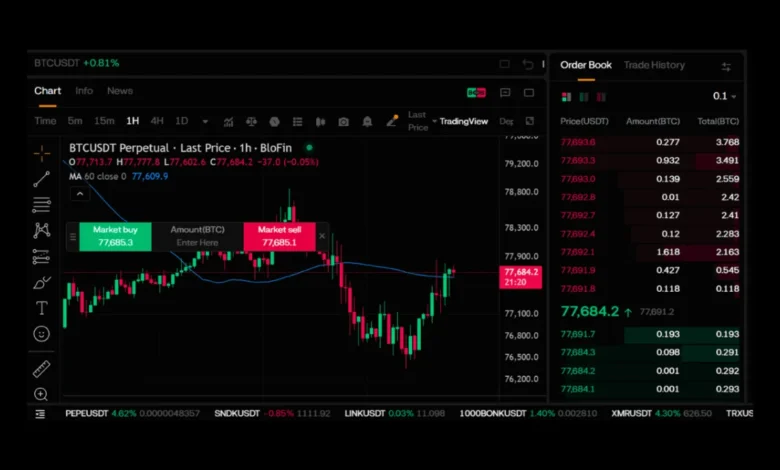
For market participants who require substantial leverage without venturing into the volatile territory of 500x platforms, BloFin represents a compelling middle ground. Among established, full-service institutional exchanges, BloFin offers some of the highest practical leverage available, peaking at 150x on highly liquid perpetual contracts such as BTC/USDT and ETH/USDT. This surpasses the 125x ceilings found on Binance and Bitget, and the 100x limits enforced by older legacy platforms.
BloFin complements its 150x ceiling with a competitive fee framework, featuring a 0.020% maker fee and a base 0.060% taker fee that decreases to 0.050% for users achieving VIP 1 status. Additionally, the integration of spot and futures copy-trading features appeals to retail traders looking to mirror seasoned market strategies. While order books can occasionally thin out during periods of extreme market stress, BloFin provides a more measured risk profile than its 500x counterparts.
4. Binance: Unmatched Liquidity and Market Depth
As the world’s largest digital asset exchange by trading volume, Binance caps its derivatives leverage at a conservative 125x for major pairs like Bitcoin and Ethereum. While this figure is lower than those offered by specialized high-leverage venues, Binance compensates with the deepest liquidity pool in the entire cryptocurrency ecosystem.
In leveraged trading, liquidity is often more valuable than a high headline number. When a trader operates near high leverage thresholds, the liquidation price sits in close proximity to the entry price. Consequently, tight bid-ask spreads and reliable, instantaneous fills are critical to preventing catastrophic slippage. Supported by a mature tiered margin system, advanced risk-management tools, and potential fee discounts through the use of BNB, Binance remains the industry standard for executing large-scale leveraged orders efficiently.
5. Bitget: Breadth of Assets and Copy-Trading Ecosystem
Bitget matches the industry standard with a maximum leverage ceiling of 125x, distinguishing itself primarily through market breadth. The exchange boasts an extensive selection of perpetual contracts, regularly expanding its offerings to include diverse asset classes and specialty derivatives.
Bitget’s fee structure sits at 0.020% for makers and 0.060% for takers. The platform has also carved out a significant market share by developing an advanced copy-trading ecosystem, allowing less-experienced participants to automatically replicate the positions of elite derivatives traders. While exotic listings may exhibit thinner order books, Bitget remains a primary destination for traders seeking diversified leverage exposure across non-traditional assets.
6. Bybit: High-Performance Execution Infrastructure
Rounding out the top tier, Bybit caps its leverage at 125x on primary instruments while maintaining a reputation for architectural reliability and high-speed matching engines. In high-leverage environments, order execution latency can mean the difference between a successful trade and an untimely liquidation.
Bybit’s robust API support caters heavily to algorithmic and institutional high-frequency traders deploying complex, automated strategies. Although achieving initial fee tier discounts requires substantial asset holdings, the platform’s overall execution speed and interface stability offer a distinct operational advantage over competitors plagued by network congestion during high-volatility events.
Quantitative Overview of Derivatives Platforms
| Platform | Maximum Advertised Leverage | Futures Maker Fee | Futures Taker Fee | Primary Operational Advantage |
|---|---|---|---|---|
| MEXC | Up to 500x | 0.000% | 0.020% | Extreme leverage ceilings paired with low baseline fees |
| BTCC | Up to 500x | Variable | Variable | Long-standing operational history in derivatives |
| BloFin | Up to 150x | 0.020% | 0.060% | Highest practical leverage among mainstream majors |
| Binance | Up to 125x | 0.020% | 0.050% | Industry-leading liquidity depth and tight spreads |
| Bitget | Up to 125x | 0.020% | 0.060% | Extensive catalog of leveraged perpetual markets |
| Bybit | Up to 125x | 0.020% | 0.055% | High-performance matching engine and robust API support |
Strategic Implications and Risk Management
The proliferation of high-leverage derivatives exchanges highlights a broader structural maturation within the digital asset economy, mirroring traditional financial futures markets. However, the unique volatility inherent to cryptocurrencies introduces systemic risks that require strict self-regulation and prudent risk management.
Industry analysts and veteran traders consistently advise that maximum headline leverage should be treated as a marketing metric rather than a practical operational tool. Professional market participants typically restrict their usage to single-digit or low double-digit leverage, sizing their positions dynamically relative to the underlying asset’s historical volatility to ensure liquidation thresholds remain far removed from standard market noise. Furthermore, traders must remain acutely aware of funding rates, maintenance margin requirements, and abrupt regulatory shifts that could impact exchange accessibility within their respective jurisdictions.
As the derivatives market continues to evolve, the distinction between platforms that merely advertise inflated leverage ceilings and those that provide the necessary infrastructure for sustainable trading will remain paramount for capital preservation and long-term profitability.