Navigating the Long-Term Compute Dilemma in Physical AI: Insights from MIPS and IDEMIA Leadership

Choosing the underlying compute platform for a physical artificial intelligence product ranks among the most consequential and irreversible decisions an enterprise engineering team will make. Long before software development reaches its final iterations, hardware choices are locked into a trajectory that vehicles, industrial robotics, and automated factory systems must depend on for years—and sometimes decades—after commercial launch. Once heavy assets are deployed into the field, retrofitting or completely changing core hardware components becomes cost-prohibitive, while customer demands and software capabilities continue to evolve at a breakneck pace.
Recent industry benchmarks underscore the immense friction inherent in maintaining long-life-cycle automated systems. According to an extensive 2025 review published in IEEE Access, software-defined vehicle architects face a dual structural hurdle: designing physical hardware that can inherently accommodate unforeseen future capabilities, and seamlessly maintaining complex software stacks throughout a vehicle’s multi-year operational lifespan. Demonstrating the gravity of these maintenance pipelines, a National Highway Traffic Safety Administration (NHTSA) recall notice issued in 2025 revealed that autonomous vehicle pioneer Waymo was forced to deploy an emergency remote software update across 1,212 automated driving systems. The patch was engineered to mitigate collision risks involving semi-permanent physical barriers such as gates and chains—highlighting how real-world edge scenarios perpetually demand rapid, reliable software intervention on established hardware.
For chief technology officers, product directors, and engineering leaders tasked with selecting a foundational compute platform, these realities necessitate a profound shift in strategic planning. Decision-makers must evaluate not only what performance metrics a chip can deliver on launch day, but precisely which software updates the hardware will need to support years downstream, and how internal teams will rigorously test and deploy those iterations across an installed base scattered globally.
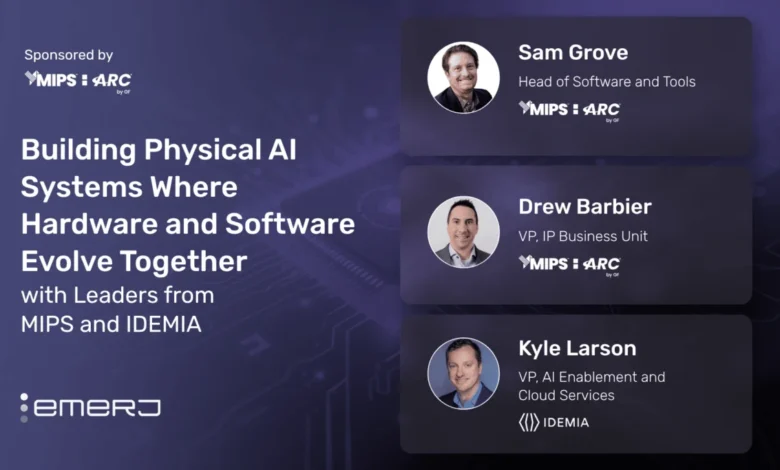
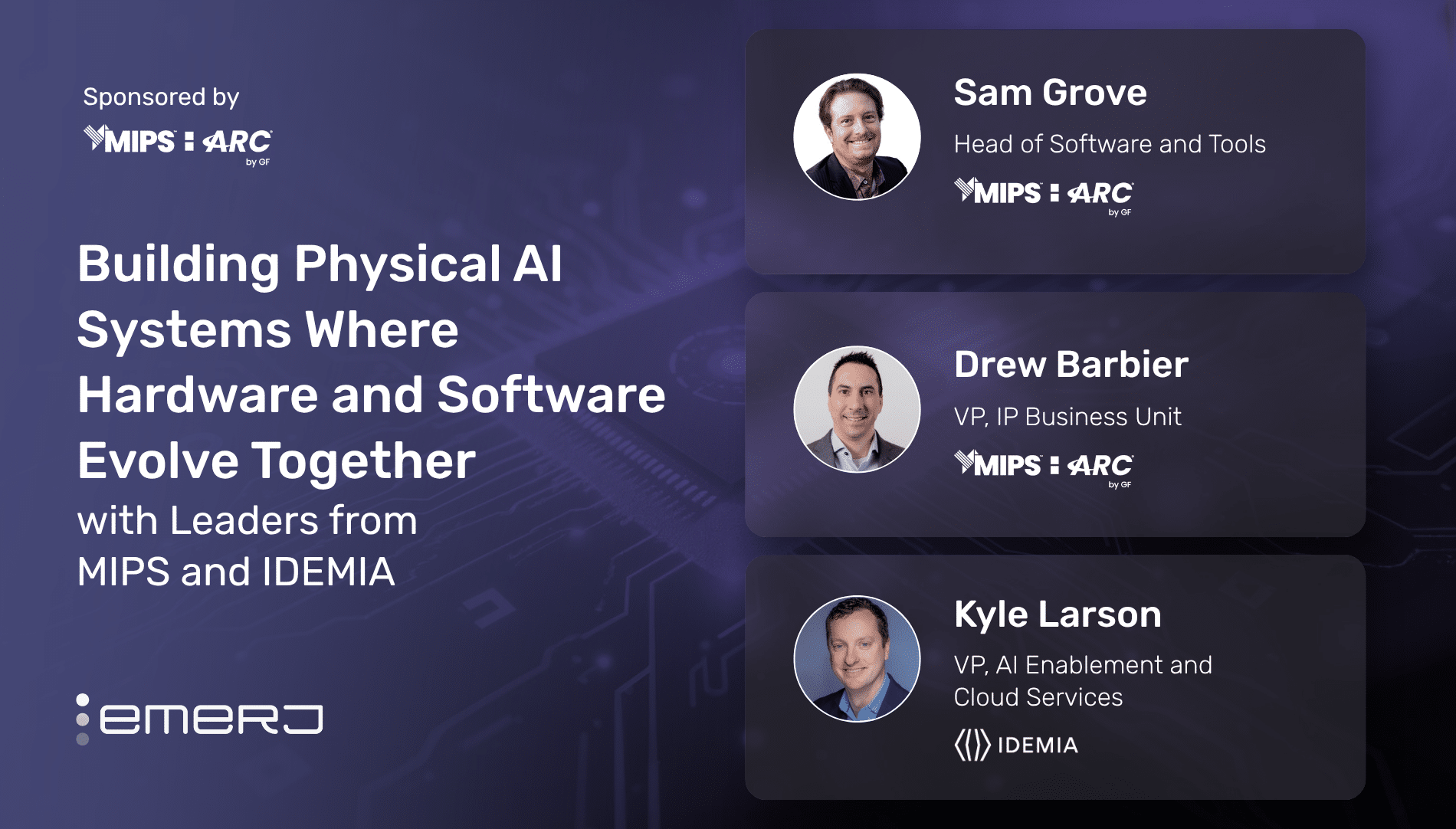
To unpack these complex architectural equations, Senior Editor Yolandi de Weerdt recently hosted a comprehensive series on the Emerj AI in Business podcast. The discussions featured key industry experts: Sam Grove, Head of Software and Tools at MIPS; Drew Barbier, Vice President of the IP Business Unit at MIPS; and Kyle Larson, Vice President of AI Enablement and Cloud Services at IDEMIA. Their strategic dialogues illuminate practical frameworks to help enterprise leaders manage the long-term total cost of ownership, technical debt, and systemic complexity intrinsic to physical AI deployment.
The Pitfalls of Serial Development and System Consolidation
As modern product designs strive for greater efficiency, system architects frequently attempt to streamline physical footprints. Every additional discrete electronic control unit (ECU), box, or modular processor integrated into a vehicle or industrial machine carries recurring costs regarding firmware updates, cybersecurity patch management, and component-level supply chain support over the product’s lifecycle. Consequently, engineering organizations are strongly incentivized to consolidate disparate functions into fewer, highly centralized compute platforms.
However, Sam Grove, Head of Software and Tools at MIPS, cautions that integration efforts can introduce hidden economic traps. Consolidating previously separated hardware functions frequently amplifies software complexity to such a degree that it entirely erases the expected financial savings of the hardware optimization.
"Worst case scenario, what happens is you just move the cost of the hardware system into the complexity of software and you start building very large software teams, which in many cases can end up being more expensive than the hardware in the supply chain that you just optimized out," Grove explains.
This economic reality is exacerbated by extended product lifecycles. Grove emphasizes that consumer markets still expect major automotive manufacturers to support software-defined vehicles well past the eight-year mark, while heavy industrial machinery and factory robotics are routinely serviced and kept operational for decades rather than replaced on short upgrade cycles. Long-term support obligations turn initial hardware and software architectural choices into binding multi-decade financial commitments.
Grove traces the root cause of this architectural bloating to traditional serial development models. In a serial workflow, hardware systems are fully specified and frozen by hardware engineering teams long before software developers are brought into the design loop. Consequently, software teams receive finalized silicon architectures as a fait accompli, leaving them with minimal time, influence, or resources to optimize the system for upcoming algorithmic paradigms.
To counter this, Grove advocates for a parallel co-design methodology where hardware and software engineering teams operate in tandem from inception. Software groups must be adequately resourced and empowered to shape hardware specifications while the physical design remains fluid. Without this early collaboration, organizations risk building products over a multi-year development cycle only to find that foundational AI model architectures have shifted, rendering the finished hardware obsolete upon arrival.
Furthermore, enterprise leaders frequently underestimate the friction of workforce re-tooling. Reflecting on his career experiences, Grove notes that introducing technically superior programming paradigms or development languages often stalls not due to technical inferiority, but because engineering teams are deeply habituated to existing workflows. Transitioning enterprise engineering culture requires substantial, calculated investments in internal education. MIPS’ strategic corporate shift toward RISC-V—an open-source processor instruction set architecture—mirrors this long-term operational mindset. While proprietary instruction sets force a single vendor to shoulder the massive burden of maintaining an isolated software ecosystem, open standards distribute ecosystem development across a broad community of customers, competitors, and collaborative partners.
Reversing the Architectural Paradigm: Workload-Driven Compute
While general-purpose artificial intelligence workloads in massive hyperscale data centers prioritize raw compute throughput across sprawling server farms, edge AI deployed in physical systems operates under stringent physical constraints. Edge processors embedded in autonomous vehicles, delivery drones, and robotic manufacturing arms must function within tightly managed power envelopes and rigid thermal budgets.
Drew Barbier, Vice President of the IP Business Unit at MIPS, argues that achieving meaningful performance gains in resource-constrained environments requires abandoning traditional top-down processor selection in favor of workload-first optimization. As a self-described hardware veteran, Barbier advocates for a complete inversion of the legacy engineering pipeline:
"With AI, you really start with the software side, with the workload side, and then drive that down and understand the implications of that, not just on the CPU, but on the system as a whole."
This philosophy directly influenced the engineering of the M8500, a specialized processor design that MIPS licenses to semiconductor manufacturers. Silicon builders integrate the M8500 into microcontrollers—the dedicated, low-power chips that govern electric motors found throughout modern automotive and industrial automation systems. Rather than designing a processor first and hunting for matching algorithms later, the MIPS product team meticulously analyzed representative motor-control and localized AI workloads using advanced performance modeling tools before drafting the silicon architecture.
This deep analytical dive yielded targeted hardware features designed to mitigate specific computational bottlenecks common in high-frequency control loops. By tightly coupling the processor architecture to the precise computational demands of the workload, a single chip incorporating the M8500 core can often perform complex processing tasks that previously required a decoupled microcontroller and a separate hardware accelerator chip.
By leveraging the modular flexibility of the RISC-V architecture, MIPS can embed these specialized acceleration features into the core while retaining strict binary compatibility with the broader software toolchains and ecosystems that enterprise customers depend on. Barbier emphasizes that engaging hardware intellectual property providers early in the product definition phase—armed with thoroughly profiled, highly constrained workload requirements—yields exponential performance advantages compared to late-stage component procurement.
Managing the Divergence of Hardware and Software Lifecycles
Bridging the persistent temporal gap between rapid software iteration and sluggish physical hardware deployment remains one of the premier operational challenges for modern engineering executives. Kyle Larson, Vice President of AI Enablement and Cloud Services at IDEMIA, encounters this exact architectural friction across multiple domains, ranging from building enterprise-grade cloud systems at Amazon Web Services to delivering complex digital identity infrastructure and mobile driver’s license platforms to state government agencies.
End users invariably experience hardware and software integration as a single, unified product, regardless of whether distinct teams designed those components under separate operational schedules. A foundational decision in this orchestration involves defining the precise operational boundary between edge compute—processing executed directly on local devices—and cloud-based processing. Larson outlines strict evaluation criteria to govern this data-routing architecture: applications requiring ultra-low latency, or systems operating in environments with intermittent or entirely absent network connectivity, must execute intelligence locally on the physical device. When these two stringent conditions are absent, offloading computational overhead to external cloud infrastructure becomes a viable strategic path, subject to rigorous security, bandwidth, cost, and regulatory compliance constraints.
Crucially, Larson observes that accelerated software development cycles do not automatically translate to faster physical rollouts for end users. While artificial intelligence tools have dramatically accelerated code generation and software prototyping within IDEMIA, deploying a newly minted identity-verification feature to physical field locations—such as a state Department of Motor Vehicles (DMV) office—still necessitates physical logistics: installing compatible cameras, specialized document printers, and updated local terminals, then integrating those physical nodes with the central software stack.
Consequently, finished source code represents only a single milestone along a complex path toward operational deployment. Comprehensive rollout strategies must holistically account for hardware procurement, physical installation, field operational readiness, and years of ongoing software maintenance.
To mitigate the risks of hardware-software desynchronization, Larson advocates for elevating developer tooling to the exact same priority level as physical hardware engineering. Engineering teams must never be forced to wait for physical product prototypes to roll off an assembly line simply to discover whether their software logic functions correctly. Virtualized testing environments and cloud-based device emulation platforms allow developers to stress-test applications across a vast matrix of disparate hardware configurations long before physical units are manufactured.
While pre-release testing cannot mathematically capture every conceivable edge-case scenario, relying exclusively on live production environments to discover critical software bugs is catastrophic. For instance, IDEMIA leverages sophisticated cloud-based device testing services to virtually evaluate mobile identity applications across a fragmented ecosystem of consumer smartphone models prior to public release, smoothing out hardware-specific rendering and performance anomalies.
Larson places the ultimate burden of orchestrating these asynchronous development cycles squarely on product leadership:
"Never think that there is a world where hardware and software are going to move at the same speed. We are not going to get there. But the responsibility for leaders now is to connect the two through a single product roadmap, early feedback, and shared accountability for the teams. That is ultimately what is going to turn good ideas into great products."
When evaluating compute platforms for long-lifecycle physical products, Larson advises organizations to avoid long-term vendor lock-in wherever feasible, utilizing flexible, on-demand infrastructure models during early exploratory phases. However, for physical deployments where long-term hardware commitments are unavoidable—such as AI-enabled building access control systems, where facility managers cannot realistically replace mounted cameras and localized servers every twelve months—leaders must treat silicon selection as a binding multi-year product pact. In such scenarios, the underlying hardware must be deliberately over-provisioned with extensible headroom to accommodate emerging algorithmic capabilities and use cases that do not yet exist at the time of initial installation.
Strategic Takeaways for Enterprise Engineering Leaders
Synthesizing the insights shared by industry leaders from MIPS and IDEMIA reveals a cohesive roadmap for executives navigating the physical AI compute landscape:
- Mandate Hardware-Software Co-Design: Break down traditional serial development silos. Empower software engineering teams to influence silicon architecture while physical designs remain flexible to prevent architectural misalignment.
- Prioritize Workload-First Evaluation: Discard top-down hardware procurement strategies. Profile actual application workloads, power constraints, and algorithmic demands first, and select or design compute platforms tailored precisely to those metrics.
- Embrace Open Standard Ecosystems: Mitigate the long-term maintenance liabilities of proprietary processor architectures by adopting open-source standards like RISC-V, distributing ecosystem development across collaborative industry communities.
- Decouple Development via Virtualization: Invest heavily in developer tooling, emulation, and cloud-based testing infrastructure to validate software performance continuously, bypassing the bottlenecks of physical hardware prototyping.
- Architect for Extensibility: When multi-year hardware commitments are mandatory, deliberately select platforms that retain computational headroom, ensuring field-deployed assets can absorb future AI software iterations without requiring costly physical replacements.