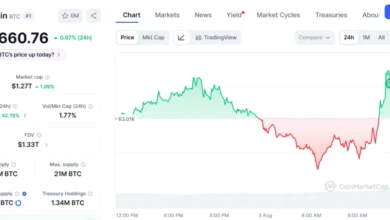
This pivotal regulatory decision elevates the maximum allowable position and exercise limits for IBIT options from 250,000 contracts to an expansive 1,000,000 contracts, representing a remarkable fourfold increase. As detailed in the SEC’s official release, this adjustment is not merely a technicality but a profound acknowledgment of the rapid integration of Bitcoin ETF options into the established financial trading infrastructure. While such updates may lack the immediate fanfare of a novel ETF launch, their ramifications for market structure, liquidity, and institutional risk management are substantial, signifying a critical phase in Bitcoin’s maturation within traditional finance.
The Regulatory Green Light: Expanding Horizons for IBIT Options
The approval, stemming from a rule change filing by NYSE Arca, underscores a growing confidence among regulators and exchanges regarding the robustness and integrity of the spot Bitcoin ETF ecosystem. For months following their landmark approval in January 2024, spot Bitcoin ETFs have witnessed unprecedented demand, attracting billions in capital and establishing themselves as viable investment vehicles. Options on these ETFs, particularly those on highly liquid products like BlackRock’s IBIT, were a natural next step, offering sophisticated traders additional tools for hedging, speculation, and income generation.
The decision to dramatically increase these limits reflects a careful assessment by both NYSE Arca and the SEC. Position limits are fundamental safeguards in derivatives markets, designed to prevent excessive concentration of positions by a single entity, thereby mitigating the potential for market manipulation or undue influence over pricing. By raising these limits for IBIT options, regulators are signaling that the market for these products has demonstrated sufficient depth, liquidity, and resilience to support a significantly larger volume of institutional activity without compromising market integrity. This move is akin to an asset class receiving its "growth spurt" in the derivatives world, enabling it to accommodate larger, more complex financial strategies that were previously constrained.
Understanding Options and the Imperative of Position Limits
Options contracts are derivatives that give the holder the right, but not the obligation, to buy or sell an underlying asset at a specified price (the strike price) on or before a certain date (the expiration date). They are invaluable tools for institutional investors, enabling a wide array of strategies:
- Hedging: Protecting existing spot Bitcoin ETF holdings against potential downside risks.
- Speculation: Expressing bullish or bearish views on Bitcoin’s price movements with leveraged exposure.
- Income Generation: Selling options to collect premiums, a strategy often employed by funds seeking to enhance yield.
- Volatility Strategies: Profiting from anticipated changes in market volatility, irrespective of directional price movement.
Position limits are thresholds set by exchanges and approved by regulators, capping the maximum number of options contracts an individual or entity can hold on a particular underlying asset. These limits serve several critical functions:
- Preventing Market Manipulation: By restricting the size of positions, regulators aim to prevent single actors from cornering the market or exercising undue influence over prices.
- Ensuring Orderly Markets: Limits help maintain a diverse participant base, fostering competitive pricing and efficient price discovery.
- Managing Systemic Risk: Excessive concentration could amplify market shocks, and limits act as a circuit breaker against such scenarios.
The original limit of 250,000 contracts, while substantial for retail investors, could prove restrictive for large institutional players managing multi-billion-dollar portfolios. A fund with significant underlying Bitcoin exposure, for instance, might find itself unable to fully hedge its risk with options if its notional value exceeded the capacity afforded by the lower limit. The quadrupling of this limit effectively unlocks a new realm of possibilities for these larger entities, allowing them to scale their strategies proportionally to their underlying asset base.
The Meteoric Rise of Spot Bitcoin ETFs: A Chronology of Integration
The journey of Bitcoin from a niche digital asset to a mainstream financial instrument has been punctuated by several key milestones, with the approval of spot Bitcoin ETFs in the United States in January 2024 being arguably the most significant. For years, the SEC had resisted such products, citing concerns about market manipulation, custody risks, and investor protection. However, a landmark court ruling against the SEC in its denial of Grayscale’s Bitcoin Trust conversion, coupled with increasingly robust market surveillance agreements, paved the way for the historic approval of nearly a dozen spot Bitcoin ETFs.
BlackRock’s iShares Bitcoin Trust (IBIT) quickly emerged as a frontrunner among these new offerings. Within weeks of its launch, IBIT, alongside Fidelity’s FBTC, garnered substantial inflows, rapidly accumulating billions in assets under management (AUM). As of recent reports, IBIT has consistently been one of the top-performing and most liquid of the new ETFs, often leading in daily trading volume. This rapid accumulation of AUM and liquidity made IBIT a prime candidate for enhanced derivatives capabilities.
The timeline of Bitcoin’s financial market integration can be broadly outlined:
- 2013-2017: Early attempts at Bitcoin ETFs are filed and rejected by the SEC.
- 2017: Introduction of Bitcoin futures contracts on regulated U.S. exchanges (CME, CBOE), marking the first major step into regulated derivatives.
- 2021: Approval of Bitcoin futures ETFs in the U.S., offering indirect exposure.
- January 2024: Historic approval of spot Bitcoin ETFs in the U.S., opening direct, regulated exposure to a broad investor base.
- March 2024: Options trading commences on several spot Bitcoin ETFs, including IBIT, providing initial derivatives tools.
- Recent Approval (May/June 2024): SEC approves increased position and exercise limits for IBIT options, signaling deeper institutional integration.
This chronology highlights a clear pattern: initial resistance followed by gradual acceptance, with each step moving Bitcoin closer to the operational norms of traditional asset classes like gold or equities.
A Maturing Market Structure: From Access to Infrastructure
The initial phase of the spot Bitcoin ETF narrative was primarily about "access." Investors, previously constrained by the complexities of direct Bitcoin ownership (wallets, private keys, unregulated exchanges) or the premium associated with closed-end trusts, sought a simpler, regulated pathway. Asset managers desired products that could seamlessly integrate into existing portfolio structures, while financial advisors required a framework free from the intricacies of direct crypto custody. This phase has now largely matured, with billions of dollars flowing into these accessible products.
The current phase, exemplified by the increased options limits, is centered on "market structure." Once an ETF achieves significant liquidity and investor adoption, the focus shifts to building out the surrounding financial ecosystem. This includes:
- Derivatives: Options, futures, and other instruments for hedging and speculation.
- Arbitrage Routes: Mechanisms for market participants to profit from and thus equalize price discrepancies between the ETF, its derivatives, and the underlying spot Bitcoin market.
- Enhanced Position Limits: Allowing large institutions to engage with the product at scale.
"This move by the SEC is a clear indicator that Bitcoin ETFs are no longer just investment products; they are rapidly evolving into foundational trading infrastructure," remarked a senior derivatives analyst at a major investment bank, who wished to remain anonymous due to internal compliance policies. "For institutions managing significant capital, options are indispensable. Lifting these limits allows them to deploy capital more effectively and manage risk with greater precision, mirroring how they operate in mature asset classes."
Why These Limits Matter to Institutional Players
The practical implications of quadrupled options limits for institutional participants are profound:
- Hedge Funds: Funds with substantial long positions in IBIT or direct Bitcoin exposure can now implement more comprehensive downside protection strategies using options. This allows them to manage volatility and mitigate tail risks more effectively.
- Market Makers: These entities provide liquidity to the market by continuously quoting bid and ask prices. Higher options limits enable market makers to take on larger inventory, facilitate bigger block trades, and maintain tighter spreads, ultimately leading to a more efficient and liquid options market. This, in turn, can improve liquidity in the underlying IBIT ETF itself, as market makers have more tools to manage their exposure.
- Asset Managers: Large institutional asset managers, including pension funds and endowments, often use options to enhance yield or implement complex portfolio overlays. The increased limits mean they can scale these strategies to match the size of their growing Bitcoin allocations.
- Proprietary Trading Firms: Firms specializing in volatility trading or arbitrage can now build more sophisticated and larger-scale strategies, taking advantage of implied volatility discrepancies or managing risk across multiple related products.
- Inter-market Arbitrage: Increased liquidity and higher limits in IBIT options can facilitate more efficient arbitrage between the ETF, its options, and the underlying spot Bitcoin market on crypto exchanges, contributing to better price discovery and convergence.
"For years, institutional engagement with crypto was hampered by a lack of regulated, scalable tools," stated a representative from a leading crypto prime brokerage, speaking off the record. "The spot ETFs addressed access, and now these enhanced options limits address scale. This is about enabling multi-billion-dollar institutions to treat Bitcoin as a legitimate, tradable asset within their established frameworks."
The Normalization of Bitcoin in Traditional Finance
The approval of higher options limits is a powerful testament to Bitcoin’s ongoing normalization within the traditional financial ecosystem. This process involves several stages:
- Regulated Access: Achieved through spot ETFs, allowing mainstream investors to buy Bitcoin exposure via familiar brokerage accounts.
- Derivative Layers: The introduction of options and futures, providing sophisticated tools for risk management and speculation.
- Scalable Infrastructure: Enhancements like increased position limits, enabling large-scale institutional participation.
- Integration into Broader Financial Systems: Bitcoin becoming a component in diversified portfolios, subject to the same analytical frameworks and trading strategies as other asset classes.
This trajectory mirrors the evolution of other alternative assets that have gained mainstream acceptance, such as gold. Gold ETFs, launched in the early 2000s, revolutionized access to the precious metal. Over time, robust options and futures markets developed around these ETFs, accompanied by adjustments in position limits, enabling a deeper and more liquid ecosystem for gold trading and hedging. Bitcoin is now following a similar, albeit accelerated, path.
This shift is particularly significant when contrasted with Bitcoin’s earlier market cycles. Historically, much of Bitcoin’s trading activity and derivatives volume were concentrated on offshore, often less regulated, crypto-native exchanges. While these platforms continue to play a vital role, the emergence of regulated U.S. ETF markets and their associated derivatives layers is changing the balance, drawing institutional capital into more transparent and compliant environments.
Implications for Market Dynamics and Volatility
The integration of deeper options markets around Bitcoin ETFs could have multifaceted effects on Bitcoin’s overall market dynamics and volatility profile.
On one hand, greater options liquidity and the ability for institutions to hedge more efficiently could potentially lead to a smoother risk profile for Bitcoin. If large holders can easily offset their spot exposure with options, it might reduce the need for abrupt selling in the spot market during downturns, potentially dampening extreme price swings. The availability of sophisticated hedging tools can absorb some of the volatility that might otherwise cascade through the spot market.
Conversely, the growing influence of options positioning could introduce new sources of volatility. Large options expiries, particularly for contracts with significant open interest around key strike prices, can trigger dealer hedging flows. As options approach expiration, market makers who are short options often need to buy or sell the underlying asset (in this case, IBIT shares, or indirectly, Bitcoin) to remain delta-neutral, potentially causing sharp price movements. This phenomenon is well-documented in equity and commodity markets and could become a more prominent factor in Bitcoin’s price action.
"Bitcoin traders will increasingly need to broaden their analytical lens," advised a crypto market strategist. "Beyond monitoring spot flows and on-chain data, understanding ETF options data – open interest, volume, implied volatility, and dealer positioning – will become crucial for anticipating market movements and managing risk effectively."
The SEC’s approval does not inherently guarantee higher Bitcoin prices; options can be utilized for bullish, bearish, or neutral strategies. It does not alter Bitcoin’s fundamental supply schedule or remove its inherent volatility. However, what it undeniably achieves is making the institutional Bitcoin market more functional, robust, and integrated.
The Broader Regulatory Landscape and Future Outlook
This latest regulatory action by the SEC reflects an ongoing evolution in its approach to digital assets. While the Commission has maintained a cautious stance, particularly regarding direct crypto offerings, its willingness to approve and then enhance regulated products like spot Bitcoin ETFs and their derivatives suggests a pragmatic adaptation to market realities and growing investor demand. The SEC’s approval of the NYSE Arca rule change indicates a maturing regulatory perspective, acknowledging that well-structured and surveilled products can mitigate some of the risks previously associated with the crypto market.
Looking ahead, it is plausible that other highly liquid spot Bitcoin ETFs may also seek similar increases in their options position limits. As the market continues to grow and demonstrate its capacity, regulators may become more comfortable expanding the operational parameters for these products across the board. This could lead to an even more competitive and liquid derivatives landscape, further solidifying Bitcoin’s place within the mainstream financial system.
The most important takeaway from this development is not just the specific numbers involved but the profound symbolic message it conveys. Bitcoin ETFs are transcending their initial role as mere exposure vehicles. They are rapidly becoming an integral component of a sophisticated, multi-layered financial system, complete with the advanced trading and risk-management tools traditionally associated with the world’s most established asset classes. This represents a significant stride in Bitcoin’s journey toward full institutional acceptance and integration.
This article is based on publicly available information including SEC rule filings such as the referenced SR-NYSEARCA-2026-76 and Federal Register materials, interpreted in the context of recent market developments regarding spot Bitcoin ETFs and their options trading.