StakerX AI Trading Platform Surpasses $40 Million in Staked Assets on Solana Driven by Autonomous StakerGPT Agent

Switzerland-based cryptocurrency trading and asset management platform StakerX has announced a major operational milestone, revealing that its flagship artificial intelligence trading agent, StakerGPT, has successfully attracted more than $40 million in staked assets on the Solana blockchain. This significant capital accumulation occurred within just three months of the agent’s public launch, underscoring a broader, accelerating institutional and retail market shift toward autonomous, AI-driven cryptocurrency trading solutions.
The rapid adoption of StakerGPT highlights a growing appetite for automated financial strategies within the decentralized finance (DeFi) and digital asset ecosystems. As market participants increasingly seek algorithmic solutions to navigate the volatile 24/7 cryptocurrency markets, platforms combining high-speed infrastructure like Solana with machine learning agents are capturing substantial market share.
Rapid User Acquisition and Platform Growth
According to official platform disclosures released as of October 18, 2026, StakerX has scaled its user base to more than 8,200 registered accounts. Of these registered participants, over 3,000 users have actively funded accounts, deploying capital into the platform’s automated ecosystem. This conversion rate indicates strong initial trust and a clear value proposition for retail and semi-professional crypto investors looking for hands-free yield generation.
The core engine driving this growth is StakerGPT, an autonomous trading agent engineered to monitor global cryptocurrency market dynamics continuously. Operating around the clock, the AI agent is programmed to identify market inefficiencies, evaluate risk parameters, and execute approved trades within perpetual futures markets. To maintain strict oversight and prevent runaway risk exposure, the system operates under built-in automated risk controls designed to safeguard principal capital during periods of heightened market volatility.
Total Transparency and Public Trade Records
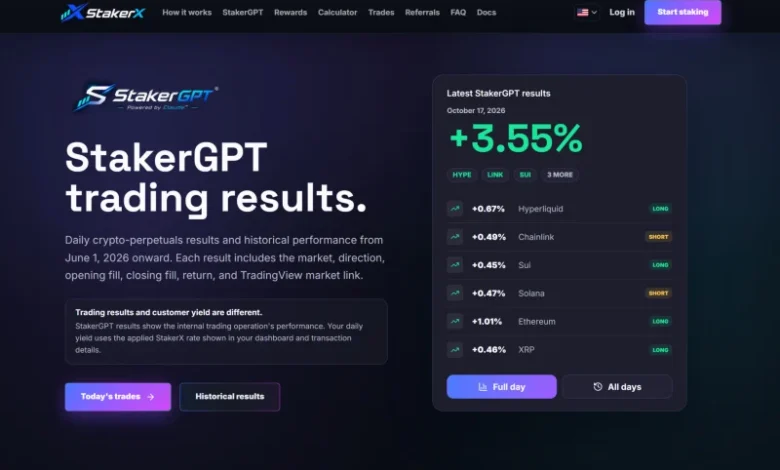
In an industry historically scrutinized for opacity regarding trading strategies and algorithmic performance, StakerX has adopted an unconventional approach centered on radical transparency. The platform mandates that every trade executed by StakerGPT—whether live-executed or derived from signal processing—must be entirely public.

To substantiate its performance claims, StakerX maintains a comprehensive, publicly accessible trade ledger updated daily at stakerx.ai/trades. This repository provides granular data for every position taken by the AI agent, including the specific asset market traded, execution direction (long or short), entry and exit prices, and the ultimate net return of each position.
By October 2026, the platform reported a published historical record of 804 executed trades spanning 139 consecutive trading days. Over this operational window, StakerX credited participating users with nearly $12 million in cumulative yield, figures that have been independently tracked and scrutinized by prominent industry publications, including Business Insider, CoinMarketCap, Binance Square, Investing.com, TradingView, Benzinga, Decrypt, and The Block.
Frictionless Multi-Chain Accessibility
A primary barrier to entry in decentralized finance has traditionally been the technical complexity associated with cross-chain bridging, token swapping, and network gas fee management. StakerX has engineered its onboarding architecture to bypass these hurdles, enabling a streamlined user experience.
The platform accepts deposits across a diverse array of more than 40 different cryptocurrencies originating from various major blockchain networks. Upon deposit, these assorted digital assets are automatically converted and credited to the user’s account as USDC, a prominent United States dollar-backed stablecoin native to the Solana blockchain. This automated conversion layer ensures that end-users are not required to manually bridge assets or navigate complex decentralized exchanges (DEXs) themselves.
Stakes on the platform are designed to be accessible to a wide demographic of investors, with minimum deposit thresholds starting at just $10 and operating on fixed 30-day staking cycles. Once the capital is converted to Solana-based USDC, StakerGPT deploys the aggregated liquidity pool into high-frequency perpetual futures markets, seeking optimized yield generation on a daily basis.
Macro Context: The Rise of Agentic Commerce and AI in Crypto
The rapid ascent of StakerX and its StakerGPT agent arrives at a pivotal juncture in the evolution of financial technology. Financial analysts and major institutional entities have increasingly turned their attention toward the concept of "agentic commerce"—an economic model wherein autonomous software agents execute financial transactions, manage portfolios, and negotiate value on behalf of human users.

Recent research and whitepapers published by major global financial institutions, including asset management giant BlackRock, have highlighted that autonomous AI agents are poised to become primary drivers of demand for digital assets, particularly regulated and dollar-pegged stablecoins. Because software agents require high-speed, low-latency, and programmable settlement layers to function effectively, high-performance blockchains like Solana combined with stablecoins like USDC provide an ideal infrastructure for autonomous financial operations.
Furthermore, the integration of generative AI and machine learning into trading systems marks a departure from traditional static quantitative trading bots. Unlike legacy algorithms that follow rigid, pre-coded "if-then" rules, modern agentic AI systems can process unstructured data, analyze macroeconomic news sentiment, adapt to shifting market regimes, and dynamically recalibrate risk parameters in real-time.
Risk Factors and Market Disclaimers
Despite the impressive yield figures and rapid capital inflows reported by StakerX, financial industry experts continually emphasize the inherent risks associated with automated crypto trading and perpetual futures markets. Perpetual futures are highly leveraged financial instruments that carry substantial risk of capital loss, particularly during sudden market liquidations or systemic black swan events.
StakerX has explicitly reminded its user base that deposited funds—though converted to USDC on Solana—are exposed to standard trading risks, platform-specific operational risks, and smart contract vulnerabilities. Moreover, the platform explicitly notes that historical performance metrics and reported yields over the initial three-month launch period do not serve as a guarantee of future returns. Regulatory scrutiny surrounding AI-managed investment funds and automated crypto platforms also remains a critical variable for the sector as international watchdogs continue to develop comprehensive compliance frameworks, such as the European Union’s Markets in Crypto-Assets (MiCA) regulation.
Implications for the Future of Decentralized Asset Management
The milestone achieved by StakerX and StakerGPT serves as a compelling case study in the commercial viability of consumer-facing AI asset management. By democratizing access to institutional-grade perpetual futures strategies through a simplified, stablecoin-denominated interface, the platform has tapped into a vast pool of retail capital that previously remained sidelined by the technical friction of DeFi.
As autonomous agents continue to mature and gain regulatory clarity across global jurisdictions, the success of platforms like StakerX may well foreshadow the mainstream commodification of AI-driven portfolio management. Whether these algorithmic systems can sustain their performance across diverse market cycles—including prolonged bear markets—will ultimately determine the long-term sustainability of agentic trading in the digital asset economy.