Institutional Influx Reshapes Crypto Landscape: Bitcoin Surges as Memecoins Retreat Amidst Market Maturation

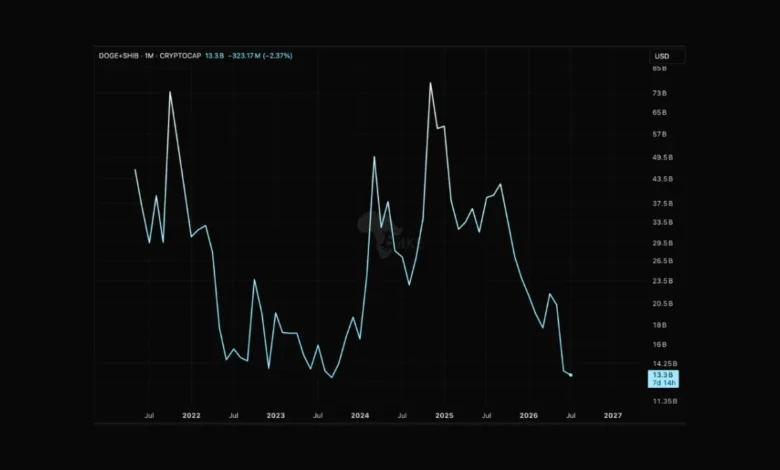
The cryptocurrency market is undergoing a significant transformation, marked by a pronounced shift in investor sentiment and capital allocation. A substantial wave of institutional money is increasingly flowing into established digital assets, particularly Bitcoin, while highly speculative memecoins like Dogecoin (DOGE) and Shiba Inu (SHIB) are losing considerable ground. This divergence highlights a fundamental maturation of the crypto sector, moving away from retail-driven hype towards a more institutionalized, value-centric investment paradigm.
The Great Divergence: Bitcoin’s Ascent vs. Memecoin’s Decline
Recent market data vividly illustrates this evolving landscape. Bitcoin, the flagship cryptocurrency, has demonstrated robust performance, gaining approximately 10% this month alone. Concurrently, the combined market capitalization of DOGECOIN and SHIBA INU, historically the two largest memecoins by market value, has plummeted to $13.27 billion. This figure represents their lowest level in three years and a decline of about 2% over the same period that Bitcoin has rallied. This stark contrast underscores a critical change in investor appetite, with sophisticated asset managers, hedge funds, and corporate treasuries increasingly funneling capital into regulated investment products tied to Bitcoin, rather than engaging with the volatile world of highly speculative tokens.
This isn’t merely a short-term fluctuation; it signifies a structural change. Unlike previous bull markets, where the exuberance of retail traders often fueled explosive, albeit ephemeral, gains in memecoins, the current cycle is unequivocally dominated by institutional participation. This institutional embrace is reshaping market dynamics, favoring assets with perceived long-term value and robust underlying infrastructure over those driven primarily by social media trends and community-driven speculation. The implications of this shift are profound, suggesting a future where fundamental analysis and regulatory compliance play a far greater role than viral marketing in determining crypto asset valuations.
Historical Context and Market Evolution
To fully appreciate the current market dynamics, it’s essential to examine the historical trajectory of the cryptocurrency market. The early days of crypto, particularly during the 2017 bull run and the subsequent explosion in 2020-2021, were largely characterized by retail investor enthusiasm. These periods saw the meteoric rise of numerous altcoins and memecoins, often fueled by accessible trading platforms, social media trends, and the allure of rapid, life-changing gains. Dogecoin, originally created as a joke in 2013, gained unprecedented traction in 2021, propelled by endorsements from high-profile figures and a vibrant online community. Shiba Inu followed a similar trajectory, positioning itself as the "Dogecoin killer" and leveraging community engagement for its valuation.
During these earlier cycles, the narrative was often about democratizing finance, allowing anyone to participate and potentially profit from nascent digital assets. Memecoins, with their low unit prices and high volatility, became particularly attractive to retail investors seeking disproportionate returns. The absence of stringent regulatory oversight and the perceived "Wild West" nature of the market further emboldened speculative behavior. However, this era also saw immense volatility, frequent pump-and-dump schemes, and a high mortality rate for new projects, a trend that continues to plague the memecoin sector. A recent report highlighted that a staggering 97% of all memecoins created have ultimately failed, with over 2,000 new memecoins dying daily in 2024 alone. This grim statistic underscores the inherent risks associated with these highly speculative assets, often lacking any real utility or long-term development plans.
The Institutional Tidal Wave: Catalysts for Change
The turning point for this market evolution can largely be traced to several pivotal developments that have paved the way for institutional capital.
1. The Approval of Spot Bitcoin ETFs: The most significant catalyst has been the approval and subsequent adoption of spot Bitcoin exchange-traded funds (ETFs) in the United States in January 2024. This landmark decision opened the floodgates for traditional financial institutions and their clients to gain exposure to Bitcoin without directly holding the asset or navigating complex crypto exchanges. Products offered by industry giants like BlackRock, Fidelity, and Grayscale have provided a regulated, accessible, and familiar investment vehicle, significantly lowering the barrier to entry for institutional capital. These ETFs have seen billions of dollars in inflows, directly channeling fresh capital into established digital assets.
2. Growing Corporate Bitcoin Holdings: Beyond investment products, a growing number of corporate treasuries have begun allocating portions of their balance sheets to Bitcoin. Companies such as MicroStrategy, led by Michael Saylor, have championed Bitcoin as a superior treasury reserve asset, citing its scarcity, censorship resistance, and potential as a hedge against inflation. This trend signals a shift in perception, moving Bitcoin from a speculative gadget to a legitimate, strategic asset for corporate financial management.
3. Enhanced Regulatory Clarity (Albeit Evolving): While the global regulatory landscape for cryptocurrencies remains fragmented, there have been gradual improvements in clarity, particularly around established assets like Bitcoin. Jurisdictions are increasingly working towards frameworks that address market integrity, consumer protection, and anti-money laundering (AML) concerns. This evolving regulatory environment, though still imperfect, provides a greater degree of confidence for institutional players who operate under strict compliance mandates. The inference from industry executives at events like Consensus Miami 2026 suggests a consensus that the industry has indeed entered a new phase of mainstream adoption, driven by these regulatory and structural advancements.
4. Risk Management and Due Diligence: Institutional investors operate under rigorous risk management protocols. Their investment decisions are typically guided by extensive due diligence, fundamental analysis, and a focus on long-term value preservation. Memecoins, by their very nature, often lack these fundamental attributes. They typically have no clear utility, no established development team, and their value is almost entirely dependent on speculative hype and community sentiment. This makes them inherently unsuitable for institutional portfolios seeking stability and verifiable value.

The Retreat of Speculative Assets: Why Memecoins Struggle
The struggle of memecoins to keep pace with Bitcoin’s rally is not accidental; it’s a direct consequence of this market shift. Their valuations are largely predicated on:
- Social Media Hype: Memecoins thrive on viral trends, celebrity endorsements, and community-driven promotions on platforms like X (formerly Twitter) and Reddit. When institutional money dominates, these social media narratives lose their power to move markets significantly.
- Retail Speculation: Historically, memecoins have been the playground for retail traders seeking quick profits. As institutional investors account for a growing share of market activity, the influence of these retail-driven rallies diminishes. Institutions are not looking for 1000x gains from a joke coin; they are looking for reliable returns from assets with defensible value propositions.
- Lack of Intrinsic Value or Utility: Unlike Bitcoin, which serves as a decentralized store of value and a medium of exchange, or other utility tokens that power specific decentralized applications, memecoins often offer little to no intrinsic value or technological utility. Their existence is often purely speculative.
- High Volatility and Risk: The very characteristics that make memecoins attractive to some retail investors—extreme volatility and the potential for exponential gains—also make them anathema to institutional investors focused on risk-adjusted returns and capital preservation. The report indicating that 2025 was the "deadliest year on record for crypto projects," fueled by memecoins, serves as a stark reminder of their inherent fragility.
Statements and Inferred Reactions from Industry Stakeholders
Leading crypto analysts and financial experts have widely acknowledged this market pivot. "We are witnessing the maturation of the cryptocurrency market," stated a prominent blockchain analyst, speaking anonymously to reflect general industry sentiment. "The ‘Wild West’ days are receding, replaced by a more disciplined approach where fundamentals and regulatory compliance are paramount. Institutions aren’t interested in internet memes; they’re interested in digital assets that offer a robust investment thesis."
Similarly, executives from major asset management firms, while rarely commenting directly on memecoins, consistently emphasize their focus on regulated, secure, and long-term investment opportunities within the digital asset space. Their public statements often revolve around the security and liquidity offered by spot Bitcoin ETFs and the potential for Bitcoin to serve as a portfolio diversifier or a hedge against macroeconomic uncertainties. This implicitly steers capital away from highly speculative and unregulated tokens. Regulatory bodies, too, have consistently expressed concerns about the speculative nature and investor protection issues surrounding memecoins, implicitly favoring the development of a more regulated and transparent digital asset ecosystem.
Broader Impact and Implications for the Future
The current trend marks a profound shift from previous crypto cycles and carries significant implications for the entire digital asset ecosystem:
1. Enhanced Market Stability and Liquidity: The influx of institutional capital tends to bring greater market stability and deeper liquidity. Institutions trade in larger volumes and often hold assets for longer periods, reducing the extreme price swings characteristic of retail-dominated markets. This increased stability can make the broader crypto market more attractive to even more conservative investors.
2. Focus on Fundamental Value and Utility: The institutional shift encourages a greater emphasis on fundamental value, technological utility, and robust development within the crypto space. Projects that offer genuine innovation, solve real-world problems, and have clear roadmaps are likely to attract more attention and capital, while projects built purely on hype will struggle to gain sustainable traction.
3. Regulatory Evolution: Increased institutional participation will inevitably lead to further demands for regulatory clarity and oversight. As more traditional financial products become intertwined with cryptocurrencies, regulators will face growing pressure to establish comprehensive frameworks that protect investors, prevent market manipulation, and ensure financial stability. This could accelerate the formal integration of digital assets into the global financial system.
4. Reshaping Investor Behavior: This trend is likely to influence retail investor behavior over time. As institutions demonstrate a preference for less speculative assets, retail investors may gradually shift their focus towards more established cryptocurrencies and projects with clear utility, driven by a desire for more sustainable and less volatile returns. The education around risk management within crypto will become increasingly important.
5. The Future of Altcoins and Memecoins: While memecoins may never completely disappear, their role in driving overall market narratives and capital flows is likely to diminish. The bar for new altcoins to succeed will be higher, requiring them to demonstrate clear utility, strong development, and a defensible value proposition beyond mere speculation. Niche communities and dedicated retail segments may continue to engage with memecoins, but their impact on the broader market will likely be overshadowed by institutional movements.
In conclusion, the cryptocurrency market is evolving beyond its speculative roots. The robust performance of Bitcoin amidst the decline of prominent memecoins signals a fundamental reorientation towards a more mature, institutionalized landscape. This era is characterized by a preference for regulated investment products, a focus on intrinsic value, and a growing recognition of digital assets like Bitcoin as legitimate components of diversified investment portfolios. As institutional investors continue to expand their footprint, the industry is poised for further integration into mainstream finance, driven by stability, compliance, and a renewed emphasis on fundamental value over fleeting hype.