HaasOnline and WEEX Launch Elite API Trader Tournament and Official Integration

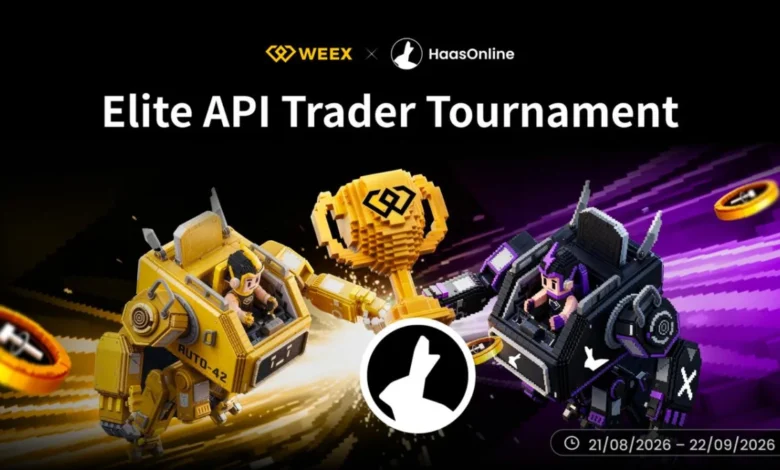
The professional trading landscape is witnessing a significant expansion of algorithmic capabilities as HaasOnline, a pioneer in crypto trading automation, officially announces full integration with the WEEX exchange. This integration, which encompasses both spot markets and USDT-margined perpetual futures, serves as the foundation for the newly inaugurated Elite API Trader Tournament. Running from 21 August to 22 September 2026, this competitive event invites quantitative traders to leverage HaasOnline’s robust automation infrastructure against WEEX’s high-liquidity order books.
The Integration Architecture
The technical synergy between HaasOnline’s TradeServer—available in both cloud-based and self-hosted environments—and WEEX is designed to minimize friction for institutional and retail traders. A primary feature of this integration is the consolidated credential management system. Unlike many exchanges that necessitate disparate API keys for varying product suites, WEEX utilizes a unified authentication protocol. Users connect a single set of API keys to unlock access to over 1,500 spot trading pairs and nearly 1,000 USDT-margined perpetual futures contracts.
For the HaasOnline user base, this means the migration or expansion of existing strategies onto the WEEX platform requires minimal configuration. Because the API structure is designed for compatibility with industry-standard protocols—often referred to as Binance-compatible architecture—traders can repurpose existing HaasScript logic, grid bots, or Dollar-Cost Averaging (DCA) frameworks with little more than a credential update.
Tournament Dynamics and Competitive Framework
The Elite API Trader Tournament represents more than a simple incentive program; it serves as a stress test for the newly minted integration. Participants are evaluated based on cumulative trading volume, a metric that rewards both high-frequency algorithmic activity and sustained market participation. By hosting this event, WEEX and HaasOnline aim to incentivize liquidity provision and showcase the precision of automated execution in volatile market conditions.
The tournament timeline is structured as follows:
- 21 August 2026: Official commencement of the tournament and activation of tracking for trading volume.
- 22 August – 21 September 2026: Continuous competition phase, allowing traders to adjust strategies and optimize their API interactions.
- 22 September 2026: Tournament conclusion and final snapshot of leaderboard standings.
Participants are encouraged to utilize the full breadth of HaasOnline’s toolkit, including backtesting modules and simulated paper-trading environments, to refine their strategies before committing capital to the live competition.
Technical Capabilities: Spot and Derivatives
The integration provides granular control over trade execution. In the spot market, HaasOnline users can deploy accumulation strategies and grid trading bots that operate without the complexities of leverage, targeting long-term asset positioning.
In the derivatives sector, the integration supports sophisticated position management. The availability of "hedge mode" is particularly significant for quantitative traders. This feature allows a single account to hold simultaneous long and short positions on the same contract, facilitating market-neutral strategies, such as funding-rate arbitrage, which are essential for traders seeking to mitigate directional market risk. Furthermore, the inclusion of both cross and isolated margin modes allows for precise capital allocation, enabling users to isolate risk per trade or optimize collateral usage across a portfolio of positions.
WEEX Market Context and Regulatory Standing
WEEX, which transitioned from its original Singaporean roots to a Dubai-based headquarters, has focused its growth strategy on providing a secure, compliant environment for derivatives trading. The exchange holds money services business (MSB) registrations with the Financial Crimes Enforcement Network (FinCEN) in the United States and the Financial Transactions and Reports Analysis Centre of Canada (FINTRAC). This regulatory alignment provides a degree of oversight that attracts both retail and semi-professional algorithmic traders who prioritize institutional-grade security.
The exchange’s infrastructure is specifically optimized for high-throughput API calls, a necessity for HaasOnline’s automated bots. By maintaining low latency and high uptime, WEEX ensures that algorithmic strategies—which may execute hundreds of orders per hour—are not hindered by network delays or execution slippage.
Strategic Implications for Algorithmic Traders
The partnership between HaasOnline and WEEX signals a broader trend toward the professionalization of retail trading tools. As markets become increasingly efficient, the barrier to entry for successful trading has shifted from manual execution to the development of robust, automated logic.
Analysts suggest that the integration of HaasOnline’s sophisticated scripting engine with WEEX’s expansive list of altcoin futures will provide traders with a distinct competitive advantage. By enabling the execution of complex mathematical models—such as mean reversion, trend-following, and statistical arbitrage—within a unified environment, the integration empowers traders to act upon market data with a speed and consistency unattainable through manual intervention.
Implementation and Risk Management
For those looking to participate in the tournament or integrate their existing infrastructure, the process involves three distinct steps: account registration on the WEEX platform, the generation of secure API keys with appropriate permission sets (typically restricted to trading and query functions), and the final configuration within the HaasOnline TradeServer interface.
However, the increased speed and efficiency of automated trading bring inherent risks. The rapid execution of trades means that a flawed strategy can impact an account balance significantly faster than human error. Consequently, both parties emphasize the necessity of rigorous backtesting. HaasOnline’s platform allows users to run historical simulations using real market data, a critical step for identifying potential failure points in a strategy before it encounters live liquidity.
Risk management best practices recommended by the providers include:
- Strict API Permissions: Ensuring that API keys are only granted the minimum necessary permissions—specifically "Trade" and "Read"—and explicitly disabling "Withdrawal" capabilities to prevent unauthorized fund transfers.
- Position Sizing Constraints: Implementing hard limits on trade sizes relative to the total account equity.
- Fail-Safe Protocols: Utilizing automated stop-loss mechanisms and "circuit breaker" logic to pause bot execution during extreme market volatility or anomalous price action.
Conclusion and Looking Forward
The launch of the WEEX integration marks a milestone for HaasOnline as it continues to expand its ecosystem of supported exchanges. For the average trader, the tournament provides a structured opportunity to explore these new tools while competing for a share of the prize pool.
As the digital asset market matures, the demand for reliable, high-performance automation tools continues to rise. The collaboration between a established automation platform like HaasOnline and an agile exchange like WEEX addresses this demand directly, providing the infrastructure necessary for traders to operate with greater efficiency and precision. Interested parties can access the tournament registration via the official WEEX campaign portal, where full terms and conditions, as well as real-time leaderboard data, are maintained.
Disclaimer: HaasOnline provides trading automation software only. This article is intended for informational purposes and does not constitute investment advice, trading recommendations, or financial guidance. Cryptocurrency trading involves significant risks, including the potential for the total loss of capital. Users are solely responsible for their trading decisions, and it is recommended that individuals conduct thorough research and consult with financial professionals before deploying capital into automated trading strategies. Past performance of any strategy or software is not indicative of future results.