Stateful vs. Stateless Agent Design: Tradeoffs for Scalable Agentic Systems.

The rapid evolution of artificial intelligence from simple chat interfaces to complex, autonomous agentic systems has forced a critical re-evaluation of backend architecture. As developers transition AI agents from experimental prototypes to production-ready enterprise tools, a fundamental question emerges: where should the agent’s memory reside? This decision, which centers on the choice between stateless and stateful design paradigms, dictates not only the implementation of the code but also the entire deployment strategy, infrastructure cost, and scalability potential of the system.
In the current landscape of AI deployment, characterized by high-speed inference providers like Groq and advanced open-weights models such as Meta’s Llama 3.1 series, the management of conversation state has become a primary bottleneck. State refers to the accumulated context of an interaction, including previous user prompts, assistant responses, and the results of intermediate tool calls. How an architecture handles this data determines its ability to handle thousands of concurrent users while maintaining a coherent and personalized user experience.
The Rise of Agentic Architectures
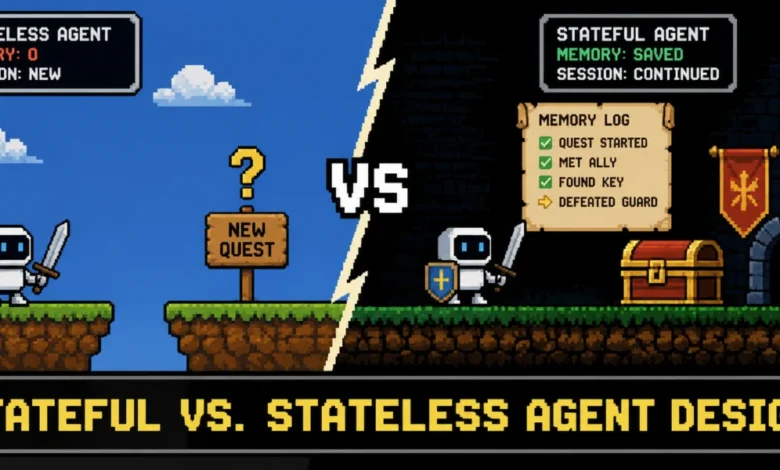
The industry has moved beyond the "one-shot" prompt era. Modern AI agents are expected to perform multi-step reasoning, interact with external APIs, and maintain long-term relationships with users. This shift has highlighted a significant architectural divide. A stateless approach treats every interaction as a fresh start, requiring the external environment to provide all necessary context. Conversely, a stateful approach empowers the agent to manage its own history, relying on persistent storage to maintain continuity across sessions.
To understand these trade-offs, engineers are increasingly turning to benchmarking tools and efficient models. For instance, using the Llama 3.1 8B Instant model via the Groq API provides a high-performance environment for testing these paradigms. With Groq’s infrastructure capable of processing hundreds of tokens per second and offering generous free-tier limits (up to 14,400 requests per day), developers can simulate high-concurrency environments to observe how state management affects latency and throughput.
Stateless Agents: The "Fire and Forget" Philosophy
Stateless agents are characterized by their lack of internal memory. In this model, the agent is a pure function: it receives an input and produces an output without retaining any information from the transaction once the execution cycle is complete.
The Mechanics of Statelessness
In a stateless deployment, the responsibility for maintaining conversation history is shifted to the client side—usually the frontend application or a separate orchestration layer. When a user sends a message, the frontend must bundle the entire conversation history into the payload. The agent receives this comprehensive "snapshot," processes the latest request using the provided context, and returns a response.
Advantages of Horizontal Scaling
The primary benefit of stateless design is its inherent compatibility with horizontal scaling. Because no user-specific data is stored on the individual server instances, a load balancer can route an incoming request to any available container in a cluster. This eliminates the need for "sticky sessions," where a user must be routed to the same server that handled their previous message. If one instance fails, another can immediately take its place without any loss of continuity for the user, provided the client sends the full history.
The Cost of Token Snowballing
However, statelessness introduces a significant operational challenge: the "snowball effect" of token usage. Because the entire history must be re-sent with every new prompt, the size of the request payload grows linearly with the length of the conversation. In a 20-turn dialogue, the agent might process thousands of redundant tokens in the final turn. In an enterprise setting where API costs are calculated per million tokens, this redundancy can lead to ballooning expenses. Furthermore, as the payload grows, it risks hitting the model’s context window limit, requiring complex client-side pruning strategies.
Stateful Agents: Context-Driven Continuity
Stateful agents take the opposite approach by assuming the "memory burden" themselves. In this paradigm, the agent is linked to a persistent storage layer—such as a database or a high-speed cache—where it stores and retrieves conversation history based on a unique session identifier.
The Mechanics of Statefulness
When a request arrives at a stateful agent, it typically includes only the new user prompt and a session ID. The agent then performs a retrieval step, querying a database (like SQLite for small-scale tests or PostgreSQL/Redis for production) to fetch the relevant history. It appends the new prompt, calls the Large Language Model (LLM), and then updates the database with the new response before returning the answer to the user.
Complex Workflows and Asynchronous Execution
Statefulness is often a requirement for advanced agentic workflows. For agents that need to perform long-running tasks—such as waiting for a human-in-the-loop approval or polling an external API for a slow-running report—state must be preserved. A stateful architecture allows the agent to "pause" its execution and resume exactly where it left off once the external trigger is received. This is essential for building agents that function more like digital employees than simple chatbots.
The Infrastructure Hurdle
The trade-off for this enhanced capability is architectural complexity. Scaling stateful systems is significantly more difficult than scaling stateless ones. Developers must implement a centralized memory layer, such as a Redis cluster, to ensure that if a request is routed to a different server instance, that instance can still access the user’s history. Without this centralized "source of truth," the system suffers from "localized amnesia," where the agent forgets the user’s name or previous requests because the data is trapped on a different physical machine.
Comparative Analysis: Data and Performance
When evaluating these two paths, organizations must consider the following metrics:
- Network Overhead: Stateless agents require larger request payloads, increasing the bandwidth consumed between the client and the server. Stateful agents minimize request size but introduce internal latency through database queries.
- Computational Efficiency: Groq’s Llama 3.1 8B model is highly optimized for speed. In a stateless setup, the bottleneck is often the time taken for the LLM to process the increasingly large system prompts and histories. In a stateful setup, the bottleneck is the I/O operations associated with the database.
- Reliability: Stateless systems are more resilient to individual node failures. Stateful systems require robust database replication and failover strategies to prevent data loss.
Stakeholder Perspectives and Market Trends
Industry analysts suggest that the choice of architecture often depends on the specific use case. CTOs of customer-facing startups often lean toward stateless designs in the early stages to minimize infrastructure management and maximize the benefits of serverless computing platforms like AWS Lambda or Google Cloud Functions.
Conversely, enterprise architects working on "Agentic AI" (agents that use tools and have long-term memory) are moving toward sophisticated stateful designs. "We are seeing a trend toward ‘hybrid statefulness,’" says one industry expert. "This involves using stateless API calls for the core logic while maintaining a robust, externalized state layer that can be accessed by any agent in the fleet."
Timeline of Development in Agent Memory
- Early 2023: Predominance of stateless "Chatbot" APIs. Users were responsible for managing their own JSON arrays of messages.
- Late 2023: Emergence of "Assistant" APIs (like OpenAI’s Assistants API) which popularized server-side state management, abstracting the database layer from the developer.
- 2024: The rise of open-source frameworks like LangGraph and CrewAI, which provide developers with granular control over state machines and persistent checkpoints.
- 2025 (Projected): Integration of vector databases directly into the state management layer, allowing agents to seamlessly transition between short-term conversation memory and long-term knowledge retrieval.
Broader Implications for the AI Ecosystem
The stateless vs. stateful debate is more than a technicality; it reflects the maturing of AI infrastructure. As the industry moves toward "Autonomous Agents," the management of state will become the defining characteristic of a system’s intelligence. An agent that can remember a user’s preferences across weeks of interaction (stateful) is fundamentally different from one that only knows what it is told in the current minute (stateless).
Furthermore, the choice impacts the environmental and economic footprint of AI. Stateless systems, by re-processing the same tokens repeatedly, contribute to higher energy consumption per meaningful interaction. As sustainability becomes a core metric for enterprise IT, the efficiency of stateful designs—which only process new information while retrieving context—may become the preferred standard.
In conclusion, there is no one-size-fits-all solution. Stateless agents offer a path of least resistance for high-scale, simple interactions where the client can manage context. Stateful agents, while requiring more rigorous engineering and a persistent database layer, unlock the true potential of agentic systems by providing a foundation for complex, multi-step, and personalized AI experiences. As models like Llama 3.1 continue to lower the barrier to entry for high-performance inference, the battle for the "brain" of the agent will be won or lost in the architecture of its memory.