The Hidden Costs and Bureaucratic Nightmares of Modern Home Remodeling

The modern residential renovation landscape has transformed into an arduous endeavor characterized by spiraling budgets, extended timelines, and severe bureaucratic bottlenecks. For many property owners, undertaking a comprehensive "gut remodel" has evolved from a routine home improvement project into a multi-year exercise in fiscal strain and psychological endurance. Industry analyses indicate that voluntary home renovations frequently result in severe financial overruns and friction with local regulatory bodies, prompting a growing segment of real estate analysts and seasoned homeowners to advise against major construction projects altogether.
Chronology of a Construction Crisis: The Timeline of Delays
The trajectory of residential construction and permitting has deteriorated significantly over the past two decades. According to collaborative research from the University of Chicago and Princeton University, published via ResiClub, the national average duration from initial permit application to the final completion of a single-family home has expanded considerably.
Historically, permitting processes were completed within weeks, but national metrics indicate that single-family permitting times roughly tripled from an average of 1.6 months in the year 2000 to approximately 4.9 months by 2023. When accounting for subsequent construction phases, the total lifecycle of a build or major overhaul frequently spans multiple years, depending heavily on municipal efficiency.
Geographic disparities in permitting and construction speeds remain stark. Major metropolitan areas experience severe administrative backlogs. San Francisco, California, leads the nation in construction friction, averaging 1.1 years merely to secure a building permit and an additional 3.8 years to complete the construction of a single-family home. Other urban centers follow closely behind; Miami, Florida, and Philadelphia, Pennsylvania, report average timelines of approximately 3.4 years from conception to completion.
Conversely, municipalities with less restrictive regulatory frameworks, such as Indianapolis, Indiana, El Paso, Texas, and Colorado Springs, Colorado, manage similar projects in roughly six months. This disparity means a resident in Indianapolis might theoretically observe the completion of multiple residential projects in the time it takes a single homeowner in San Francisco to navigate local regulatory hurdles.
Financial Implications: Beyond the Initial Construction Estimate

The true economic impact of a residential remodel routinely exceeds initial contractor projections. Financial experts consistently recommend that individuals budgeting for a major structural renovation prepare for expenses to exceed initial estimates by at least 50 percent, with project timelines stretched by an equivalent margin.
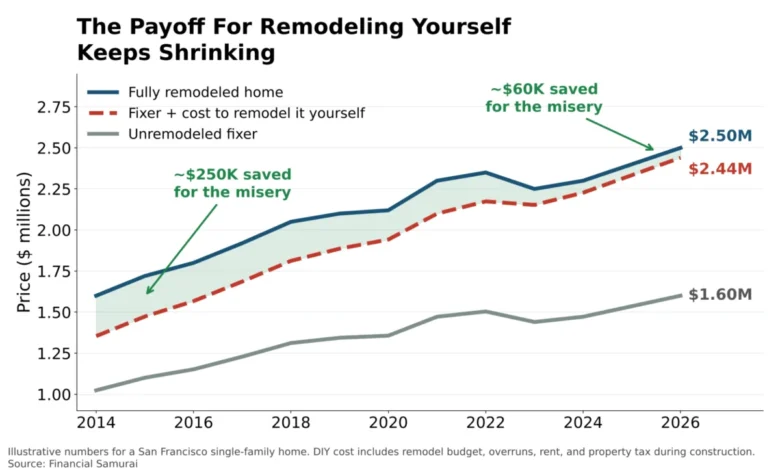
To illustrate the broader financial exposure, consider a standard acquisition and renovation scenario. A buyer purchasing a fixer-upper property for $1.6 million might allocate an initial budget of $400,000 for an 18-month gut renovation. Factoring in typical cost overruns of 50 percent, the construction expenditure escalates to $600,000.
During the extended 2.5-year construction window, the homeowner must secure alternative living arrangements. Assuming a rental cost of $6,500 per month, temporary housing adds approximately $195,000 to the total expenditure. Additionally, property taxes—averaging roughly 1.2 percent annually—continue to accrue on a domicile that remains uninhabitable, contributing an extra $48,000 over the course of the project.
When combining the purchase price, inflated construction costs, temporary living expenses, and holding taxes, the total capital outlay for the $1.6 million asset surpasses $2.44 million. This calculation excludes the opportunity cost of tying up hundreds of thousands of dollars in illiquid construction equity rather than deploying those funds into yielding financial instruments or public markets.
Regulatory and Logistical Bottlenecks
The friction points in modern home renovations are multifaceted, stemming from labor shortages, supply chain vulnerabilities, and stringent municipal oversight. General contractors frequently contend with sub-contractor scheduling conflicts, material delivery delays, and unexpected structural deficiencies discovered only after demolition begins.
Furthermore, municipal building departments enforce rigorous inspection protocols. Projects typically require multiple rounds of specialized inspections covering structural integrity, electrical wiring, plumbing installations, and insulation before any drywall can be installed. Failed inspections necessitate remediation and rescheduling, adding weeks or months to the critical path of the project.
For urban homeowners, these delays are compounded by neighborhood restrictions, historic preservation guidelines, and noise ordinances that limit working hours. Consequently, the daily management of a construction site requires constant oversight, transforming the homeowner into an involuntary project manager tasked with mediating disputes between tradespeople and municipal inspectors.

Shifting Market Dynamics: Finished Properties Versus Fixer-Uppers
Historically, purchasing a distressed property and executing a self-managed renovation offered substantial financial incentives, often generating significant savings compared to acquiring a turnkey home. However, narrowing profit margins have altered the calculus of residential real estate investment.
Economic analyses suggest that the historical discount associated with fixer-upper properties has compressed significantly due to surging labor and material costs. While a decade ago a DIY renovation might have yielded substantial net savings after accounting for all expenses, contemporary projects frequently yield marginal savings—sometimes amounting to a fraction of the historical discount—once the totality of construction inflation and holding costs are calculated.
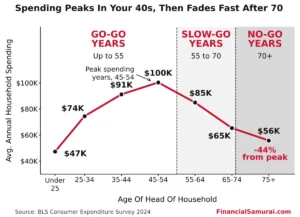
Given the high probability of budget overruns and the intangible toll of prolonged construction, real estate professionals increasingly advise buyers, particularly those over the age of 40 residing in slow-to-build urban markets, to prioritize fully remodeled homes. Although turnkey properties command market premiums, these premiums often fail to fully reflect the true aggregate cost, stress, and time expenditure required to execute a ground-up renovation independently.
Broader Industry Impact and Alternative Real Estate Investment
The cumulative challenges of residential construction have influenced broader consumer behavior and investment preferences. Many individuals seeking exposure to the real estate sector are deliberately bypassing direct property development and physical asset management.
Instead, capital is increasingly directed toward passive real estate investment vehicles, such as specialized real estate investment trusts (REITs) and institutional platforms focused on residential and industrial sectors. These alternatives allow investors to capture real estate yields and appreciation without the administrative burdens of permitting, contractor management, and municipal compliance.
Ultimately, while residential remodeling remains a viable path for achieving highly customized living spaces, the economic and psychological toll necessitates rigorous upfront planning. For the average property owner, the decision to renovate requires balancing the desire for personalization against the empirical reality of prolonged timelines, inflated budgets, and the complexities of modern municipal bureaucracy.