Navigating the IPO Quiet Period: A Case Study on Anthropic Ahead of Its Public Debut

The upcoming initial public offering of artificial intelligence pioneer Anthropic has brought renewed scrutiny to the mechanics of the regulatory quiet period, offering a distinct case study in how information flows—and is legally restricted—prior to a major market debut. With market expectations pointing toward a public filing of its registration statement by late September and a potential trading debut as early as October, the company finds itself navigating the strictest phases of federal securities oversight.
The Information initially reported Anthropic’s target timeline on August 27, with subsequent updates from Reuters on September 4 noting a minor shift toward a late-September launch window. However, as the company prepares to enter the public markets, financial observers and retail investors face a counterintuitive phenomenon: while public discussion surrounding the firm’s valuation, revenue projections, and technological capabilities is intensifying, the company itself is legally required to remain silent.
Understanding the Regulatory Framework and the Three Phases of the Quiet Period
To comprehend the information vacuum surrounding a high-profile market debut, financial analysts must distinguish between the operational blackouts of already-public corporations and the statutory restrictions mandated by the Securities Act of 1933 for companies in registration. The latter framework is legally binding, strictly enforced by the U.S. Securities and Exchange Commission (SEC), and designed to prevent the unlawful conditioning of the market through promotional disclosures ahead of a prospectus release.

The regulatory process is divided into three distinct chronological phases:
-
Pre-Filing Phase: Commencing the moment an issuer decides to pursue a public listing and lasting until the formal filing of a registration statement, Section 5(c) of the Securities Act prohibits offers of any kind, whether written or oral. Regulators define "offer" broadly, encompassing any publicity or forward-looking commentary that could be interpreted as conditioning the market—a violation commonly referred to as "gun-jumping."
-
Waiting Period: This phase begins once the registration statement is officially and publicly filed. During this interval, preliminary prospectuses circulate among institutional buyers, and underwriters initiate the formal roadshow process. Oral offers become permissible, providing a modest loosening of communications restrictions.
-
Post-Effective Phase: This period commences once shares are priced and begin trading on a national exchange. A statutory 25-day prospectus delivery requirement typically applies for initial public offerings, after which the issuer returns to normal, ongoing periodic disclosure rules under federal securities laws.
Compounding these restrictions is Rule 163A, which provides a safe harbor for issuer communications made more than 30 days prior to the filing of a registration statement, provided such communications do not directly reference the upcoming securities offering. With Anthropic submitting a confidential draft S-1 on June 1, 2026, and approaching its public filing window, the company has operated well within this restrictive regulatory perimeter. When Anthropic previously announced its confidential filing, corporate counsel explicitly relied upon Rule 135 to release a narrow factual statement acknowledging the existence of the process without violating promotional prohibitions.

The Information Vacuum: Who Can Speak and Who Cannot
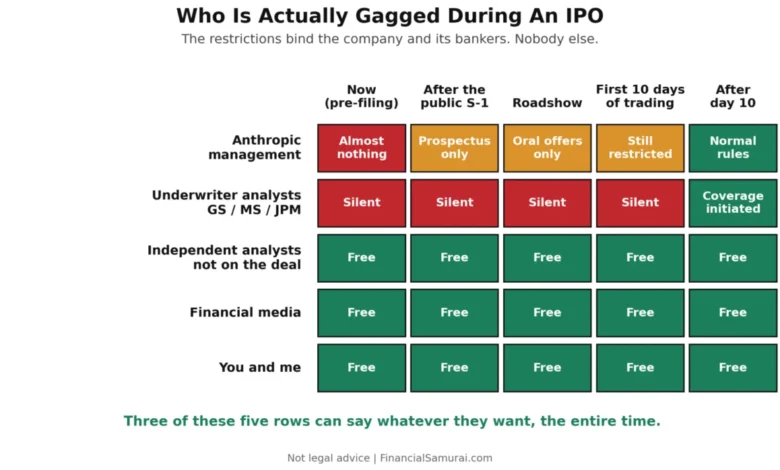
A common misconception among retail investors is that the quiet period enforces total market silence. In practice, the restrictions under the Securities Act bind only the issuing company, its officers, directors, and participating underwriters.
Independent financial media outlets, non-underwriting equity analysts, financial commentators, and market participants face no such constraints. Consequently, an unusual information ecosystem emerges: the entity possessing the most comprehensive and accurate financial data—management—is legally muzzled, while external analysts and reporters publish speculation regarding multi-trillion-dollar valuations, total addressable markets, and forward revenue trajectories.
Recent reports from financial publications have highlighted aggressive estimates circulating within institutional circles, projecting that Anthropic could achieve significant annualized recurring revenue milestones over the coming years. Yet, corporate disclosures have remained strictly limited to routine, ordinary-course factual business updates permitted under Rules 168 and 169—such as acknowledging broad operational growth metrics without offering valuation commentary, earnings projections, or promotional statements regarding the impending public offering.
The Secondary Research Blackout and Institutional Dynamics

Beyond the initial regulatory quiet period governing the issuer, a secondary restriction impacts the research community immediately following a listing. Under Financial Industry Regulatory Authority (FINRA) guidelines, investment banks acting as managers or co-managers on an initial public offering are prohibited from publishing equity research reports on the newly public issuer for a minimum of 10 calendar days following the commencement of trading.
Given the projected scale of Anthropic’s market debut—which market observers anticipate could rival or exceed historical precedent for major technology listings—a substantial syndicate of lead underwriters, including major financial institutions like Goldman Sachs, Morgan Stanley, and JPMorgan, will be bound by this research blackout.
Once the 10-day restriction lapses, syndicate analysts typically initiate formal coverage simultaneously. Historically, this synchronized release of institutional research provides a secondary catalyst for trading activity, offering prospective institutional buyers the formal analytical validation required to allocate capital to newly listed equities.
Broader Market Implications and Valuation Perspectives
For everyday investors seeking exposure to late-stage private artificial intelligence leaders prior to an IPO roadshow, navigating the quiet period requires distinguishing between verified foundational disclosures and speculative market estimates.

The public filing of the S-1 registration statement serves as the definitive watershed moment for the market. Once accessible via the SEC’s EDGAR system, the prospectus provides audited financial statements, historical gross margins, customer concentration metrics, exhaustive risk factor disclosures, and an accurate, fully diluted capitalization table. These verified metrics replace speculative calculations with empirical data, allowing institutional and retail participants to price the security against actual financial performance.
As the market approaches the anticipated autumn listing window, the interplay between regulatory constraints, institutional syndicate rules, and independent media coverage continues to shape the price discovery process. While the information vacuum inherent to the quiet period can introduce near-term volatility and uncertainty, it ultimately precedes the structured, highly regulated disclosure of financial fundamentals that governs modern public equity markets.