The Financial and Privacy Paradox of Cloud AI
The reliance on major cloud providers like OpenAI, Anthropic, or Google for agentic workflows is an increasingly expensive proposition. Industry analysts note that a standard coding session utilizing agentic loops—where an AI autonomously reads files, executes terminal commands, and iterates on solutions—can incur costs ranging from $0.60 to $0.80 per session. For heavy-duty automation or continuous integration tasks, these costs can balloon to $20 per session.
Beyond the financial burden, there is an inherent security risk. When an agent is granted access to a directory, it transmits the contents of those files to remote servers. For enterprises, freelancers, or students working with proprietary or sensitive data, this creates a significant compliance and security hurdle. The rise of Hermes Agent, developed by Nous Research, offers a path to bypass these issues entirely by providing a modular, MIT-licensed platform that functions as an intelligent interface between the user and local LLM backends.
Chronology of Local Agentic Evolution
The transition toward local agentic AI has been rapid. In early 2023, the focus was primarily on basic chat interfaces. By late 2024, the industry saw the rise of Ollama, which simplified the deployment of large language models (LLMs) to a single command. The subsequent release of Hermes Agent (v0.21.1) served as the catalyst for integrating these models into actual, functional agents.
This evolution is defined by three major technical milestones:
- Model Serving: The ability to run models locally with API parity, allowing local models to respond to requests using the standard OpenAI
/v1/chat/completionsendpoint. - Tool Orchestration: The shift from passive text generation to active agents capable of calling "tools"—executing shell commands, performing file system operations, and browsing the web.
- Memory Persistence: The integration of vector databases or persistent file-based memory that allows agents to remember project-specific contexts, reducing the need for repetitive prompting.
Technical Infrastructure: The Role of Ollama
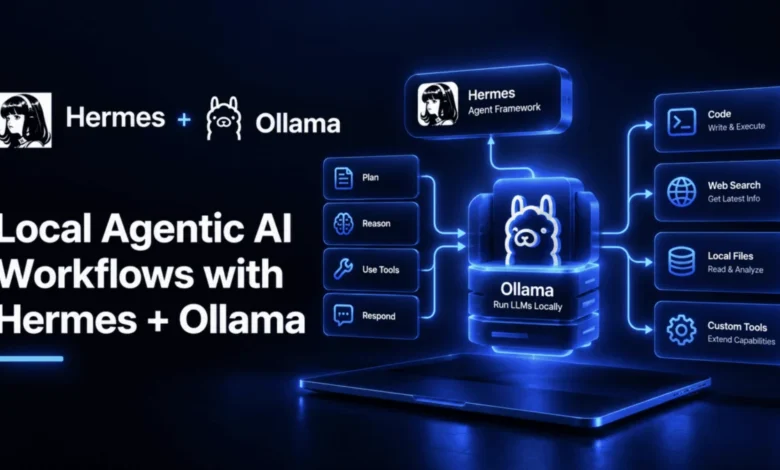
At the heart of this workflow is Ollama, an open-source framework designed to serve open-weight models like Llama 3, Gemma 2, and Mistral. Ollama acts as the inference engine. By running locally, it creates an OpenAI-compatible interface on localhost:11434. This is critical for compatibility; because Hermes Agent is built to communicate with standard AI APIs, it does not require a specialized integration to talk to a locally running model. It simply points its configuration toward the local address instead of a cloud-based URL.
The division of labor is efficient: Ollama handles the heavy mathematical lifting of model inference, while Hermes Agent manages the logic of when to invoke specific tools. When a user asks the agent to "Find all Python files and count the lines," Hermes analyzes the request, realizes it requires system-level access, executes a find command through its sandbox environment, and feeds the output back into the model to generate a natural language summary.
Hardware Prerequisites and Optimization
Performance is directly proportional to hardware capability. While entry-level systems with 8GB of RAM can handle smaller 3B parameter models, the "agentic" experience—which requires high reasoning capabilities—demands more. A 31B parameter model typically requires at least 24GB of RAM and significant GPU support to maintain a usable tokens-per-second rate.
| Component | Minimum Specification | Recommended Specification |
|---|---|---|
| RAM | 8 GB | 32 GB or higher |
| Storage | 5 GB free | 50 GB+ for model variety |
| CPU | 4 Cores | 8+ Cores (Apple Silicon or modern x86) |
| GPU | Not Required | NVIDIA RTX 30/40 series (8GB+ VRAM) |
For users operating on CPU-only machines, the system remains functional but slower, with latency increasing as the model size grows. To mitigate this, users can employ "Model Quantization" or simply select smaller, highly optimized models for non-complex tasks.
Implementation Guide: From Setup to Execution
Setting up the workflow begins with the installation of Ollama via the terminal. Once the binary is active, the user must pull a model capable of "Tool Calling." Not all models are created equal in this regard; whereas a standard 9B chat model is excellent for conversation, it lacks the architectural training to successfully parse and execute JSON-based tool calls. Therefore, models such as Gemma 2 (27B or 31B variants) are recommended for professional-grade agentic work.
After pulling the model, the configuration of ~/.hermes/config.yaml is the final step. By setting the provider to "custom" and the base URL to the local Ollama instance, the agent becomes fully operational.
Advanced Features: Gateways and Fallbacks
The most sophisticated implementations of local agents utilize the "Gateway" pattern. By integrating with platforms like Telegram, a user can host an agent on a home workstation and interact with it via a mobile device. This is achieved by adding a platform-specific block to the Hermes configuration, which effectively creates a secure bridge between the user’s private server and the messaging app.
Furthermore, a "Hybrid Fallback" strategy allows for the best of both worlds. A user can configure Hermes to use a local model for 90% of tasks, while reserving a paid cloud API (such as Claude 3.5 Sonnet) only for tasks where the local model fails or lacks the necessary training data. This ensures that the user is only incurring costs when the complexity of the request justifies the expense.
Analysis: Implications for Data Sovereignty
The broader implication of this technology is the decentralization of AI intelligence. For years, the narrative has been that high-performance AI is the exclusive domain of companies with massive server farms. This model challenges that premise, proving that for many professional coding and organizational tasks, local hardware—leveraging the latest open-weight models—is sufficient.
The environmental and economic impact of this shift is also noteworthy. By reducing the number of requests sent to massive data centers, individual users can lower their carbon footprint while reclaiming ownership of their intellectual property. As Hermes Agent continues to mature, it is likely that the "zero-cost" model will become the default for developers who prioritize security above all else.
In summary, the transition to local agentic AI is not merely a technical choice but a strategic one. It offers a robust defense against rising API costs and provides a sanctuary for private data, all while delivering a level of automation that was, until recently, only accessible through enterprise-tier cloud subscriptions. By combining the inference power of Ollama with the agentic orchestration of Hermes, users can build a digital assistant that is as private as it is capable.