Fiduciary-Grade AI and the Future of Regulated Professional Workflows: Navigating Compliance and Innovation in Financial Services

The integration of artificial intelligence into highly regulated sectors has reached a critical inflection point, as financial institutions, legal firms, and audit functions move beyond experimental pilots toward enterprise-grade implementation. Unlike the consumer technology sector, where "beta" releases and minor inaccuracies are often tolerated as part of the iterative process, regulated industries operate under a mandate of zero tolerance for error. In these environments, partial accuracy is not merely a technical limitation; it represents a fundamental compliance failure with the potential for severe regulatory, financial, and reputational consequences.
The stakes for these organizations were high long before the current generative AI boom. According to research published by the National Bureau of Economic Research (NBER), the average firm in the United States allocates between 1.3 and 3.3 percent of its total wage bill to regulatory compliance. This burden is not static; it has grown significantly over the last decade, varying by industry and firm size, with the most heavily regulated sectors—such as banking and healthcare—bearing the highest costs. As the volume of global regulation increases, the manual labor required to maintain compliance has become a primary bottleneck for growth, prompting a search for technological solutions that can handle the "investigative burden" of professional work without compromising the integrity of the output.
The Accuracy Gap and the Stanford Hallucination Study
The primary hurdle for the adoption of general-purpose large language models (LLMs) in professional workflows is the phenomenon of "hallucinations"—the tendency of probabilistic models to generate factually incorrect but confident-sounding information. For a tax attorney or a corporate auditor, a single hallucinated case citation or an incorrect decimal point in a financial filing is catastrophic.
Recent empirical data underscores this risk. Researchers at Stanford University’s RegLab tested general-purpose language models against a series of verifiable legal questions and discovered hallucination rates ranging from 58 to 88 percent. These findings highlight why off-the-shelf AI systems remain fundamentally unfit for high-stakes legal and regulatory work. Without purpose-built safeguards and domain-specific training, these models cannot distinguish between authoritative legal precedents and statistically likely but fictional narratives.
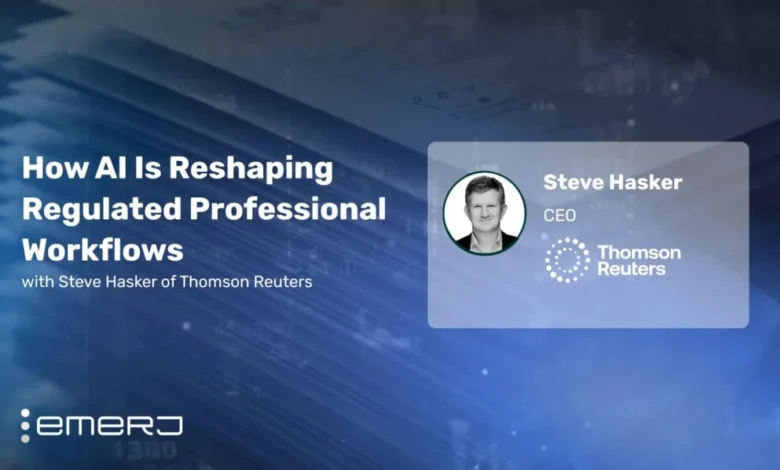
In a recent episode of the AI in Financial Services Podcast, Daniel Faggella, CEO and Head of Research at Emerj, sat down with Steve Hasker, CEO of Thomson Reuters, to discuss how regulated institutions are bridging this gap. Hasker, who oversees one of the world’s largest providers of professional information and technology, argues that the solution lies in "fiduciary-grade AI"—systems designed to meet the same standards of care and precision expected of licensed human professionals.
Defining Fiduciary-Grade AI: A New Standard for Precision
Fiduciary-grade AI represents a departure from the "black box" approach of many consumer AI models. It is built on three core pillars: precision, verifiability, and consistency. In the context of financial services, this means that machine-generated work must align perfectly with the standards governing regulated submissions.
Hasker emphasizes that for AI to enter core workflows, its correctness must match the expectations placed on CFOs, General Counsels, and auditors. These professionals are not merely looking for a tool that can summarize text; they require a system that can analyze structured documents, follow repeatable review steps, and apply well-defined correctness criteria.
The challenge is not simply reducing the frequency of errors but ensuring that every output can be traced back to an authoritative source. This "grounding" of AI in trusted data sets—such as tax codes, case law, and internal corporate records—is what separates a general-purpose chatbot from a professional-grade tool. By prioritizing tasks that involve structured documentation and repeatable processes, institutions can find a safe path to adoption, using AI to support professionals rather than replace the necessary human oversight.
Workflow Automation and the Investigative Burden
One of the most labor-intensive aspects of regulated work is the preparation of regulatory filings. Financial institutions routinely manage millions of pages of disclosures, audit inputs, and supporting documentation. This process is highly repetitive and accuracy-sensitive, yet it consumes a disproportionate amount of professional time.
During the discussion, Hasker pointed to regulatory filing preparation as the workflow most likely to be transformed in the near term. He described a future where expert-driven AI applications automate the vast majority of the investigative burden—the searching, cross-referencing, and drafting that precedes a final decision.
"Regulatory filing preparation consumes enormous professional time, carries significant compliance risk, and is built on authoritative content," Hasker noted. He argued that while AI can fundamentally automate the "heavy lifting" of data gathering and preliminary analysis, the accountability structure of the firm remains unchanged. The CFO or the General Counsel still retains the ultimate sign-off responsibility. The value of AI in this context is not the removal of the expert, but the radical efficiency gain that allows the expert to focus on high-value analysis rather than document handling.
Data Protection as a Prerequisite for Adoption
Beyond accuracy, data handling remains a significant barrier to AI adoption. The National Institute of Standards and Technology (NIST), in its AI Risk Management Framework, identifies privacy concerns and the security of training data as core risk categories. For a financial institution, the idea that sensitive client data or proprietary transaction records could be used to train a public model is an existential threat.
Hasker argues that data-protection guarantees are not a technical preference but a foundational requirement. Regulated institutions need absolute certainty that their information will remain isolated from the model’s training corpus. This is a guarantee that most commercial, consumer-facing AI systems are not architected to provide.
To address this, the industry is moving toward "data-isolated" environments. In these setups, an institution’s data is used to inform the AI’s responses for that specific user or firm, but the data never "leaks" back into the underlying model. This ensures that proprietary institutional knowledge and sensitive filings never become part of a future output for a competitor or the general public. Without these safeguards, the productivity benefits of AI are outweighed by the risks of data leakage and the subsequent violation of regulatory expectations.
The Persistence of Human Accountability
Perhaps the most critical insight from the dialogue between Faggella and Hasker is the role of explicit sign-off requirements. As AI systems become more capable of generating legal opinions or financial reports, the question of who is responsible for a machine-assisted decision becomes paramount.
Hasker’s view is that AI will not dilute responsibility; it will make it more explicit. In a regulated environment, fiduciary responsibility cannot be delegated to an algorithm. Whether a document was drafted by a junior associate or a sophisticated LLM, the senior leader who signs the filing is legally and ethically responsible for its contents.
Institutions must therefore formalize the boundaries between machine support and human judgment. This involves determining which tasks are "safe" for AI to handle independently and which require "human-in-the-loop" verification. For example, while an AI might be trusted to flag inconsistencies in a 500-page disclosure, a human expert must still evaluate whether those inconsistencies represent a material risk that needs to be reported.
Broader Implications for the Professional Services Sector
The shift toward fiduciary-grade AI has implications that extend far beyond technical architecture. It signals a change in the economics of professional services. If AI can reduce the time required for regulatory filings by 50 or 80 percent, the traditional billable-hour model used by legal and accounting firms may face significant pressure.
Furthermore, the "junior professional" role is likely to evolve. Traditionally, junior staff spent years performing the very investigative and document-heavy tasks that AI is now poised to automate. Firms will need to rethink how they train the next generation of experts when the "entry-level" work is increasingly handled by machines.
The analysis suggests that the winners in this new landscape will be those who can successfully integrate AI into their workflows while maintaining the highest standards of accuracy and data security. As Steve Hasker highlighted, the goal is to strengthen professional output, not to introduce new layers of risk. By focusing on purpose-built safeguards and preserving the primacy of human accountability, regulated industries can finally harness the power of AI to manage the ever-growing burden of global compliance.
In conclusion, the path to AI adoption in the financial and legal sectors is paved with "fiduciary-grade" requirements. While the potential for efficiency is vast, the tolerance for error remains zero. As organizations navigate this transition, the focus must remain on systems that offer not just speed, but the precision and protection required to satisfy the world’s most demanding regulators.