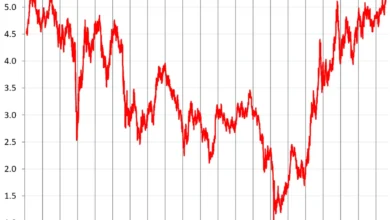
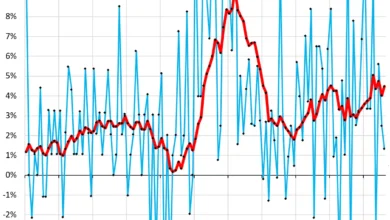
Core services CPI +4.0% annualized, Core CPI +3.5% annualized, all-items CPI +4.9% annualized in August from July.


The latest Consumer Price Index (CPI) report for August indicates a persistent inflationary environment, with the all-items index rising by 0.40% on a seasonally adjusted monthly basis. This jump, representing an annualized rate of 4.9%, marks a notable acceleration compared to the tempered figures observed in July and the significant deflationary reading recorded in June, which was largely skewed by a temporary plunge in energy costs. The data, provided by the Bureau of Labor Statistics (BLS), highlights the complex dynamics currently influencing the U.S. economy, where service-sector inflation continues to exert upward pressure on the broader cost of living.

Chronology of Recent Inflationary Trends
To understand the August data, one must look at the preceding months. In June, the all-items CPI experienced a rare negative reading, primarily driven by a sharp contraction in energy prices. This provided a brief, artificial relief in the headline inflation numbers, which masked underlying price pressures. July saw a modest recovery in prices, but the August rebound to a 0.40% monthly increase suggests that the downward trajectory of inflation has encountered significant friction. Since the onset of the pandemic in early 2020, the all-items CPI has climbed by nearly 30%, a cumulative increase that has profoundly altered the purchasing power of the American consumer and recalibrated household budgets across the country.
Deconstructing the Drivers of August Inflation
The surge in August inflation was multifaceted, driven by both volatile energy markets and the sticky, persistent nature of core services. Gasoline prices, which saw a marked increase in late August—a trend expected to spill over into the September reporting cycle—played a significant role in the headline number. However, the more concerning structural trend remains within the "core services" category.

Core services, which constitute nearly two-thirds of the all-items CPI, rose by 0.33% in August, translating to an annualized rate of 4.0%. This sector is notoriously difficult to disinflate because it encompasses essential expenditures such as housing, healthcare, and insurance. Unlike commodities, which can see rapid price corrections due to supply chain improvements or inventory gluts, services are deeply tied to labor costs and long-term contractual obligations, making them a primary focus for central bank policymakers.
The Core CPI and the Role of Goods vs. Services
The core CPI—a metric that excludes the volatile categories of food and energy—climbed by 0.29% month-to-month, resulting in a 3.5% annualized rate. On a year-over-year basis, core CPI is up 2.4%. This figure is pulled in two directions: upward by core services and downward by core goods.

Core goods, which include everything from automobiles to household furnishings, saw a relatively muted increase of 0.1% for the month, or 1.3% on an annualized basis. Within this category, divergences are evident. For instance, while new vehicle prices rose by 0.3%, used vehicle prices—a significant source of inflationary noise in previous years—showed a more stable monthly increase of 0.4%, though they remain down 2.3% year-over-year. Conversely, categories such as apparel and recreation commodities continue to show year-over-year price increases of 3.6% and 3.1%, respectively. Information technology, including computers and smartphones, remains one of the few deflationary bright spots, with a year-over-year price decrease of 4.3%.
Methodological Criticisms and Measurement Challenges
A significant portion of the discourse surrounding the CPI involves the methodology used to calculate service costs, specifically Owners’ Equivalent Rent (OER) and medical care. OER is designed to measure the implicit rent a homeowner would pay to live in their own home. Critics argue that OER is a flawed proxy, as it relies on surveys of homeowners’ perceptions of rent rather than actual market-based costs incurred by owners, such as property taxes, homeowner insurance premiums, and maintenance expenditures. Because these actual ownership costs have surged significantly in the current economic climate, many economists argue that the current CPI methodology understates the true inflationary burden on homeowners.

Similarly, the medical care component of the CPI has been subject to intense scrutiny. While healthcare remains a major household expense, the specific weightings and calculations for health insurance and prescription drugs have, at times, acted as a downward drag on the index. For example, reported year-over-year decreases in health insurance premiums (-8.5%) and medical drugs (-2.7%) appear at odds with the broader anecdotal experience of rising healthcare costs. These discrepancies lead to ongoing debates regarding the efficacy of the CPI as a true measure of the cost of living versus a technical benchmark for policy adjustments.
Energy and Food: The Volatile Foundations
The energy sector remains a primary source of headline volatility. In August, the energy CPI jumped by 2.1% month-to-month and by 16.3% year-over-year. Gasoline prices were the primary culprit, spiking 3.9% in a single month and 27.4% over the past year. While electricity and piped natural gas saw some easing on a monthly basis, they remain elevated by 3.8% and 4.4% year-over-year, respectively. Since 2020, the energy CPI has surged by 46%, illustrating the long-term impact of global supply constraints and geopolitical energy policies.

Food at home, by contrast, remained relatively stable in August, with a 0% change month-to-month and a 2.2% increase year-over-year. While this is a welcome reprieve compared to the aggressive spikes seen in staples like eggs, beef, and coffee over the last three years, the cumulative increase since 2020 remains a staggering 32%. While some commodities have seen a "normalization" of prices, they are currently holding at levels that remain historically high for the average consumer.
Economic Implications and Future Outlook
The persistence of a 4.9% annualized rate in the headline CPI, despite the efforts of aggressive monetary tightening over the past several years, presents a challenge for economic forecasters. The reliance of the index on core services means that inflation is no longer merely a byproduct of pandemic-era supply chain snarls, but has become embedded in the cost of labor and services.

From a macroeconomic perspective, the data suggests that the "last mile" of disinflation—bringing inflation down to the traditional 2% target—may be the most difficult. The implications for consumers are clear: while the rate of change in some categories has slowed, the elevated price levels established over the last four years are largely permanent. Households are now navigating an economy where the cost of essential services has structurally reset to a higher plateau.
For policymakers, the August data reinforces the need for continued vigilance. If the "core" components of the CPI remain sticky, it limits the flexibility of the Federal Reserve to pivot toward more accommodative policies. The interplay between energy volatility and the rigidity of core services suggests that the path toward price stability will remain uneven, subject to the twin pressures of global energy markets and domestic service sector demand. As the economy moves into the final quarter of the year, the focus will likely remain on whether labor market cooling can eventually drag down core services inflation, or if the current inflationary environment will necessitate a "higher-for-longer" interest rate strategy to ensure long-term stability.