Building a Multi-Modal RAG Pipeline in Python to Unlock Complex Document Intelligence

The rise of Large Language Models (LLMs) has fundamentally transformed how organizations interact with digital archives, yet a persistent "blind spot" remains: the inability of standard Retrieval-Augmented Generation (RAG) systems to process the visual components of business documents. While traditional text-based RAG architectures excel at parsing whitepapers and legal prose, they frequently falter when confronted with the reality of modern documentation—files saturated with embedded diagrams, complex data tables, and architectural schematics. By treating images as secondary or non-existent data, these legacy pipelines often strip away the context necessary for accurate decision-making. To bridge this gap, developers are increasingly turning to multi-modal RAG pipelines, which treat images and text as first-class citizens in the retrieval process.
The Evolution of RAG and the Visual Frontier
For years, the gold standard for document querying relied on chunking text into smaller, vector-embedded segments. When a user submitted a query, the system performed a similarity search against these segments, feeding the most relevant results into an LLM. However, the limitation of this approach is architectural. In a financial report, for example, a revenue growth trend is often captured in a bar chart rather than a paragraph. A text-only parser would ignore the chart entirely, leaving the AI with an incomplete understanding of the document.
The emergence of multimodal models like GPT-4o has shifted the paradigm. These models possess the native ability to "see" and interpret visual data. By building a pipeline that leverages this capacity, developers can ensure that when a user asks about a specific quarter’s performance, the system does not just search for the text "Q3," but actually retrieves the image of the chart itself. This methodology is supported by recent industry shifts toward "vision-language" integration, where the semantic richness of an image is captured through high-fidelity summarization and stored in a multi-vector retrieval system.
Chronology of the Pipeline Implementation
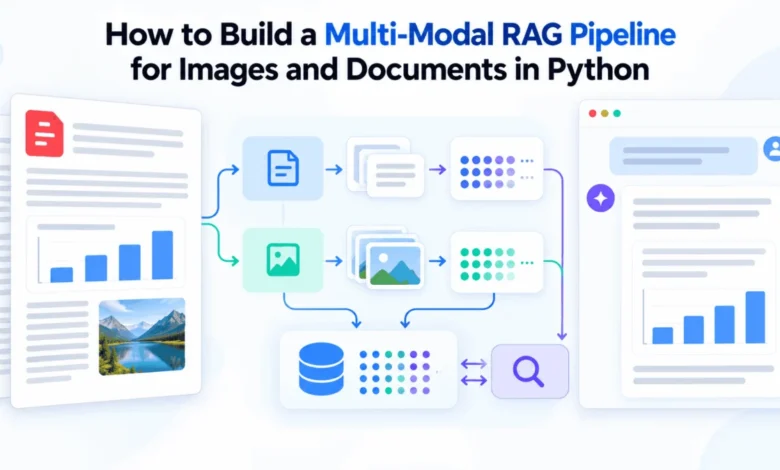
The construction of a modern, API-driven multi-modal RAG pipeline follows a rigorous four-stage chronological process, ensuring that data is parsed, enriched, indexed, and retrieved with high precision.
- Document Parsing (The Decomposition Phase): The process begins with the
unstructuredlibrary, which acts as the initial gatekeeper. Unlike basic text scrapers, this tool executes a deep scan of the PDF, distinguishing between textual headers, prose paragraphs, table structures, and image blocks. By assigning these elements distinct metadata, the system preserves the spatial relationship between the visual and textual data. - Multimodal Summarization (The Enrichment Phase): Once the images are isolated, they are not simply stored; they are translated into searchable text. Using a vision-capable model, each image is analyzed, and a detailed descriptive summary is generated. This ensures that the image is discoverable via semantic search, even though the "index" is technically text-based.
- Multi-Vector Storage (The Indexing Phase): The system implements a bifurcated storage architecture. A vector database—such as Chroma—maintains the embeddings of the text chunks and the image summaries, while a secondary document store holds the raw, original source material. These two are linked via unique universal identifiers (UUIDs).
- Retrieval and Reasoning (The Execution Phase): When a query is initiated, the system performs a cross-modal search. If the retriever identifies an image summary as the most relevant "match" for the query, the raw image file is retrieved from the document store and passed to the LLM, alongside any relevant text chunks, allowing for a comprehensive, evidence-based synthesis.
Technical Prerequisites and System Dependencies
Deploying this architecture requires a robust Python environment. Beyond standard libraries, the implementation depends on the poppler-utils system dependency, which is critical for the unstructured library to perform image extraction from binary PDF structures.
# Essential installation command for the development environment
pip install langchain langchain-openai unstructured[pdf] chromadb pillow
apt-get install -y poppler-utils
Developers must maintain strict environment hygiene, specifically by securing the OpenAI API key, which serves as the engine for both the image-to-text summarization and the final reasoning stage. It is recommended to implement a filtering layer during the parsing stage, specifically to discard irrelevant assets like logos or decorative icons, which can increase latency and API consumption without adding informational value.
Data-Driven Implications for Enterprise Adoption
The shift toward multi-modal RAG is not merely a technical trend; it is a response to the massive volume of unstructured data currently trapped in corporate silos. According to industry data, nearly 80% of enterprise information is stored in formats that are not easily searchable, such as PDFs, presentations, and scans.
By implementing this pipeline, organizations can achieve a higher degree of "grounding"—a metric describing how closely an AI’s answer aligns with the source document. Traditional RAG systems often suffer from "hallucinations" when the context is sparse or missing. A multi-modal approach reduces these errors by providing the model with visual evidence that acts as a ground-truth check. For instance, in a medical context, a system that can retrieve both the text description of a diagnosis and the accompanying X-ray or diagnostic chart provides a significantly more reliable response than one limited to text alone.
Official Perspectives and Future Directions
The integration of vision and language is currently the primary focus for researchers at institutions like LangChain and various AI research labs. The move away from local, hardware-intensive models toward API-driven architectures—such as the one described here—represents a pragmatic shift for businesses that require scalability without maintaining massive GPU clusters.
However, the field is moving quickly. While the current pipeline utilizes separate parsing and retrieval steps, emerging research into "end-to-end" vision-language models—such as ColPali—suggests a future where the document is embedded as a whole, bypassing the need for explicit parsing. This would eliminate the overhead of image extraction and summarization entirely, though it requires specialized hardware capabilities that remain out of reach for some standard enterprise environments today.
Conclusion and Practical Impact
The construction of a multi-modal RAG pipeline marks a significant maturation in how developers approach document intelligence. By effectively managing the extraction of visual elements, generating high-quality metadata, and utilizing a robust multi-vector storage system, developers can turn static, complex documents into dynamic, interactive knowledge bases.
As businesses continue to navigate the complexities of AI adoption, the ability to synthesize information from both prose and visual media will become a critical differentiator. Whether applied to financial auditing, scientific research, or technical documentation, this architectural pattern provides the necessary framework to ensure that no piece of information—whether written or drawn—remains hidden from the reasoning engine. As the ecosystem matures, the focus will likely shift toward optimizing retrieval precision through re-ranking and expanding the diversity of supported file types, ensuring that the next generation of AI systems is truly capable of seeing the full picture.