USD/JPY Surges to 40-Year Highs Amid Persistent Yen Weakness and Intervention Fears


The Japanese yen has plunged to its lowest level in four decades against the US dollar, reaching a staggering 163.81 on Friday, as market participants largely disregarded repeated official warnings of potential currency intervention. This sharp depreciation underscores a confluence of factors, including a broadly strengthening US dollar, underlying concerns about Japan’s fiscal policy, and escalating geopolitical tensions that threaten energy import costs. The yen’s precipitous decline is setting it on track for its worst weekly performance since May, signaling significant headwinds for the Japanese economy.
A Deepening Decline: Yen’s Relentless Slide
The unimpeded ascent of USD/JPY above the 163 mark represents a critical juncture, not only for currency traders but also for the broader Japanese economy, which is heavily reliant on imports. The current surge marks a significant acceleration in the yen’s depreciation, which has seen it shed approximately 0.8% since the beginning of the week alone. This rapid weakening has amplified anxieties among policymakers and economists alike, who fear the repercussions for inflation, corporate profitability, and overall economic stability.
The market’s apparent indifference to official pronouncements from Japanese authorities highlights a persistent disconnect. The Finance Minister’s assertion that the government stands ready to "take decisive action" to curb the yen’s slide has, thus far, failed to instill any significant buying pressure on the Japanese currency. This lack of market reaction suggests that traders are seeking more concrete evidence of intervention or are unconvinced of its potential effectiveness against the prevailing macroeconomic forces.
Furthermore, reports indicating that the Bank of Japan (BOJ) might be contemplating a faster pace of interest rate hikes than currently anticipated by markets have also proven insufficient to bolster the yen. This suggests that while the prospect of tighter monetary policy is generally seen as supportive for a currency, the current differential in interest rates between Japan and major economies like the United States remains a dominant factor. The Federal Reserve’s hawkish stance, driven by persistent inflation in the US, continues to provide a strong tailwind for the dollar, overshadowing any potential shifts in BOJ policy expectations.
Multifaceted Pressures on the Yen
Several interwoven factors are contributing to the sustained pressure on the Japanese yen, pushing it to historic lows:

1. The Dominance of the US Dollar: The US dollar has exhibited broad-based strength across major currency pairs. This is largely attributed to the Federal Reserve’s aggressive monetary tightening cycle, aimed at combating elevated inflation in the United States. Higher interest rates in the US attract foreign capital, increasing demand for the dollar and consequently pushing down the value of currencies like the yen, which operates under a significantly more accommodative monetary policy.
2. Fiscal Policy Uncertainty: Concerns surrounding Prime Minister Sanae Takaichi’s fiscal policies are casting a shadow over the yen. While specific details of her proposed fiscal measures may not be publicly disseminated, any perception of increased government spending or potential for fiscal expansion without corresponding revenue generation can fuel inflation expectations and erode confidence in the currency’s long-term stability. This, in turn, can lead to capital outflows.
3. Geopolitical Instability and Energy Prices: The escalating conflict between the United States and Iran has introduced a significant layer of uncertainty into global energy markets. Japan, as a nation with virtually no domestic energy resources, is acutely dependent on imported oil and gas. A surge in global oil prices, a likely consequence of heightened Middle East tensions, directly impacts Japan’s trade balance. Higher import costs translate into a weaker yen, as more yen are required to purchase the same amount of foreign currency-denominated energy. This vulnerability amplifies the negative impact of geopolitical shocks on the Japanese economy and its currency.
4. Inflationary Trends: While Japan has historically struggled with deflation, recent data shows a shift. Headline inflation in Japan reached a six-month high in June. This development, while potentially signaling a move towards the BOJ’s long-standing inflation target, also reinforces expectations of further interest rate hikes. However, as noted earlier, the market’s reaction to this has been muted, suggesting that the immediate impact of other stronger forces is dominating sentiment. The challenge for Japan is to manage this inflation without triggering excessive currency depreciation, which can further exacerbate price pressures through import costs.
A Timeline of Decline and Market Reaction
The current depreciation of the yen is not an overnight phenomenon but rather a culmination of trends observed over recent months and years. However, the pace of decline has intensified significantly.
- Early 2023: The yen began a gradual weakening trend as the US Federal Reserve continued its aggressive rate-hiking cycle, widening the interest rate differential with Japan.
- Mid-2023: Warnings of potential intervention began to surface as USD/JPY approached critical psychological levels. These warnings, however, had limited and short-lived impact.
- Late 2023 – Early 2024: The trend of yen depreciation accelerated, fueled by continued divergence in monetary policy and growing global economic uncertainties.
- Recent Weeks: The pace of the yen’s decline has become particularly acute. Friday’s surge to 163.81 represents a significant milestone, signaling a new chapter in the currency’s weakness. The 0.8% loss in the current week underscores the intensity of the selling pressure.
The market’s response, or lack thereof, to official statements is a critical aspect of this unfolding situation. The Japanese Ministry of Finance has a history of intervening in currency markets to stabilize the yen. However, such interventions are often costly and can be rendered ineffective if the underlying economic fundamentals driving the currency’s weakness remain unaddressed. The current market sentiment suggests that traders are waiting for either a direct and sustained intervention, a significant shift in US monetary policy, or a more robust domestic economic outlook to change their bearish stance on the yen.
Technical Analysis: Charting the Path Ahead
Technical indicators provide further insight into the potential trajectory of USD/JPY.
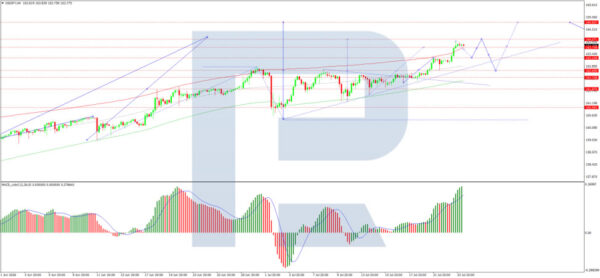
On the H4 (four-hour) chart, the market is exhibiting consolidation around the 163.70 level, with price action oscillating between 163.97 and 163.70. This suggests a brief pause before a potential continuation of the upward trend. Projections indicate a rise to 164.27, with the possibility of extending the move to 164.84. The Moving Average Convergence Divergence (MACD) indicator supports this bullish outlook, with its signal line positioned above the zero line and demonstrating a firm upward trajectory, signaling increasing upward momentum.
The H1 (one-hour) chart suggests a more nuanced short-term picture. After a completed downward move to the 163.50 level, there is a potential for a brief extension towards 163.30. However, this is anticipated to be followed by a significant move higher, targeting at least 164.30. A decisive break above this level could pave the way for a further advance towards 164.84. The Stochastic oscillator, with its signal line below 50 and pointing downwards towards the 20 level, indicates short-term selling pressure that could precede a reversal and upward move.
The technical outlook, therefore, points towards continued strength in USD/JPY in the near to medium term. However, the recurring mention of intervention levels in the analysis serves as a constant reminder of the potential for sudden shifts in market dynamics should authorities decide to act decisively.
Broader Implications and the Road Ahead
The sustained weakness of the yen has far-reaching implications for Japan and the global economy.
- Inflationary Pressures: A weaker yen makes imports more expensive, directly contributing to higher inflation for Japanese consumers and businesses. This can erode purchasing power and impact corporate profit margins, particularly for companies heavily reliant on imported raw materials.
- Trade Balance: While a weaker yen can make Japanese exports more competitive, its impact on the trade balance is complex. For an energy-importing nation like Japan, the negative impact of higher energy import costs can outweigh the benefits of increased export competitiveness, leading to a widening trade deficit.
- Monetary Policy Dilemma: The Bank of Japan faces a delicate balancing act. Tightening monetary policy too aggressively to support the yen could stifle nascent economic growth and risk triggering a recession. Conversely, maintaining an accommodative stance risks further yen depreciation and persistent inflation.
- Global Economic Stability: A rapidly depreciating major currency like the yen can create volatility in global financial markets and put pressure on other economies.
The coming days and weeks will be crucial in determining the future direction of USD/JPY. The market will be closely watching for any concrete signs of Japanese government intervention, shifts in the Federal Reserve’s monetary policy stance, and developments in geopolitical hotspots that could influence energy prices. The interplay of these factors will ultimately dictate whether the yen’s historic slide continues or if a turning point is finally reached. The risk of intervention remains the most significant wildcard, capable of injecting abrupt volatility into the market at any moment.
Related posts: