The discourse surrounding the Financial Independence (FI) movement has undergone a significant shift in recent years, moving away from strict frugality toward a nuanced understanding of psychological barriers to spending. As the movement matures, observers note that many long-term adherents, having spent decades optimizing for savings and capital accumulation, struggle to pivot toward spending when they reach the "FI" milestone. This phenomenon, often described as a "scarcity mindset" hardened into a permanent lifestyle, has prompted experts and community leaders to re-evaluate the transition from the accumulation phase to the distribution phase of wealth.
The Evolution of the Financial Independence Movement
The FI movement, which gained mainstream momentum following the 2008 global financial crisis, initially emphasized extreme frugality and the rapid acquisition of assets—primarily low-cost, broad-based stock index funds. By the mid-2010s, the movement’s central mantra, "live on less than you earn," became a defining ethos for a generation of workers seeking autonomy from traditional corporate structures.
However, a chronological review of the community’s development reveals a growing disconnect. While the early 2010s were characterized by the "how-to" mechanics of saving, the 2020s have seen an influx of reports regarding "accumulation paralysis." High-profile figures within the community, such as the creator of the Mad Fientist platform, have publicly documented the psychological difficulty of shifting from a mindset of indefinite deferral to one of intentional consumption. This transition is not merely a logistical challenge but a profound shift in identity for individuals whose sense of security has been tethered to an ever-growing net worth.
Redefining the Concept of Deprivation
Contrary to the common criticism that proponents of financial independence live lives of deprivation, many long-term practitioners argue that their habits represent a form of high-utility spending. When an individual directs 50% or more of their income toward assets, they are not technically "saving" in the traditional sense of hoarding cash; they are purchasing a product: financial autonomy.
Economic data suggests that for most households, the marginal utility of additional consumer goods—such as luxury vehicles or non-essential electronics—diminishes rapidly once basic security needs are met. According to the "Easterlin Paradox," while rising income correlates with happiness at lower levels, the correlation flattens significantly once individuals achieve a standard of living that removes the stressors of debt and employment insecurity. Consequently, the act of investing is increasingly framed as a proactive purchase of freedom, providing a psychological dividend that arguably exceeds the fleeting satisfaction of material luxury.
The Myth of the "New Model" Consumerism
A recent, anecdotal observation from the automotive industry highlights a growing societal friction between traditional consumerism and minimalism. During a typical dealership interaction, consumers increasingly report a desire for mechanical reliability over complex, integrated digital features. The push for "fewer features" in modern luxury goods reflects a broader trend: the rejection of "feature creep" in favor of utility and durability.
This preference for simplicity is not necessarily a rejection of wealth, but a refinement of value. While many in the FI community possess the liquidity to purchase luxury goods, they often opt for refurbished or older models. This behavior mirrors a shift in the luxury market, where "stealth wealth" and high-quality, long-lasting goods are prioritized over rapidly depreciating, tech-heavy consumer items.

The Concept of "Everything is Free"
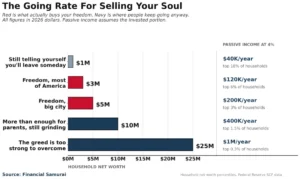
A central pillar of the advanced FI philosophy is the "everything is free" principle, popularized through discussions within the community. This theory posits that once an individual’s asset base reaches a certain scale, the returns on those investments exceed the cost of their annual living expenses. Mathematically, this is the point at which an individual’s net worth functions as a self-sustaining engine.
In this context, the withdrawal of funds to pay for expenses does not reduce the principal in a way that compromises future solvency. Instead, the principal continues to generate yield, rendering the expenditure "free" in terms of its impact on the individual’s long-term financial trajectory. This is analogous to the historical literary example of the "Richest Man in Babylon," where the protagonist’s purse remains perpetually full because the income from his assets outpaces his consumption. However, this model requires a discipline often compared to federal fiscal management; just as nations can face insolvency through debt, individuals can exhaust their capital if their withdrawal rate exceeds their investment yield.
The Role of the 4% Rule and Financial Thresholds
The 4% rule, derived from the Trinity Study, remains the industry standard for determining when an individual has reached "Enough." The study suggests that a portfolio consisting of a diversified mix of stocks and bonds can support a 4% annual withdrawal rate, adjusted for inflation, over a 30-year period with a high probability of success.
For the individual who has reached this milestone, the psychological transition is critical. Once the threshold of "Enough" is crossed, the necessity to continue aggressive accumulation diminishes. Experts argue that the "paralysis of saving" occurs when individuals fail to recognize that the primary goal—buying freedom—has already been achieved. At this juncture, the individual is no longer a saver in the traditional sense; they are a free agent with the capacity to choose between further accumulation, philanthropy, or the pursuit of work that is intrinsically rewarding rather than financially necessary.
Implications for the Future of Work
The rise of financial independence intersects with broader debates regarding the future of the labor market, particularly in the age of artificial intelligence. As automation threatens to displace traditional roles, the question of what constitutes "work" becomes paramount. Many who achieve financial independence do not actually retire in the traditional sense of total inactivity. Instead, they pivot toward vocations—woodworking, writing, community service, or independent research—that are driven by personal interest rather than economic survival.
This suggests that the human drive to be productive is not inherently tied to the requirement of earning a wage. The challenge for the future workforce will not necessarily be the survival of the species, but the search for meaningful activity in a post-automation world. For those who have secured their financial independence, this future is already a reality. They possess the autonomy to define their own labor, a luxury that has historically been reserved for the ultra-wealthy.
Conclusion: The Freedom of Choice
The ultimate goal of financial independence is not to stop spending, but to gain the ability to choose how, when, and where to deploy capital. Whether an individual chooses to continue living frugally out of habit, or decides to spend lavishly on experiences—or perhaps "give like a billionaire"—the objective remains the same: the removal of the obligation to work for survival.
The critics who view the movement as a cold, calculating, or deprivation-based lifestyle often fail to see the objective outcome: a population that is increasingly resilient, autonomous, and capable of directing its resources toward the endeavors it values most. As the movement continues to evolve, the focus will likely shift further toward the "distribution phase," teaching a new generation not just how to build the engine of wealth, but how to effectively utilize it to improve their quality of life and their impact on the world around them.
Related posts: