The Editors Room: Debunking the Myth of Financial Primacy and the Resilience of Physical Banking

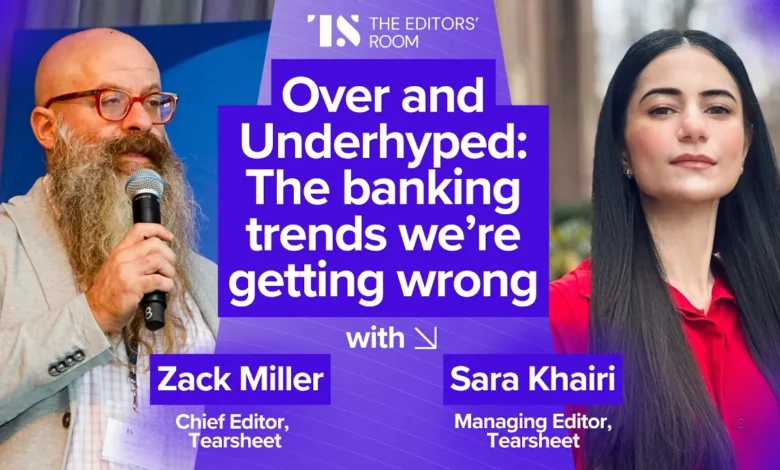
The financial services landscape is currently navigating a period of profound structural transformation, driven by rapid digitalization, the integration of artificial intelligence, and evolving consumer expectations. In the latest installment of Tearsheet’s podcast series, The Editors Room, Editor-in-Chief Zack Miller and Managing Editor Sara Khairi peel back the curtain on the industry’s most pressing debates. By moving beyond rehearsed talking points, the duo examines the disconnect between industry strategy and consumer reality, specifically challenging the obsession with "financial primacy" and the narrative of the dying bank branch.
The Evolution of Financial Relationships: A Historical Context
For decades, the "holy grail" of retail banking has been the primary financial relationship—a state where a single institution captures a customer’s entire economic life, from checking and savings accounts to mortgages, credit cards, and wealth management. This strategy was predicated on the belief that convenience and loyalty were inextricably linked to the number of products a customer held under one roof.
However, the 2010s marked a pivot point in this trajectory. The rise of fintech challengers—often categorized as the "unbundling of the bank"—introduced specialized providers that excelled at singular tasks. Companies like Wise for currency exchange, Robinhood for brokerage, and various neo-banks for low-fee checking forced consumers to view their financial stack as a modular construct rather than a monolithic dependency.
By 2020, as the industry entered a phase of "rebundling," many incumbents doubled down on the idea that they could win back customers by expanding their product suites. The prevailing logic was that if a bank could cross-sell enough services, it would become the default hub for the consumer’s financial life. Recent market data, however, suggests that this pursuit of primacy may be a legacy strategy ill-suited for the modern digital consumer.
Challenging the Primacy Paradigm
In the latest podcast discussion, Sara Khairi argues that the industry’s fixation on becoming a customer’s "everything" app is increasingly out of touch with behavioral reality. Customers are not looking for a single destination; they are looking for "best-in-class" solutions for specific jobs.
This behavioral shift has significant implications for product development. When institutions force-feed a wide array of secondary products to their customer base, they often face diminishing returns. Adding complexity to a banking app can alienate users who are primarily there for a specific, efficient interaction. Khairi notes that expansion into adjacent businesses—such as a lender launching a wealth management platform—can often dilute the brand identity and introduce unnecessary operational risks.
The alternative, according to the discussion, is "embeddedness." Rather than striving to own the entirety of the relationship, firms should focus on becoming indispensable within a specific niche. If a firm can solve a critical pain point—such as cross-border payments or high-stakes credit evaluation—better than any competitor, it secures a level of loyalty that a generic "full-service" account cannot match. This shift suggests that the future of banking belongs to firms that prioritize utility over breadth.
The Paradox of the Physical Branch
While digital-only banking was once heralded as the inevitable end of the physical branch, the data from the last three years tells a different story. In a surprising reversal of the trend that saw thousands of locations shuttered between 2010 and 2020, the U.S. banking sector has begun a period of physical consolidation and, in some cases, expansion.
According to recent reports, the net number of U.S. bank branches increased for the first time in 17 years during the 2023-2024 period. Approximately 120 net new branches were added over three consecutive quarters, a trend that contradicts the narrative of total digital transition. Zack Miller highlights that this is not a return to the past, but an evolution of the branch’s function.
Data from the 2025 Accenture Global Banking Consumer Study indicates that 64% of banking consumers continue to rely on physical branches for conflict resolution. This statistic is telling: digital channels are highly efficient for routine tasks like balance checks, fund transfers, and mobile deposits, but they remain insufficient for high-friction, emotionally charged, or complex financial events. Whether it involves resolving a fraudulent charge, navigating a sophisticated mortgage application, or seeking guidance on estate planning, the human element remains a critical component of financial trust.
Chronology of Branch Trends
- 2008–2019: The "Branch Apocalypse." Following the financial crisis, major banks engaged in massive cost-cutting measures, closing thousands of branches as mobile adoption skyrocketed.
- 2020–2021: The Pandemic Catalyst. COVID-19 forced a total reliance on digital tools, leading many to believe that physical banking was effectively obsolete.
- 2022–2023: The Stabilization Period. Banks began to realize that digital-only strategies led to higher customer churn in high-value segments.
- 2024–2025: The Re-investment Phase. Major institutions, including Bank of America, PNC, and Truist, announced significant capital expenditure programs to modernize and expand their branch footprints in high-growth demographic corridors.
Strategic Implications for Financial Institutions
The dual trends discussed in the podcast—the rejection of the "one-size-fits-all" primacy model and the resurgence of the branch—point toward a more nuanced future for the industry.
For large-scale financial institutions, the implication is that digital and physical channels must be treated as a unified, complementary ecosystem. Bank of America’s success serves as a primary case study: by reaching over 50 million active digital users while simultaneously investing in 150 new financial centers, they have demonstrated that digital growth does not require the sacrifice of the physical presence.
Furthermore, the integration of AI will likely accelerate these trends rather than replace them. As AI handles routine queries, chatbots, and basic administrative tasks, the role of the human advisor in a branch setting will shift toward higher-value consulting. This suggests that the branch of the future will be less of a transactional center and more of a "trust hub."
The Future of Indispensability
The conversation between Miller and Khairi underscores a fundamental truth: the industry is moving away from the era of "owning" the customer toward the era of "serving" the customer at their point of need.
Institutions that attempt to be everything to everyone run the risk of becoming essential to no one. Conversely, firms that identify where they are truly indispensable—whether through superior technology, deep data insights, or a well-timed human touch—will be the ones that thrive in an increasingly fragmented market.
As banking continues to automate, the moments that require genuine human interaction will arguably become more valuable. The ability for an institution to pivot from the "primary relationship" mandate to a "value-driven" strategy will be the defining challenge for leadership in the coming years. By leaning into the strengths of both digital efficiency and physical empathy, banks can build a sustainable model that acknowledges the consumer’s desire for modular, best-in-class financial services while maintaining the security and trust that only a physical presence can provide.
Ultimately, the lesson for the financial sector is clear: the race for primacy is a vanity metric. The real race is for relevance, and in a digital-first world, that requires knowing exactly when to step away from the screen and into the branch.
Related posts: