The Truths About Index Fund Investing and Strategic Wealth Transfer for High-Income Professionals

The evolution of modern portfolio theory has increasingly favored passive management, a trend underscored by recent data from Vanguard demonstrating that the characteristics of an investment—rather than the "active" or "index" label—dictate long-term success. Financial experts, including Dr. Jim Dahle of The White Coat Investor, have recently highlighted a seminal Vanguard white paper that dismantles common myths surrounding index funds while reinforcing the structural advantages of low-cost, diversified investing. This analysis comes at a pivotal time when passive assets in U.S. equity funds have officially surpassed active assets, marking a fundamental shift in how both institutional and retail investors approach capital markets.
The core efficacy of index fund investing is rooted in three primary pillars: broad diversification, minimal cost, and predictable relative performance. By holding a total market index, an investor effectively eliminates "idiosyncratic risk"—the risk associated with the failure of a single company—leaving only the systematic risk of the market itself. Furthermore, the "arithmetic of active management" suggests that because the market as a whole is a zero-sum game before costs, it must be a negative-sum game after costs. Active managers, who must pay for research, high-frequency trading, and significant overhead, often find their gross outperformance neutralized by these expenses. In contrast, index funds operate with ultra-low turnover, which not only preserves capital but also maximizes tax efficiency by minimizing capital gains distributions.
Debunking Market Distortions and Price Discovery Concerns
Critics of the indexing movement often argue that the rise of passive investing distorts market prices or creates "bubble" conditions in large-cap stocks. However, empirical data suggests these concerns are largely unfounded. While index funds own a significant portion of the total market capitalization, they account for approximately only 1% of daily trading volume. Price discovery—the process by which the market determines the fair value of a security—is driven by the 99% of trading activity conducted by active participants, such as hedge funds, institutional traders, and market makers.

Furthermore, there is no statistically significant evidence linking the growth of index funds to increased market volatility. Volatility is generally driven by macroeconomic factors, interest rate shifts, and geopolitical events rather than the vehicle through which investors hold their shares. The Vanguard research clarifies that index funds are "price takers" rather than "price makers," meaning they reflect the aggregate wisdom of the active market rather than forcing prices upward through blind buying. For the long-term investor, the simplicity and transparency of this model provide a psychological "behavioral gap" advantage, making it easier to remain disciplined during market downturns compared to those attempting to evaluate the shifting strategies of active managers.
Navigating Generational Wealth: The Mechanics of Inheritance
The complexities of wealth management extend beyond accumulation into the realm of distribution and estate planning. A common dilemma facing high-net-worth families is the optimal timing and structure of an inheritance. In a recent case study involving a retired emergency physician with an estate valued at approximately $5 million, the question arose regarding whether assets should be passed to the next generation (the children) or "skipped" directly to the grandchildren.
From a federal tax perspective, the current landscape is relatively permissive for estates of this size. As of 2024, the federal estate tax exemption stands at $13.61 million per individual (nearly $27.22 million for a married couple). Consequently, a $5 million estate is unlikely to trigger federal estate taxes regardless of whether the beneficiaries are children or grandchildren. A critical component of this transfer is the "step-up in basis" rule. When an heir inherits an appreciated asset, such as real estate or stocks, the "cost basis" is reset to the fair market value at the time of the original owner’s death. This effectively wipes out the capital gains tax liability on any appreciation that occurred during the decedent’s lifetime.
While skipping a generation can provide the younger generation with capital during their formative years (such as for education or home purchases), it does not offer a significant additional tax advantage over a standard inheritance if the estate is well below the exemption limit. Furthermore, legal experts emphasize the rigid role of the executor. An executor is legally bound by fiduciary duty to execute the will exactly as written. They cannot unilaterally "circumvent" the will to redirect assets to grandchildren, even with the consent of other heirs, without potentially facing legal challenges or violating probate laws. If a change in distribution is desired, the estate plan must be formally amended by the grantors while they are still living and of sound mind.

Advanced Tax Optimization: S Corp Withholding vs. Estimated Payments
For high-earning professionals operating as 1099 independent contractors through an S Corporation, tax timing represents a significant opportunity for cash flow optimization. The Internal Revenue Service (IRS) generally requires taxpayers to pay taxes as income is earned through quarterly estimated payments. Failure to do so can result in underpayment penalties. However, a specific provision in the tax code treats W-2 withholdings as having been paid evenly throughout the year, regardless of when the withholding actually occurs.
This creates a legitimate strategy where a business owner can accumulate cash in a high-yield savings account throughout the year, earning interest, and then perform a large "catch-up" withholding on a December salary payment. As long as the total withholding meets the "Safe Harbor" requirements—typically 100% of the previous year’s tax liability or 90% of the current year’s liability—the taxpayer can avoid underpayment penalties for the earlier quarters.

While this strategy is legal, it requires precise calculation and discipline. CPAs often express skepticism because the margin for error is slim; if the December withholding is insufficient to meet the safe harbor threshold, the taxpayer will owe interest and penalties on the underpayment from the first three quarters. For many, the modest interest earned in a savings account may not outweigh the administrative complexity and risk of a miscalculation. However, for those with significant tax bills, the interest on several hundred thousand dollars held for nine months can be substantial.
Debt Forgiveness and the Path to Positive Net Worth
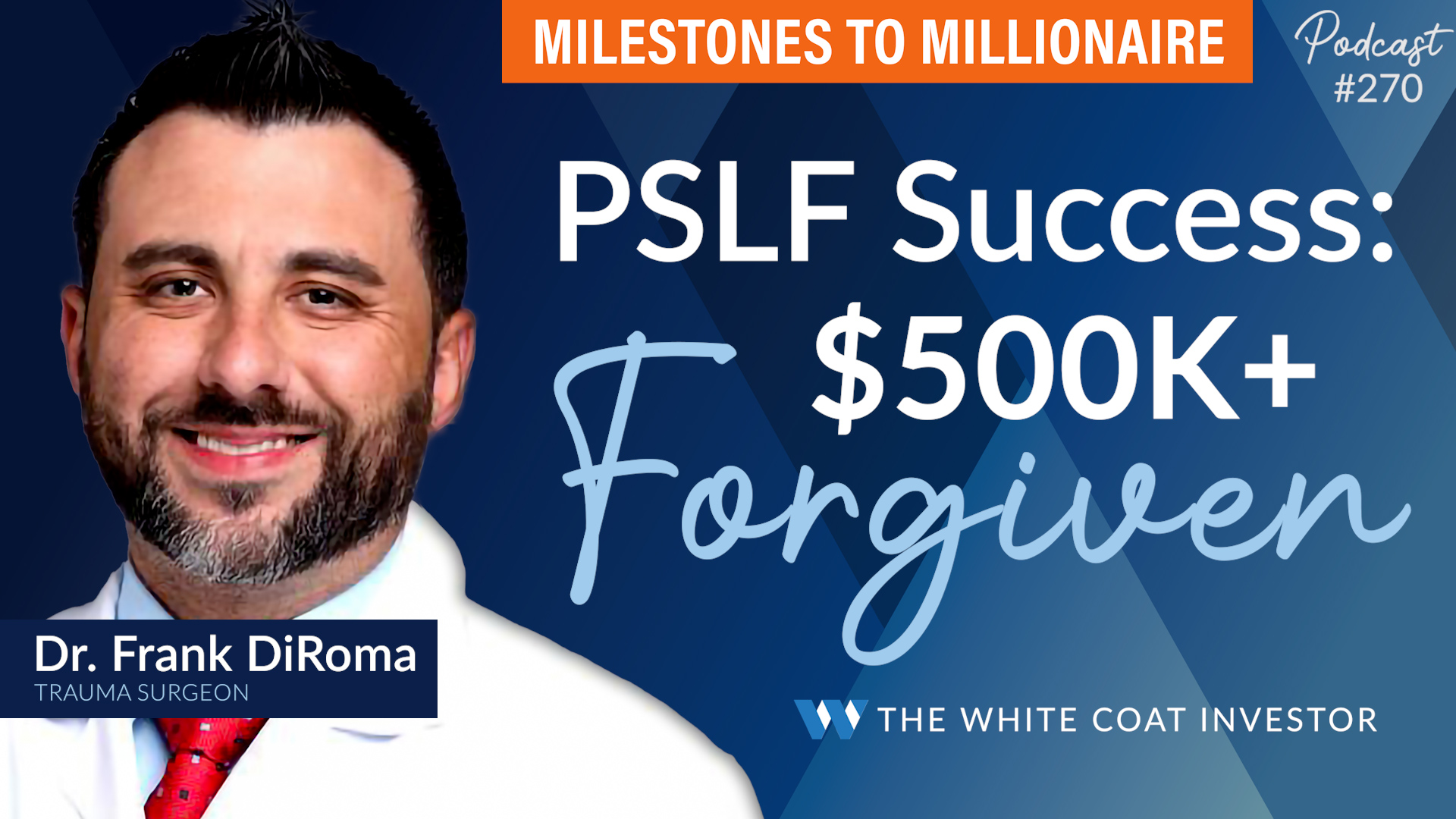
The financial journey for many medical professionals is defined by a dramatic "U-shaped" net worth curve, beginning with significant student loan debt. Recent success stories involving the Public Service Loan Forgiveness (PSLF) program highlight the transformative impact of federal debt relief. In one documented case, a physician saw over $500,000 in student debt forgiven after completing ten years of service in qualifying non-profit or governmental institutions.

The transition from a negative net worth to a "milestone millionaire" status often hinges on this pivot point. Once the burden of debt is removed, the "forced savings" that previously went toward interest and principal can be redirected into the low-cost index funds discussed previously. This shift marks the transition from defensive financial management (debt reduction) to offensive wealth building (asset accumulation).
Philanthropy and the Strategic Use of Donor-Advised Funds
As wealth grows, many professionals turn toward philanthropy, seeking ways to maximize the impact of their giving while optimizing their tax profile. The Donor-Advised Fund (DAF) has emerged as a leading vehicle for this purpose. A DAF allows a donor to make a charitable contribution, receive an immediate tax deduction, and then recommend grants from the fund to various charities over time.

The primary advantage of a DAF is the ability to donate "long-term appreciated assets," such as stocks that have been held for more than a year. By donating the shares directly to the DAF, the donor avoids paying capital gains tax on the appreciation and receives a tax deduction for the full fair market value of the shares. This is significantly more efficient than selling the shares, paying the tax, and then donating the remaining cash.
Furthermore, DAFs allow for "tax grouping" or "bunching." In years of exceptionally high income, a donor can contribute several years’ worth of charitable giving into a DAF to surpass the standard deduction threshold, then distribute those funds to charities gradually over the following years. This decoupling of the tax deduction from the actual grant-making provides a level of strategic flexibility that traditional direct giving cannot match.
Broader Implications for Financial Planning
The synthesis of these strategies—passive indexing, thoughtful estate planning, aggressive tax optimization, and efficient philanthropy—represents a holistic approach to modern wealth management. The overarching theme is the move away from speculative, high-cost activities toward evidence-based, structural advantages.
The growth of index funds and the refinement of tax-advantaged giving vehicles like DAFs suggest a maturing financial landscape where the "average" investor can achieve "above-average" results simply by minimizing leakage to taxes and fees. As the Vanguard data confirms, the most successful long-term outcomes are not driven by the ability to predict market movements, but by the ability to control the variables that are actually controllable: costs, taxes, and personal discipline. For the high-income professional, mastering these nuances is the most reliable path to achieving and maintaining financial independence.