UK Financial Conduct Authority Escalates Crackdown on Illegal Peer-to-Peer Crypto Trading with Raids Across London

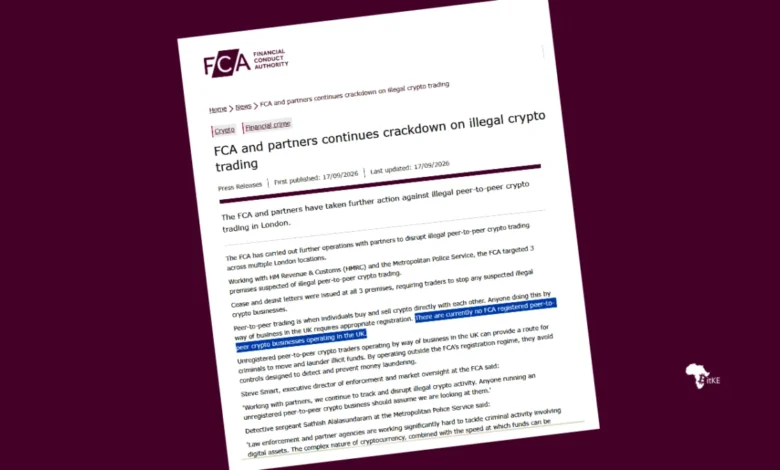
The regulatory landscape for digital assets in the United Kingdom experienced a significant shift as the Financial Conduct Authority (FCA), operating in a coordinated effort with HM Revenue & Customs (HMRC) and the Metropolitan Police Service, executed a series of targeted raids across three London premises. Conducted on September 10, 2026, the operation marked a decisive escalation in the British government’s campaign against unregistered and illicit peer-to-peer (P2P) cryptocurrency operations. By issuing immediate cease-and-desist letters at all targeted locations, authorities signalled a zero-tolerance policy toward individuals and entities facilitating digital asset transactions outside the bounds of established regulatory frameworks.
The operation underscores a growing anxiety among financial watchdogs regarding the vulnerabilities inherent in direct, decentralized cryptocurrency exchanges. P2P trading platforms and informal networks allow buyers and sellers to transact directly with one another, bypassing traditional institutional intermediaries such as banks or centralized brokerages. While this model appeals to proponents of financial decentralization, it presents acute challenges for law enforcement. Because these operations frequently lack robust Know Your Customer (KYC) and Anti-Money Laundering (AML) protocols, they can inadvertently or intentionally serve as conduits for illicit financial flows, allowing bad actors to launder the proceeds of serious crimes across international borders with unprecedented speed and anonymity.
Chronology of Regulatory Escalation and Enforcement
The September raids do not represent an isolated incident, but rather the continuation of an aggressive enforcement strategy that has gained momentum over the past several years. In April 2026, the FCA made headlines by executing the United Kingdom’s first major crackdown on illegal P2P crypto trading networks. Evidence gathered during that spring operation has since proven instrumental, feeding into ongoing criminal investigations and laying the groundwork for the subsequent autumn raids. Legal experts note that the sequence of events over the span of just six months demonstrates a profound structural shift within the regulatory agency—moving away from passive warnings and guidance letters toward active, physical disruption of unauthorized market participants.
Caroline Black, a legal consultant at Gherson Solicitors LLP, highlighted the gravity of this strategic pivot. The second coordinated enforcement operation in six months confirms that the FCA has transitioned into an active disruption phase regarding unregistered P2P crypto businesses. For any operator conducting digital asset business without proper authorization, criminal liability is no longer a distant theoretical concern, but an immediate, live risk.
Beyond P2P networks, the FCA’s broader enforcement ledger includes the successful prosecution of operators behind unlawful cryptocurrency ATM networks, as well as operational support for the arrest of individuals suspected of running underground, unauthorized crypto exchanges. These actions are executed primarily under the authority of Britain’s Money Laundering, Terrorist Financing, and Transfer of Funds Regulations 2017, which mandate strict registration requirements for any business providing exchange or custodian services involving digital assets.
The Regulatory Vacuum and the Path to October 2027
To fully understand the context of these enforcement actions, one must examine the unique structural state of British financial regulation. Presently, cryptocurrency remains largely categorized as a high-risk, speculative investment class. Aside from targeted mandates concerning anti-money laundering compliance and strict financial promotion rules—which govern how crypto firms market their products to retail consumers—the broader domestic cryptoasset regulatory regime is still under construction.

A comprehensive, tailor-made regulatory framework for the UK crypto sector is scheduled to take full legal effect in October 2027. Until that comprehensive regime officially commences, the existing financial services legislation and anti-money laundering statutes serve as the primary legal shields protecting the UK financial system from illicit actors. Within this interim regulatory vacuum, the FCA has maintained a hardline stance: any entity conducting crypto-related business by way of trade within the UK must be registered. Crucially, as of the latest regulatory disclosures, there are currently zero registered peer-to-peer crypto businesses legally permitted to operate within the United Kingdom. This means that any entity currently offering P2P crypto services on a commercial basis is, by definition, operating outside the law.
Official Responses and Law Enforcement Perspectives
The severity of the crackdown has been echoed by senior leadership across the participating enforcement agencies, who point to the evolving nature of financial crime as a primary catalyst for cross-agency collaboration.
Steve Smart, Executive Director of Enforcement and Market Oversight at the FCA, emphasized the proactive nature of the regulator’s surveillance operations. Working alongside domestic partners, the FCA continues to systematically track and disrupt illegal crypto activity across the country. Smart issued a direct warning to unauthorized market participants, stating that anyone running an unregistered peer-to-peer crypto business should operate under the assumption that regulatory authorities are actively investigating them.
Echoing these sentiments, Detective Sergeant Sathish Alalasundaram of the Metropolitan Police Service shed light on the logistical and tactical difficulties inherent in investigating decentralized financial crimes. Law enforcement agencies are dedicating significant resources to tackle criminal activity involving digital assets, Alalasundaram explained. However, the inherently complex nature of cryptocurrency technology, coupled with the extraordinary speed at which funds can be transferred across global jurisdictions, creates formidable investigative hurdles. As criminal networks continually adapt their methodologies to evade detection, the Metropolitan Police continue to evolve their investigative capabilities and tactical disruption strategies to ensure that those who break the law are brought to justice.
Implications for the Broader Digital Asset Industry
The relentless pursuit of unregistered operators carries profound implications for the wider cryptocurrency ecosystem in the United Kingdom. As the window narrows ahead of the implementation of the comprehensive 2027 regulatory regime, compliance costs and legal risks are soaring. Legitimate fintech startups and digital asset enterprises are increasingly forced to navigate a rigorous vetting process to secure FCA registration—a process historically characterized by high rejection rates and stringent data requirements.
For informal traders, casual enthusiasts, and decentralized finance (DeFi) participants operating on a commercial scale, the recent raids serve as a stark reminder that physical location no longer offers immunity from digital-era regulation. By targeting London premises directly, the FCA and the Metropolitan Police have demonstrated that virtual assets ultimately intersect with physical infrastructure, offices, and individuals within British jurisdiction.
As regulatory oversight tightens and international cooperation among financial intelligence units deepens, the United Kingdom is positioning itself as one of the most proactive jurisdictions globally in policing the perimeter of digital finance. For the underground crypto economy, the message from regulators is unequivocal: operation without registration will be met with swift, coordinated, and severe legal consequences.