Speculative Decoding Explained: How This Breakthrough Technique Delivers 3x Faster LLM Inference

The deployment of large language models (LLMs) has reached a critical inflection point where the demand for real-time responsiveness frequently outstrips the physical capabilities of current hardware architectures. As organizations increasingly integrate AI into latency-sensitive environments—such as interactive coding assistants, real-time customer support agents, and complex diagnostic tools—the inherent "autoregressive" nature of transformer-based models has emerged as a primary technical bottleneck. Speculative decoding, an innovative inference strategy, has surfaced as a leading solution to this problem, enabling significant speed increases by fundamentally rethinking the relationship between compute cycles and memory bandwidth.
The Autoregressive Bottleneck: A Structural Limitation
To understand the significance of speculative decoding, one must first examine the mechanism by which models like GPT-4 or Llama-3 generate text. These models operate through an autoregressive process, which requires the system to generate output tokens one at a time. In this sequence, the model must read the entire context of the prompt and all previously generated tokens, perform a forward pass through its multi-billion parameter neural network, and output a single new token.
This workflow is fundamentally restricted by the architecture of modern graphics processing units (GPUs). While GPUs are theoretically capable of performing trillions of operations per second, they are often "memory-bandwidth bound" during inference. Because the model’s weights must be loaded from slow VRAM into high-speed caches for every single token generated, the processor spends a disproportionate amount of time waiting for data to arrive. The compute units remain idle for the vast majority of the generation lifecycle. Consequently, adding more computational power does not linearly improve latency; the system remains tethered to the physical speed of the memory bus.
The Chronology of Speculative Decoding
The concept of speculative decoding gained prominence in early 2023 when researchers from Google and DeepMind, alongside independent academic teams, published foundational papers (notably "Fast Inference from Transformers via Speculative Decoding") demonstrating that it was possible to bypass the sequential nature of inference without sacrificing model integrity.
Prior to this, the industry largely focused on quantization—reducing the precision of model weights to save memory—or pruning, which involves removing redundant parameters. While effective, these methods often result in a measurable drop in output accuracy. Speculative decoding marked a shift toward algorithmic optimization rather than model modification. By late 2023 and throughout 2024, major inference engines such as vLLM and llama.cpp began integrating the technique as a standard feature, signaling its transition from a niche research interest to a production-ready industry standard.
The Mechanism: Parallel Verification of Candidate Tokens
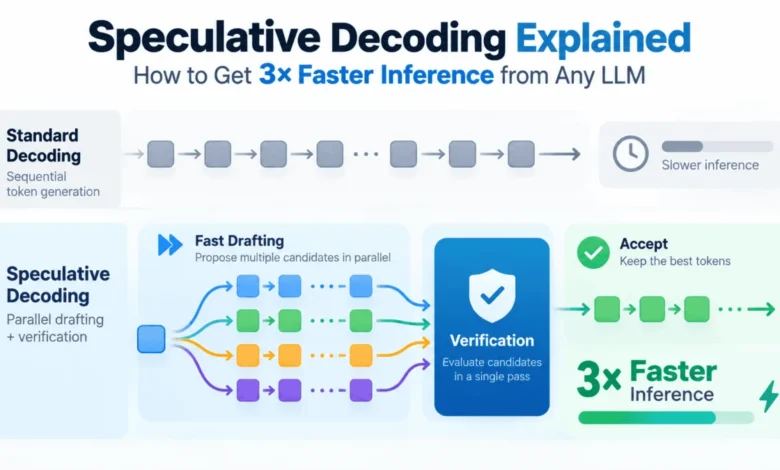
Speculative decoding operates on a two-tier architectural strategy: the draft model and the target model. The process functions as follows:
- The Drafting Phase: A significantly smaller, more agile "draft" model—which might possess only a fraction of the parameters of the main model—autonomously generates a sequence of short candidate tokens (typically four to eight). Because the draft model is lightweight, this phase is completed rapidly.
- The Verification Phase: The large, high-precision "target" model then processes these candidates in a single, parallelized batch. Instead of iterating through the sequence one by one, the target model evaluates the entire "draft" against its own internal probability distributions.
- The Acceptance Criterion: Using statistical methods, the target model compares its predicted probabilities with those of the draft model. If the target model’s confidence in the draft sequence meets a predefined threshold, the entire sequence is accepted. If a specific token deviates from the target model’s internal logic, that token is rejected and replaced, and the sequence is corrected.
Crucially, this method provides a mathematical guarantee of consistency. Because the final output is adjusted by the target model’s own distribution, the result is identical to what the model would have produced on its own. There is no "approximation" or loss of quality; the output remains statistically indistinguishable from the target model’s native generation.
Supporting Data and Efficiency Metrics
The efficacy of speculative decoding is measured primarily by its "acceptance rate." If a draft model is well-aligned with the target model, it may achieve acceptance rates of 70% to 80% on standard tasks. In such scenarios, the inference speed can increase by a factor of 2x to 3x.
Data from recent implementations suggest that the gains are most pronounced in tasks with high lexical predictability. For instance, in technical writing or code completion, where specific keywords and syntax patterns repeat, the draft model can accurately predict larger chunks of the output. Conversely, in highly creative or stochastic tasks, the acceptance rate may dip, resulting in a marginal performance penalty due to the overhead of running the draft model. Industry benchmarks indicate that when the draft model is properly tuned, the "worst-case scenario" still results in a speed profile roughly equivalent to standard decoding, making it a low-risk, high-reward optimization.
Evolution: Medusa, Eagle, and Prompt Lookup
As the field has matured, practitioners have moved beyond the requirement for a secondary "draft" model, which adds complexity to system maintenance. Modern variations now include:
- Medusa: This approach replaces the external draft model with multiple auxiliary "heads" attached to the target model. These heads predict multiple future tokens simultaneously, allowing the model to draft its own sequences without needing an entirely separate neural network.
- Eagle: By utilizing the target model’s hidden states, Eagle generates more accurate draft sequences than traditional methods, particularly for complex, domain-specific text.
- Prompt Lookup Decoding: This is perhaps the most efficient iteration for specific use cases. It involves scanning the user’s prompt for recurring phrases. When the model reaches a point where it can reuse a phrase found earlier in the input, it simply "copies" it. This requires zero additional parameters, making it highly effective for document summarization or editing tasks.
Broader Implications and Future Outlook
The shift toward speculative decoding represents a maturation of AI infrastructure. For years, the industry was obsessed with "more parameters," operating under the assumption that bigger models always equaled better performance. While that remains true for model capability, the bottleneck for deployment has shifted to inference throughput.
The implications for enterprise adoption are significant. By doubling or tripling throughput, companies can reduce the number of expensive H100 GPU clusters required to maintain a specific level of service. This shift directly impacts the Total Cost of Ownership (TCO) for AI products.
However, there is a caveat: speculative decoding is not a panacea for all scenarios. In high-density environments where a single GPU is batch-processing hundreds of user requests simultaneously, the computational overhead of the draft model can occasionally compete for resources with other requests. Engineers are therefore advised to treat speculative decoding as a configuration parameter to be toggled based on traffic volume and the specific nature of the application.
As we look toward the future, the integration of these techniques into the base layer of inference engines suggests that the "one-token-at-a-time" era of LLMs is coming to a close. Future models may be designed from the ground up to support parallel speculative execution, potentially unlocking speeds that make AI agents indistinguishable from real-time human interaction. Through this strategic fusion of statistical verification and hardware-aware engineering, speculative decoding stands as a cornerstone of the next generation of scalable, high-performance artificial intelligence.