USD/JPY Technical Outlook: Navigating Near-Term Consolidation Amid Long-Term Bullish Macro Trends

The USD/JPY currency pair continues to command significant attention across global foreign exchange markets as it navigates a complex technical landscape. Following a slight downward drift in recent sessions, the exchange rate maintains a secure position well above critical near-term support levels. While short-term momentum displays a neutral bias with a slight tilt toward a continuation of the broader upward trajectory, currency strategists and market participants are closely monitoring pivotal resistance barriers. These price boundaries will likely dictate whether the pair tests multi-year highs or succumbs to a deeper corrective phase before the resumption of its long-standing multi-decade secular trend.
Main Facts and Current Price Action
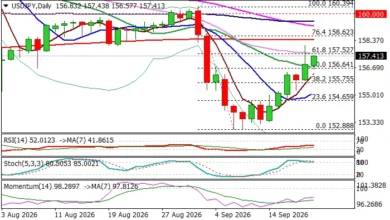
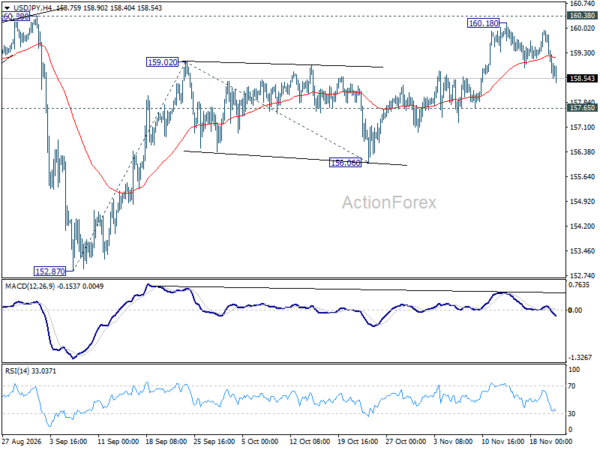
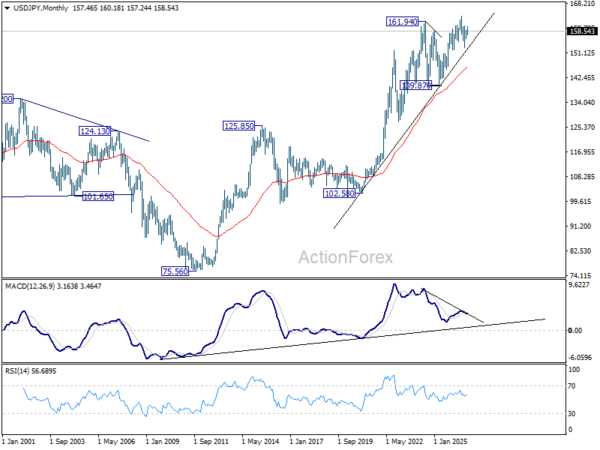
At the heart of the current technical setup, the USD/JPY pair hovers safely above the vital 157.65 support level, despite slipping lower over the preceding week of trading. Initial bias for the trading week remains neutral, though technical indicators continue to favor an eventual push higher.
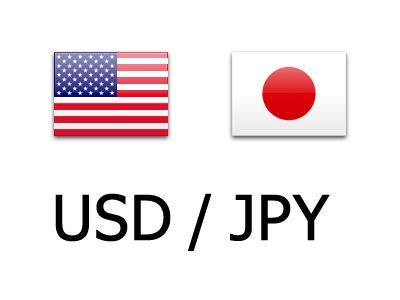
Should bullish momentum reclaim control and drive a firm, decisive break above the immediate resistance hurdle at 160.38, the path will open toward an extended upside target. Specifically, calculations using Fibonacci projections from the 152.87-to-159.02 swing, measured off the 156.06 correction low, point directly to a 100% projection target at 162.21.
Conversely, failure to maintain upward pressure and a subsequent breakdown beneath the 157.65 support floor would invalidate the immediate bullish thesis. Such a move is projected to trigger a deeper retreat toward the stronger secondary support foundation situated at 156.06.
Chronology of the Correction and Medium-Term Wave Structure
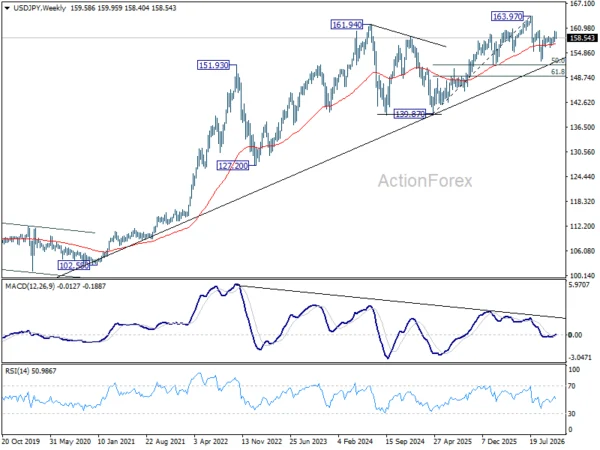
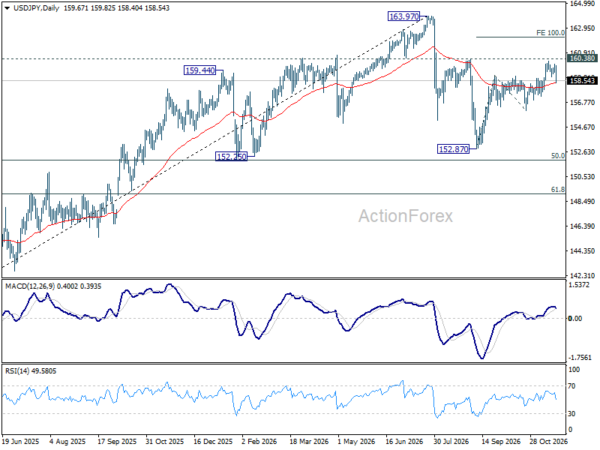
To understand the current positioning of the USD/JPY pair, analysts look back at the broader corrective pattern that has defined price action since the market peaked at the 163.97 milestone.
The structural development of the currency pair suggests that the initial leg of this corrective pattern effectively concluded when prices traced out a three-wave downward movement culminating at the 152.87 low. Following this trough, buying interest reemerged, laying the groundwork for the ongoing recovery.
Market technicians anticipate that further near-term rallies will likely retest the major peak of 163.97. However, historical trading behavior and standard Elliott Wave principles suggest that strong selling pressure and technical resistance will materialize upon this initial retest. Consequently, upside movement is expected to face heavy capping on the first attempt.
Furthermore, the broader corrective architecture is not yet deemed complete. Once the retest of the upper boundaries occurs, analysts project that the correction will extend through at least one more falling leg. Only after this final corrective sequence finishes playing out is the market anticipated to resume its underlying, long-term secular uptrend.
Macroeconomic Background and Historical Context
The sustained high valuation levels of the USD/JPY pair are deeply rooted in macroeconomic divergences between the United States and Japan, a dynamic that has persisted for over a decade.
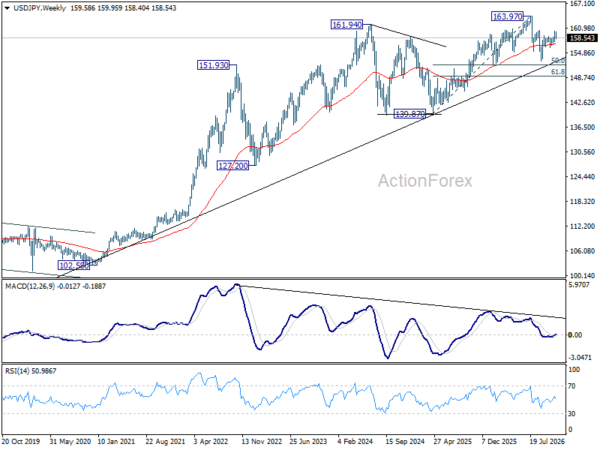
The long-term multi-year trend for the pair traces its origins back to the historic low of 75.56 recorded in 2011. In the years following that generational trough, aggressive monetary easing policies enacted by the Bank of Japan (BoJ)—characterized by quantitative easing and negative interest rate policies—contrasted sharply with the monetary tightening cycles pursued by the United States Federal Reserve. This stark divergence in interest rate differentials widened the yield gap between US Treasuries and Japanese Government Bonds (JGBs), systematically weakening the Japanese Yen against the US Dollar.
Even as the Bank of Japan has recently begun to normalize its monetary policy stance—abandoning negative interest rates and slowly adjusting its yield curve control framework—the interest rate gap remains substantial. This persistent fundamental backdrop underpins the broader long-term bullish outlook for the currency pair.
Long-Term Outlook and Critical Safety Thresholds
Despite the potential for intermediate corrections and periodic bouts of sharp volatility, the overarching macro perspective for USD/JPY remains structurally bullish.
Technical frameworks indicate that the long-term bullish outlook will remain intact and well-supported as long as the crucial structural safety threshold at 139.87 holds firm. Even in the event of an unexpected, severe macroeconomic shock or a protracted pullback that tests lower boundaries, a breach of this 139.87 level would be required to fundamentally alter the multi-year technical trend.
As a result, market consensus maintains that the secular uptrend originating from the 2011 low of 75.56 is merely pausing within a healthy consolidation phase. Once the current correction stemming from the 163.97 peak runs its course, the underlying structural forces favoring the US Dollar against the Japanese Yen are expected to reassert themselves.
Broader Economic Implications and Market Impact
The trajectory of the USD/JPY exchange rate carries profound implications for global trade, corporate earnings, and macroeconomic policy coordination.
For Japan, a persistently weak currency presents a double-edged sword. On one hand, it significantly bolsters the international competitiveness of Japanese multinational exporters, inflating overseas profits when repatriated back into Yen. On the other hand, it exacerbates domestic cost-of-living pressures by driving up the import prices of essential commodities, energy, and foodstuffs. This dynamic has frequently placed pressure on Japanese fiscal and monetary authorities to verbally intervene or contemplate direct market intervention to curb excessive and disorderly currency depreciation.
For the United States, a strong US Dollar influences domestic manufacturing competitiveness and trade balances, while also serving as a barometer of global risk sentiment and capital flows. As institutional investors, corporations, and retail forex traders navigate these cross-currents, technical reference points such as the 157.65 support, 160.38 resistance, and the overarching 139.87 macro floor will remain indispensable tools for risk management and strategic positioning in the foreign exchange market.