A critical security vulnerability identified as CVE-2026-51990 in Tencent’s widely deployed Sogou Input Method for Windows has been actively exploited by a China-aligned espionage group known as UNC3569. This sophisticated campaign leverages a one-click remote code execution (RCE) flaw to silently install the GrayRabbit backdoor on target systems. The discovery, brought to light by researchers at Gen Threat Labs, highlights the severe risks posed by integrating outdated browser components into mainstream productivity software.
Sogou Input Method, which boasts hundreds of millions of installations, serves as a primary tool for Chinese character input on Windows devices. However, its architectural reliance on a legacy version of the Chromium engine—specifically version 80—has created a significant attack surface. By chaining three distinct weaknesses, attackers can bypass standard Windows security protocols to gain persistent, high-level access to a victim’s machine.
The Anatomy of the Attack Chain
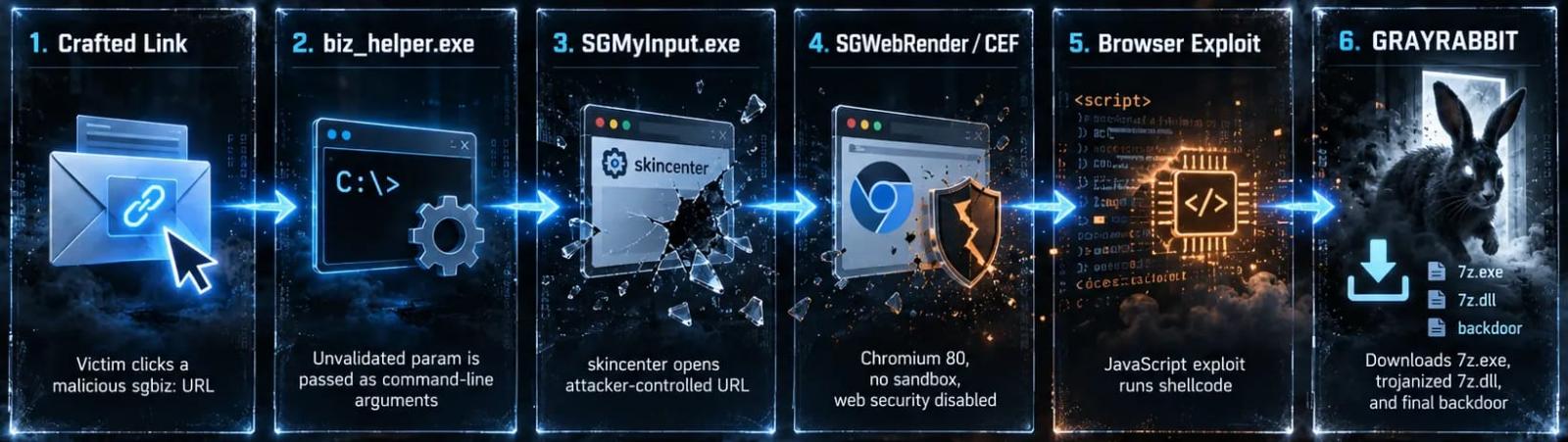
The exploitation process is characterized by its deceptive simplicity. It begins when an unsuspecting user clicks on a malicious, crafted URI scheme titled "sgbiz:". This custom URI is designed to interact directly with the Sogou application’s internal protocol handler, "biz_helper.exe."
Under normal operation, the protocol handler is intended to facilitate legitimate communication between the web and the application. In this instance, however, the handler fails to sanitize or validate the command-line arguments passed to the primary executable, "SGMyInput.exe." By injecting malicious arguments into this process, the attacker forces the application to launch its "skincenter" component.
The second stage of the attack involves the application’s embedded webview. Because the component does not place restrictions on the URL schemes or destinations that it can load, the attacker directs the browser to a malicious external site. This is where the third, most critical stage occurs: the malicious page exploits the inherent vulnerabilities of the legacy Chromium 80 engine. Because this browser instance operates without a sandbox and with fundamental web-security protections disabled, the attacker successfully achieves arbitrary code execution. Once the exploit triggers, the GrayRabbit backdoor is deployed, granting the threat actor comprehensive control over the infected host.

Contextualizing the UNC3569 Threat Group
The UNC3569 group has been on the radar of international cybersecurity researchers since at least 2024. Often categorized as a hybrid threat actor, UNC3569 operates at the intersection of traditional cyber espionage and the "contractor-for-hire" ecosystem. This dual nature allows them to pivot between state-sponsored surveillance operations and financially motivated cybercrime, depending on the specific mandate of their campaign.
In previous assessments, researchers have described GrayRabbit as a highly modular, versatile malware family. The version observed in the recent Sogou exploitation represents a significant evolution in the malware’s capabilities. The updated 64-bit variant features an expanded command set and utilizes RC4-encoded configurations for its command-and-control (C2) communications, making it significantly more difficult for traditional network security monitoring tools to detect and decrypt the traffic.
The functional reach of the GrayRabbit backdoor is extensive. Once the payload is successfully executed in memory, the malware allows the attacker to:
- Execute arbitrary processes and system commands.
- Establish interactive reverse shells for manual intervention.
- Exfiltrate sensitive user data and system information.
- Reflectively load additional malicious plugins directly into memory to avoid writing artifacts to the disk.
Timeline of Discovery and Remediation
The cycle of discovery and remediation for CVE-2026-51990 followed a standard industry path, albeit with significant implications for users who delayed updates.
- April 9, 2026: Gen Threat Labs formally reported the vulnerability to Tencent, providing detailed documentation of the three-stage attack chain and proof-of-concept evidence.
- April 21, 2026: Tencent issued a formal patch via Sogou Input Method version 16.3.0.3498. The patch introduced stricter validation for URL arguments handled by the protocol handler and enforced a policy requiring HTTPS for all web navigation. Furthermore, the updated version restricted browser navigation to a pre-approved "allowlist" of domains associated with Sogou and Tencent infrastructure.
- Post-April 21, 2026: Security researchers began conducting post-patch analysis, which revealed that while the immediate RCE vector was mitigated, the underlying architecture remains problematic.
The Persistent Risk of Legacy Components
While the patch provided by Tencent successfully mitigates the specific RCE vector used by UNC3569, security experts emphasize that the core issue—the use of an outdated Chromium engine without a sandbox—remains a systemic concern.
The integration of web browsers into desktop applications is a common practice, but it necessitates rigorous maintenance. When a vendor incorporates a browser engine into a product, they assume the responsibility of maintaining that engine’s security patches. By running an version as old as Chromium 80, the Sogou Input Method effectively exposes its users to every vulnerability discovered in that specific browser version over the last several years.
The lack of a sandbox environment further exacerbates this risk. Sandboxing is a foundational security feature that prevents a browser process from interacting directly with the operating system’s kernel or file system. By disabling this protection, the developers of Sogou inadvertently ensured that any successful browser exploit would automatically translate into a system-level compromise.
Broader Implications for Software Security
This incident serves as a poignant reminder of the "supply chain" nature of software vulnerabilities. Users often assume that a widely installed application is "safe" simply due to its popularity or the reputation of its developer. However, the complexity of modern software means that a single, overlooked dependency—such as an embedded webview—can become a gateway for state-sponsored espionage.
For enterprise environments, the incident underscores the need for robust application control policies. If an organization does not require the specific features enabled by the Sogou protocol handler, disabling the handler or restricting its execution via Group Policy can serve as an effective compensatory control.
Moreover, the case of GrayRabbit highlights the growing trend of "modular" malware. As threat actors like UNC3569 continue to refine their toolsets, the focus for defenders must shift from simple signature-based detection to behavioral analysis. Because GrayRabbit operates largely in-memory and uses sophisticated, encoded C2 communications, traditional antivirus solutions may struggle to identify the infection until after the damage has been done.
As the industry moves forward, the pressure on software vendors to implement "secure-by-design" principles will likely intensify. This includes the regular auditing of third-party libraries and the mandatory implementation of modern security sandboxes for any component that parses untrusted external web content. For now, users of Sogou Input Method are urged to verify that their software is updated to version 16.3.0.3498 or higher, though security analysts suggest that users in high-risk environments should carefully evaluate whether such software remains appropriate for their security posture.