Why Choosing an Aging Vehicle and Mastering Dealership Economics Beats Buying New

The modern automotive marketplace presents consumers with a complex financial dilemma, pitting the emotional appeal of a new vehicle against the stark economic realities of depreciation, taxation, and shifting lifestyle plans. For many vehicle owners, the tipping point between acquisition and repair is rarely determined by mechanical failure alone. Instead, it is often shaped by a convergence of long-term family logistics, precise cost-benefit mathematics, and the psychological burden associated with asset management in dense urban environments.
The Decision Calculus: Repair Versus Replacement
For nearly a year, one vehicle owner deliberated between replacing an aging 2015 Range Rover Sport or committing to its indefinite maintenance. The catalyst for ultimate resolution was not a catastrophic transmission failure or escalating repair bills, but rather a forward-looking family relocation strategy. Current planning anticipates a move to Honolulu by 2028, aligning with the children entering the sixth and third grades, respectively. This transition would afford the opportunity to provide direct care for aging parents.
Within this timeline, purchasing a brand-new vehicle would result in an ownership lifecycle of less than 24 months before relocation. Transporting a personal vehicle across the Pacific Ocean typically incurs logistics expenses averaging approximately $5,000, making long-distance shipping economically impractical for a recently acquired asset. Consequently, any new automobile purchased today would function effectively as a short-term rental subjected to heavy initial depreciation before inevitably facing liquidation.
Financial Analysis: The True Cost of New Vehicle Ownership
An exact market replacement for a contemporary luxury SUV commands an initial price tag of approximately $110,000 before factoring in state and local taxes, documentation fees, and registration costs. In high-tax jurisdictions such as San Francisco, local sales tax rates of 8.625% add roughly $9,500 to the transaction, while initial-year vehicle registration fees for high-value automobiles easily exceed $1,000. Total out-the-door costs prior to operation rapidly approach $120,000.

Industry depreciation standards indicate that luxury sport utility vehicles frequently shed up to 20% of their market value during the initial twelve months of ownership, followed by an additional 10% to 15% depreciation in year two. On a $110,000 asset, cumulative value reduction totals between $33,000 and $38,500 over a two-year window. When combined with non-refundable sales taxes, total ownership costs to operate the vehicle for 24 months scale between $43,000 and $48,000—translating to an effective operating cost of $1,800 to $2,000 monthly, exclusive of mandatory insurance premiums and fuel consumption.
Conversely, maintaining an eleven-year-old luxury platform presents a starkly divergent financial profile. Assuming an aggressive annual maintenance and repair allocation of $3,000, operational costs equate to $250 per month. Even in the event of consecutive, highly problematic mechanical repair cycles, historical cost projections demonstrate savings exceeding $40,000 compared to the depreciation curve of a new acquisition.
The Psychology of Minor Damage and Asset Attachment
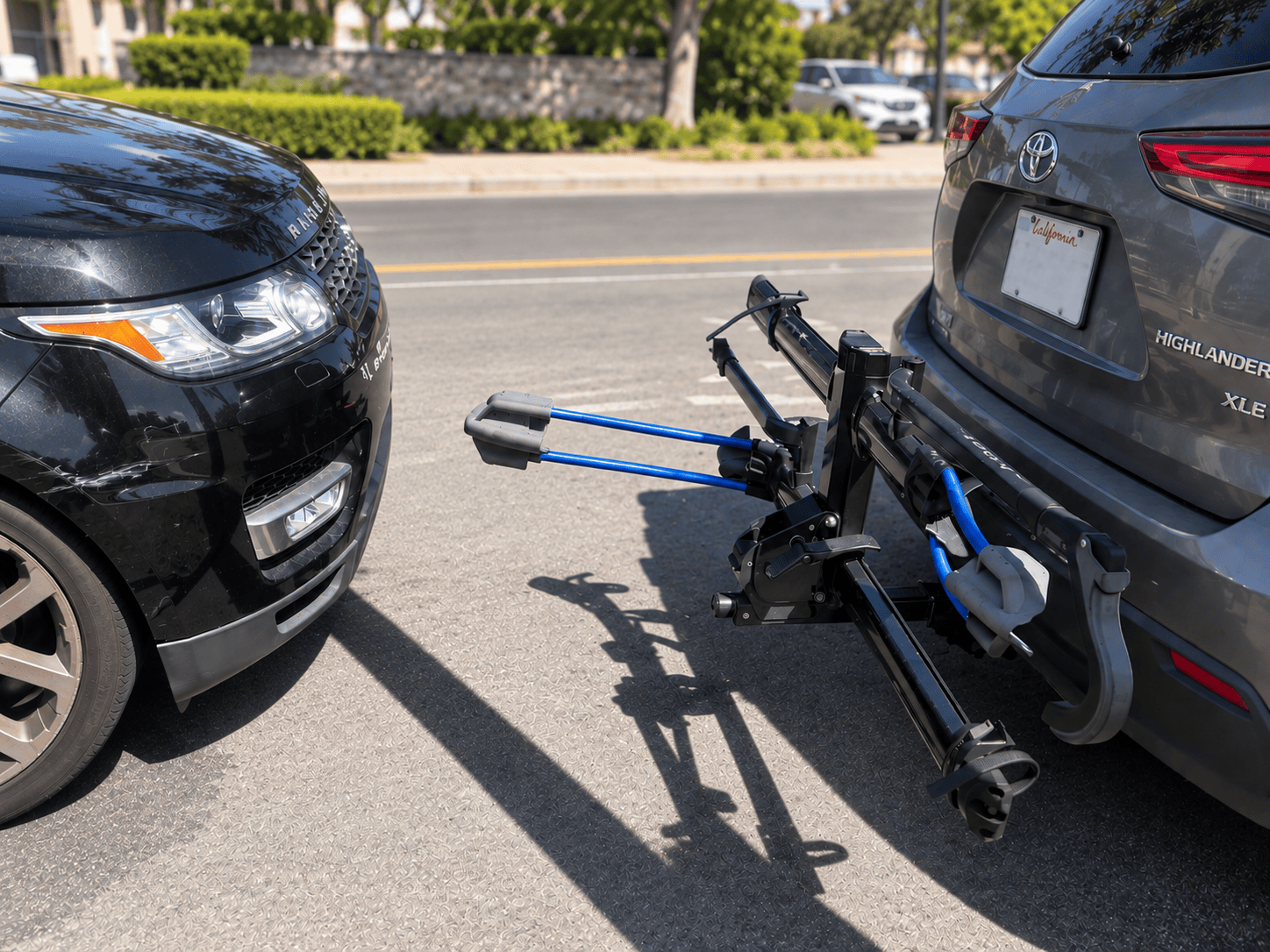
The final psychological validation for retaining the older vehicle arrived via a routine parking incident in an urban commercial district. While attempting to parallel park prior to an athletic engagement, the driver experienced mechanical resistance. Upon inspection, it was discovered that the vehicle’s right-side bumper had made contact with an extended, unpopulated bicycle rack protruding two to three feet from the rear of a preceding automobile.
Repair estimates for the resulting indentation and surface abrasion ranged from $3,000 to $4,000—equivalent to an entire annual maintenance budget for the aging SUV. Initial frustration quickly dissipated, however, replaced by a sense of financial relief. Had identical damage occurred to a newly acquired $110,000 vehicle owned for only a matter of weeks, the financial and emotional toll would have been disproportionately severe.
This dynamic highlights an unlisted variable in automotive economics: the psychological overhead of asset protection. While upfront purchase prices, financing rates, and insurance premiums are heavily scrutinized, the cognitive load of monitoring a pristine vehicle in public parking environments represents a daily, non-negotiable cost of ownership. Driving an older vehicle with preexisting cosmetic wear effectively eliminates this anxiety, transforming minor operational hazards into negligible events.
Decoding Automotive Pricing Structures
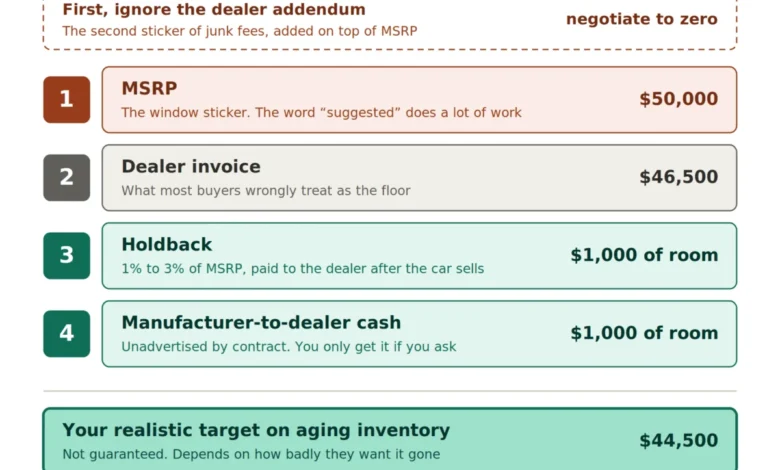
For consumers who nevertheless determine that a new vehicle purchase aligns with their financial strategy, navigating the complexities of dealership pricing requires a clear understanding of the four distinct layers that govern modern automotive transactions.
- MSRP (Manufacturer’s Suggested Retail Price): Displayed on the federally mandated window sticker, MSRP includes factory destination charges. However, consumers must remain vigilant regarding dealer addendum stickers, which incorporate high-margin items such as paint protection, pinstriping, and nitrogen tire fills. These additions are almost universally negotiable to zero.
- Dealer Invoice: Commonly misinterpreted by retail buyers as the absolute cost floor for the dealership, the invoice price simply reflects the baseline figure billed by the manufacturer to the dealer.
- Holdback: Manufacturers routinely reimburse dealerships 1% to 3% of the MSRP following the sale of a vehicle. On a $50,000 automobile, this equates to a $500 to $1,500 backend payment to the dealer. Consequently, a vehicle sold "at invoice" still yields manufacturer-backed profit margins.
- Manufacturer-to-Dealer Cash: These unadvertised financial incentives are deployed by automakers to accelerate the liquidation of specific inventory lines. Because these programs are frequently governed by contractual agreements that prohibit public advertisement, buyers must directly solicit dealerships for bottom-line pricing to access these hidden margins.
Strategic Negotiation Frameworks for Buyers
Industry experts recommend separating the purchase negotiation into three distinct, isolated transactions: the vehicle purchase price, the valuation of any trade-in asset, and the structuring of financing terms. Dealership profitability often relies on blending these variables to obscure the true cost of the acquisition.
Buyers are advised to secure written out-the-door price quotations—inclusive of vehicle price, local taxes, title fees, licensing, and regulated documentation charges—via email from multiple competing dealerships prior to visiting a physical showroom. Furthermore, adherence to disciplined budgeting principles, such as limiting the total purchase price of an automobile to a maximum of one-tenth of gross annual household income, ensures that vehicle ownership remains a manageable component of long-term personal finance rather than a primary driver of household debt.