Bridging the Knowledge Gap: How Industrial AI Is Reshaping Asset-Intensive Sectors and Preserving Institutional Expertise

Asset-intensive industries—ranging from manufacturing and energy utilities to complex aviation operations—have long depended on the deep, highly specialized, and often undocumented expertise of veteran technicians and engineers to maintain critical infrastructure. However, a profound demographic shift is currently underway across the global workforce. As baby boomers and early-tenure generation X workers reach retirement age, industrial organizations face the imminent risk of losing invaluable operational know-how. This institutional drain poses a severe and quantifiable threat to productivity, safety, and operational continuity across multiple sectors.
According to a 2020 report from the U.S. Census Bureau, nearly one-fourth of all manufacturing workers were aged 55 or older, setting the stage for a massive wave of retirements over the decade. Concurrently, the U.S. Department of Energy has repeatedly warned that workforce transitions within critical sectors, such as hydropower and traditional energy generation, risk crippling infrastructure reliability. Similar labor crunches are acute in aviation and heavy industry. The Aviation Technician Education Council’s 2026 workforce pipeline report cites an alarming Oliver Wyman projection anticipating a shortage of approximately 9,100 certificated aviation mechanics in North America by that year. Furthermore, the National Institute of Standards and Technology (NIST) has estimated that preventable operational losses for U.S. manufacturers total a staggering $119.1 billion annually, with equipment downtime alone accounting for $18.1 billion of that figure.
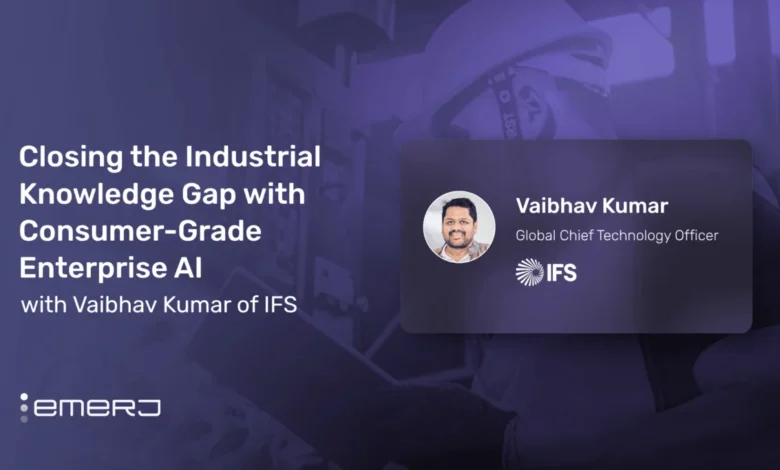
To explore how modern enterprises can mitigate these risks through technological intervention, Eysan Yazici recently hosted Vaibhav Kumar, Global Chief Technology Officer at enterprise software provider IFS, on the Emerj AI in Business Podcast. Their discussion focused heavily on the mechanics of leveraging artificial intelligence to capture institutional knowledge, break down historical data silos, and modernize access to critical operational insights. During the conversation, Kumar identified traditionally cumbersome and friction-heavy enterprise software as a primary barrier preventing experienced workers from recording their day-to-day operational knowledge.
The Genesis of the Industrial Labor Crisis: A Chronological View of Workforce Aging
The collision between an aging workforce and complex industrial software is not a sudden development, but rather the culmination of decades of demographic and technological trends. Throughout the late 20th century, heavy industries expanded rapidly, cultivating a workforce whose training was heavily grounded in hands-on mentorship, paper logs, and tacit knowledge passed down through decades of shop-floor experience.
By the early 2010s, as cloud computing began to revolutionize the enterprise landscape, heavy industries initiated digital transformation programs. However, these early implementations often prioritized back-office efficiency and corporate compliance over frontline usability. Consequently, enterprise resource planning (ERP) and computerized maintenance management systems (CMMS) remained notoriously clunky. Workers on the factory floor or the aviation hangar floor viewed data entry into these legacy systems as an administrative burden rather than a valuable operational tool.
By 2020, the demographic cliff became impossible to ignore. The COVID-19 pandemic accelerated early retirements across manufacturing, energy, and transportation, stripping organizations of their most experienced personnel faster than traditional training pipelines could replace them. This "Great Resignation" transformed a slow-burning demographic trend into an acute operational crisis. Industrial leaders suddenly found themselves scrambling to capture decades of unstructured, undocumented institutional knowledge before it walked out the door for good.
Friction at the Screen: Why Legacy Enterprise Software Fails the Frontline Worker
During his appearance on the Emerj AI in Business Podcast, Kumar highlighted a fundamental paradox in industrial technology: while consumer software has evolved to become hyper-intuitive, enterprise software has historically remained a major point of friction.
Experienced industrial workers—those individuals who can diagnose an engine fault by sound or predict a machinery failure based on subtle vibrations—are rarely unwilling to share their knowledge. Rather, the software interfaces designed to capture that data are so burdensome that they actively discourage documentation. As Kumar noted during the podcast:
"The problem that you’ve had with software for the longest time, enterprise software, is it’s just super inconvenient to go in and get data into the system. It’s a point of friction. Using that software is a point of friction for your most experienced worker who’s well respected by everybody else. So they don’t."
When seasoned technicians bypass cumbersome logging interfaces, the resulting data vacuum leaves organizations vulnerable. Even when data is successfully entered, retrieving and interpreting it requires navigating labyrinthine menus and complex query languages, rendering the information largely inaccessible to incoming, less-experienced personnel.
To reverse this trend, industrial software must evolve. By integrating consumer-grade, conversational interfaces into heavy-duty enterprise platforms, organizations can drastically lower the barrier to entry. When capturing knowledge becomes as simple as dictating a note or describing a troubleshooting step to an AI-powered assistant, veteran workers are far more likely to document their insights. This creates what Kumar terms a virtuous "flywheel": easier contribution populates the system with rich operational data, which in turn delivers faster, more accurate answers to incoming workers, incentivizing continuous engagement across the entire organization.
Democratizing Operational Data: Shifting from Intermediaries to Direct Access
The integration of advanced artificial intelligence into industrial workflows fundamentally alters how organizations access and utilize operational data. Historically, extracting meaningful insights from complex enterprise systems required navigating a long chain of organizational intermediaries.
Consider a traditional executive workflow: when a Chief Financial Officer requires specific operational data to inform a strategic decision, the request typically triggers a multi-layered process. The CFO asks a department head, who tasks a plant manager, who directs an operations analyst to pull data from a legacy ERP system, format it into a spreadsheet, and send it back up the management chain. This process can take days or even weeks, introducing delays and potential miscommunication at every step.
By layering conversational AI experiences—similar in usability to consumer tools like ChatGPT or Claude—directly over enterprise business data, organizations can fundamentally streamline this architecture. Under an AI-enabled model, the CFO can query operational systems directly using natural language and receive comprehensive, verified answers within minutes.
This democratization of insight extends far beyond the executive suite. Frontline technicians, maintenance engineers, and plant supervisors can instantly pull up equipment maintenance histories, diagnostic guides, and historical repair logs directly from the shop floor via voice or mobile interfaces.
Crucially, Kumar emphasizes that the introduction of AI does not eliminate the need for human expertise; rather, it compresses the time between human intent and operational result. Drawing on his own experience using AI to build presentations—a task that once required days of storyboarding and drafting, but can now be initiated in minutes through detailed prompting—Kumar stresses that human oversight remains paramount. The human defines the strategic intent and retains ultimate ownership of the output, while the AI handles the heavy lifting of data retrieval and synthesis.
Data Gravity and Pragmatic AI Deployment Strategies
As industrial leaders race to implement enterprise AI solutions, questions surrounding data quality and system architecture have taken center stage. A common hesitancy among corporate leadership is the belief that organizational data must be completely scrubbed, normalized, and 100% "clean" before any artificial intelligence tools can be safely deployed.
Kumar pushes back firmly against this misconception. Waiting for pristine data is a recipe for paralysis. Modern large language models possess a sophisticated capacity to recognize duplicate records, flag anomalies, and assist in the data-cleansing process itself. Consequently, placing AI agents directly over existing, imperfect enterprise systems can actively improve data quality over time rather than depending on immaculate legacy data from day one.
To maximize the impact of early deployments, Kumar advises industrial leaders to prioritize systems based on "data gravity"—the natural pull exerted by enterprise platforms containing the highest volume of meaningful operational data. By targeting the systems where critical maintenance, supply chain, and production data already reside, organizations can deploy AI layers where they will deliver immediate, measurable value.
Furthermore, industrial leaders must maintain a discerning eye when evaluating vendor claims. The rapid proliferation of AI has led some software providers to repackage existing integration APIs as advanced AI capabilities, selling them under the banner of modern innovation. Kumar stresses that the true test of an enterprise AI solution is not its marketing label, but whether it delivers a seamless, generalizable, consumer-grade experience that solves genuine operational bottlenecks.
Overcoming Cultural Resistance and Building Organization-Wide AI Literacy
Deploying advanced technology in asset-intensive industries is as much a cultural challenge as it is a technical one. Despite widespread board-level enthusiasm for artificial intelligence across manufacturing, utility, and aviation sectors, middle managers and frontline workers frequently exhibit skepticism or outright hesitation.
This resistance is often fueled by a persistent, overstated public narrative that artificial intelligence exists primarily to eliminate jobs. To successfully navigate this transition, enterprise leaders must reframe the technology through a human-centric lens: AI tools are not designed to replace workers, but to augment their capabilities, eliminate administrative friction, and make them significantly more productive.
Moreover, Kumar highlights a critical need for organization-wide AI literacy. Just as corporate executives had to become fluent in cloud computing terminology and hyperscale architecture during the cloud migration wave of the 2010s, today’s industrial leaders must build foundational AI awareness across every level of the enterprise—from the C-suite down to the frontline technician.
Ignoring this educational imperative carries severe competitive risks. As AI rapidly becomes the standard operating layer atop enterprise software, early-adopting industrial organizations are already pulling ahead through enhanced operational efficiency and preserved institutional knowledge. Within a few years, embedded artificial intelligence will cease to be a differentiator and will instead become baseline table stakes for survival in asset-intensive industries.
Ultimately, industrial leaders must treat AI literacy not as an isolated IT initiative, but as an enterprise-wide transformation program. By actively addressing middle-management incentives, streamlining knowledge capture, and deploying pragmatic AI tools over high-gravity data systems, heavy industries can successfully bridge the generational divide, secure their critical operational knowledge, and fortify their competitive standing for the decades ahead.