Amgen Harnesses Machine Learning and Generative AI to Accelerate Global Drug Development and Clinical Trial Operations

Global biotechnology leader Amgen is aggressively integrating artificial intelligence and machine learning into the core of its pharmaceutical research, development, and clinical operations. Operating across more than 50 countries with a workforce of approximately 31,500 employees, the company reported total revenues of $36.75 billion for the full-year 2025, marking a 10% increase over 2024. Amid this financial growth, Amgen has pivoted structurally toward what executives term convergent innovation. This strategic evolution reached a milestone in April 2026 with a corporate reorganization that named James Bradner as executive vice president of Research and Development (R&D), Artificial Intelligence, and Data. By merging advanced computational models with deep biomedical science, Amgen aims to solve some of the most persistent bottlenecks in pharmaceutical innovation, specifically targeting clinical trial enrollment friction and internal knowledge management inefficiency.
The push toward enterprise-wide artificial intelligence deployment builds on a foundational technological roadmap established in recent years. In May 2024, Amgen formally outlined its comprehensive Artificial Intelligence Vision, setting governance standards for trustworthy AI tool development and responsible operational use. To support the heavy computational demands of these initiatives, the company invested heavily in robust AI infrastructure. Notably, Amgen installed an NVIDIA DGX SuperPOD supercomputer, christened Freyja, at its deCODE genetics subsidiary in Reykjavik, Iceland, in 2024. This supercomputing power enables deep genomic and phenotypic analysis, feeding the machine learning pipelines that now drive Amgen’s clinical and research ecosystems.
Overcoming Clinical Trial Enrollment Bottlenecks with ATOMIC
One of the most complex financial and logistical hurdles in the pharmaceutical industry is the clinical trial phase. According to Amgen’s internal data, approximately 80% of all clinical trials fail to enroll a sufficient number of participants to move forward successfully. Furthermore, the company estimates that nearly half of the total time required to bring a new medicine through clinical trials is consumed purely by the enrollment process. Historically, site selection was managed through decentralized, manual workflows that lacked centralized data sources and consistent methodologies. Matt Austin, executive director of Data Sciences at Amgen, noted that human cognitive limitations frequently restricted the ability to integrate the vast array of variables necessary to select optimal trial sites. Additionally, poor site selection often resulted in participant demographics failing to reflect the broader real-world populations affected by specific diseases.
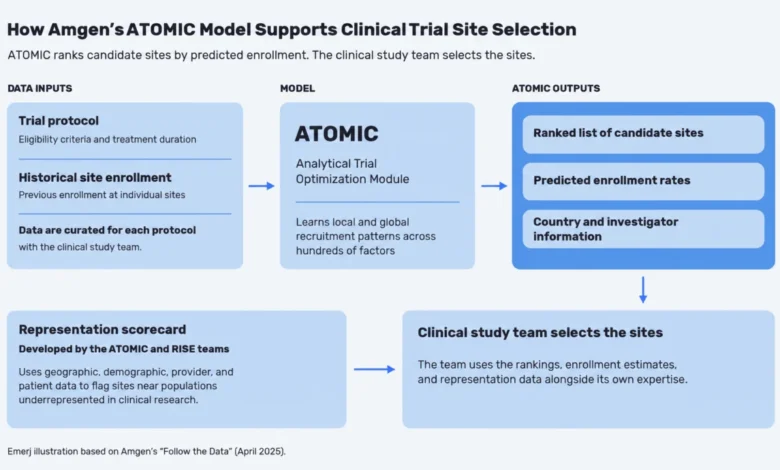
To dismantle these barriers, Amgen engineered the Analytical Trial Optimization Module (ATOMIC), an in-house machine learning model built primarily using open-source Python tools. ATOMIC predicts the speed at which potential clinical trial sites will recruit participants by analyzing local and global recruitment patterns across hundreds of variables. The model synthesizes multiple streams of information, including historical trial performance, disease epidemiology, investigator experience, and site-specific operational metrics, ultimately generating ranked lists of potential trial sites along with predicted enrollment rates.
The operational impact of ATOMIC has been demonstrated across several therapeutic areas, including cardiometabolic diseases, atopic dermatitis, ulcerative colitis, and oncology. In a 2025 internal analysis spanning 13 Amgen-sponsored clinical studies, the company reported that sites positioned at the top of ATOMIC’s rankings enrolled participants up to three times faster on average than lower-ranked sites. This built upon early indicators from January 2024, when preliminary industry reports suggested enrollment speeds were more than double at optimized sites.
Integrating Real-World Data and Diversity into Site Selection
Beyond sheer speed, Amgen utilizes ATOMIC to address public health imperatives such as real-world efficacy and clinical trial diversity. By collaborating with Amgen’s Center for Observational Research, the ATOMIC development team integrated real-world patient data to pinpoint trial locations situated near patient populations with high levels of lipoprotein(a)—often abbreviated as Lp(a)—a specific form of cholesterol strongly linked to elevated cardiovascular disease risk. By deploying this data-driven targeting, investigators testing investigational Lp(a)-lowering medications can screen 50% fewer patients to identify a qualified candidate with elevated baseline levels, dramatically reducing screening fatigue and operational expenses.

Simultaneously, Amgen partnered its ATOMIC team with the company’s Representation in Clinical Research (RISE) initiative. This collaboration aggregates anonymous geographic, demographic, provider, and patient data to generate specialized representation scorecards. These scorecards allow clinical study teams to identify high-potential trial sites situated within or near communities that have been historically underrepresented in clinical research.
Despite the sophistication of these computational models, human clinical expertise remains paramount. Sean Bruich, former senior vice president of Artificial Intelligence and Data at Amgen, emphasized the collaborative boundary between human judgment and automation. He noted that while ATOMIC leverages powerful machine learning technology to rapidly evaluate massive datasets and augment decision-making, it does not replace the critical oversight and expertise of human study teams. Sheryl Jacobs, vice president of Global Development Operations, further highlighted the importance of interdisciplinary translation, noting that clinical operations experts and data scientists work in close tandem to align technical model requirements with evolving trial protocols.
Streamlining R&D Knowledge Retrieval with Generative AI
While machine learning optimizes external clinical trial operations, generative artificial intelligence is transforming internal research workflows at Amgen. Pharmaceutical R&D relies heavily on institutional knowledge, including historical trial designs, molecular properties, regulatory precedents, and the collective expertise of multidisciplinary teams. Historically, this information was siloed across fragmented formats, such as corporate intranets, SharePoint directories, static PDF reports, PowerPoint presentations, and disparate databases.
Bryan Yee, executive director of R&D Knowledge and Learning at Amgen, described the traditional search friction experienced by drug developers. Researchers hunting for legacy trial designs or molecule-specific documentation often had to navigate a labyrinth of disconnected links, a process that could consume hours or even days. To resolve this inefficiency, Amgen’s knowledge management and technology teams partnered with Microsoft to build Catalyst Copilot in approximately six weeks using Microsoft Copilot Studio, seamlessly embedding the generative agent into Amgen’s established Catalyst platform.
Catalyst Copilot acts as an intelligent conversational interface, granting R&D staff instant access to curated institutional knowledge, training materials, and product databases categorized by therapeutic area. According to case studies released by Microsoft, the successful implementation hinged on prior content curation; Yee’s team had meticulously organized lessons learned, research articles, and presentations before deploying the AI layer. The generative copilot added advanced analytical, classification, and reasoning capabilities that fundamentally alter how researchers interact with corporate data. Instead of sorting through static search results, scientists can converse with the system to synthesize multi-source data, locate internal experts who have tackled similar scientific challenges, and retrieve precise regulatory precedents within seconds.
Strategic Implications and Future Outlook
Amgen’s dual deployment of ATOMIC for clinical site optimization and Catalyst Copilot for R&D knowledge management offers broader strategic lessons for the biopharmaceutical sector. First, these initiatives demonstrate that enterprise AI delivers the highest return on investment when deployed against well-defined, highly manual operational bottlenecks. Second, the integration of real-world data and representation metrics directly into predictive algorithms proves that computational efficiency and clinical equity can be pursued simultaneously. Finally, Amgen’s organizational model—highlighted by the April 2026 appointment of James Bradner to oversee R&D alongside AI and Data—underscores the necessity of structural convergence between biological science and data science.
Looking forward, Amgen plans to expand its network of specialized generative AI agents across other business units. Scott Skellenger, Amgen’s senior vice president and chief information officer, envisions a unified future interface capable of dynamically routing employees to the specific AI agents required for their unique workflows. As the pharmaceutical landscape grows increasingly competitive, Amgen’s systematic integration of machine learning and generative artificial intelligence positions the company to accelerate the delivery of critical therapeutics to patients worldwide while maintaining rigorous standards of scientific precision and operational excellence.