Bridging the Knowledge Gap: How Medical Device Leaders Are Leveraging AI to Combat Field Service Attrition and Protect Operational Continuity

Field service organizations across the healthcare technology management sector are facing an unprecedented operational crisis, losing specialized expertise far faster than they can capture, document, or transfer it. This growing vulnerability is no longer viewed merely as a localized training challenge or a human resources hurdle; it has materialized as a critical enterprise risk that directly threatens medical device reliability, institutional efficiency, and customer satisfaction. The convergence of an aging technical workforce, accelerating product complexity, and shorter employee tenure cycles has pushed traditional knowledge-management strategies to their absolute limits.
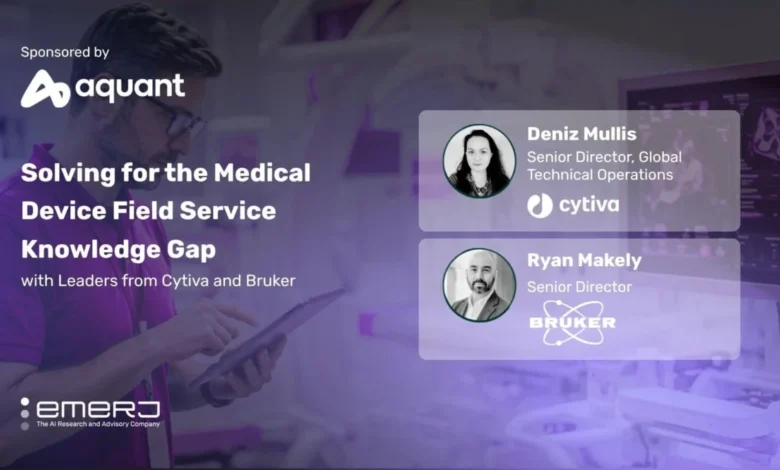
To examine how modern enterprises are navigating this high-stakes landscape, Emerj’s AI in Business Podcast recently featured an in-depth conversation series with two prominent industry leaders: Deniz Mullis, Senior Director of Global Technical Operations at Cytiva, and Ryan Makely, Senior Director of CALID Service at Bruker. Their insights, alongside broader industry data, reveal a transformative shift in how medical device manufacturers must capture institutional knowledge, execute remote diagnostics, and implement artificial intelligence to maintain service continuity.
The Looming Workforce Crisis: Attrition Meets Increasing Complexity
The structural challenges facing field service management are well-documented by industry institutions. According to comprehensive workforce research published by the Association for the Advancement of Medical Instrumentation (AAMI), nearly half—specifically 47%—of the healthcare technology management workforce is currently 50 years of age or older. This demographic reality is compounded by average vacancy rates hovering around 8.5%, with critical open technical roles frequently taking between two and four months, and often longer, to successfully fill. AAMI’s recent findings explicitly identify generational retirements and systemic weaknesses in organizational succession planning as the primary headwinds facing the sector.
Simultaneously, the demand for sophisticated medical equipment is surging. The U.S. Bureau of Labor Statistics (BLS) projects a robust 13% employment growth trajectory for medical-equipment repairers through 2035—a growth rate significantly faster than the national average for all occupations. As device volume and functional complexity scale upward, the learning curve for service technicians steepens dramatically. Capacity-constrained workers are consequently expected to master intricate systems with fewer experienced mentors available to guide them through complex troubleshooting scenarios.
The financial implications of failing to modernize service delivery models are equally pronounced. Research conducted by Aston University’s Advanced Services Group demonstrates that manufacturing organizations transitioning toward knowledge-intensive service models experience profit gains of nearly 8% alongside productivity growth exceeding 5%. These figures underscore a fundamental truth for modern executives: service knowledge is not merely a documentation task or a routine administrative chore; it is a vital balance-sheet asset that dictates operational profitability.
The Decay of Institutional Memory: Capturing Knowledge Before It Leaves
At the core of the modern field service dilemma is the rapid erosion of practical, unwritten judgment. When seasoned technicians depart an organization—whether through retirement or career transitions—they take with them decades of pattern recognition, intuitive troubleshooting pathways, and contextual understanding that cannot be found in standard operating manuals.
Deniz Mullis of Cytiva emphasizes that this loss is felt acutely on a daily basis. Shorter average tenures mean fewer individuals remain within the enterprise who possess deep, legacy familiarity with complex medical systems. When a senior engineer leaves, organizations rarely find two or three junior replacements who share that accumulated depth of experience.
To counteract this ongoing brain drain, industry leaders emphasize that structured knowledge capture must be embedded directly into daily workflows rather than treated as an afterthought during quarterly reviews. Organizations are increasingly adopting AI-consumable knowledge capture mechanisms, ensuring that every successful field intervention, unique error resolution, and field-tested diagnostic workaround is systematically logged, verified, and integrated into a centralized digital knowledge backbone.
Ryan Makely of Bruker underscores the operational friction caused by informal knowledge retention. When technical insights remain trapped inside an individual’s memory, recorded on isolated scraps of paper, or buried deep within unstructured CRM notes, cross-regional collaboration becomes severely restricted. Without a standardized, accessible knowledge repository, resolution processes frequently devolve into subjective debates between technicians, drastically inhibiting consistent service delivery across geographically dispersed teams.
Overcoming Post-Launch Knowledge Fragmentation
A recurring theme among service executives is the distinct vulnerability associated with post-launch knowledge fragmentation. During the initial rollout of a medical device, comprehensive failure modes are rarely fully understood, and diagnostic pathways remain incomplete. As engineers across different regions encounter real-world operational anomalies, they develop localized workarounds and practical insights that often fail to permeate back into corporate documentation channels.
When this post-launch learning remains unorganized, enterprises struggle to maintain uniform decision-making standards. Deniz Mullis points out that even when organizations introduce AI-enabled knowledge retrieval layers, underlying contradictions across legacy manuals, technical bulletins, and historical service notes frequently surface. Over time, knowledge drifts unless it is subjected to continuous human curation, rigorous daily feedback loops, and designated expert reviews.
To establish true operational resilience, leading medical device manufacturers are instituting formalized review boards. These teams actively evaluate field corrections, validate emerging troubleshooting patterns, and push verified updates back out to the technician network. This proactive maintenance ensures that newly acquired insights immediately become shared institutional knowledge rather than remaining isolated personal practices.
AI-Enabled Remote Diagnostics and the Quest for First-Time Fix Rates
The quality of remote diagnostics directly dictates the trajectory of the entire service lifecycle. If technical support teams can accurately isolate and diagnose a device malfunction before dispatching a field engineer, the technician arrives on-site equipped with the precise context, appropriate diagnostic tools, and correct replacement parts necessary to secure a first-time fix. Conversely, poor remote troubleshooting results in reactive dispatches, inflated cost-to-serve metrics, extended customer downtime, and heightened frustration for clinical operators.
In highly regulated healthcare environments, remote diagnostics face unique compliance and security barriers. Many hospital networks strictly restrict external data access, preventing telemetry systems from transmitting real-time performance data to manufacturer support centers. Consequently, remote teams must often rely heavily on verbal descriptions provided by clinical operators. Because operators vary widely in their technical familiarity—some possessing advanced system knowledge while others struggle with basic terminology—the accuracy of the initial diagnostic assessment relies heavily on the quality of AI-supported conversational guidance tools.
Organizations that have successfully integrated AI-driven remote diagnostics empower their support desks to interpret unstructured customer feedback, match symptoms against historical case archives, and recommend precise corrective actions. Industry experts warn that companies lagging in the adoption of these remote self-service and AI diagnostic capabilities are rapidly losing ground to competitors, widening the performance gap in customer retention and operational efficiency.
Change Management and the Human Element of AI Adoption
Deploying advanced artificial intelligence solutions within field service operations is fundamentally an exercise in organizational change management. Technology investments fail to deliver projected returns if technicians reject the tools in favor of legacy habits. Medical device service personnel are chronically busy professionals, continuously inundated with technical specifications, regulatory requirements, and administrative tasks. Introducing a new digital tool without a comprehensive change-management framework frequently leads to low adoption rates and dampened enthusiasm.
Both Mullis and Makely stress that durable AI integration requires meeting users where they are mentally and operationally. Early in deployment cycles, service teams must actively involve field technicians in testing, validation, and scenario planning. When technicians are given ownership over the evolution of the tool—seeing firsthand how their feedback is incorporated and understanding the provenance of AI-generated answers—trust increases exponentially.
Reflecting on implementation strategies, industry leaders emphasize the necessity of assigning dedicated change management resources from day one. Utilizing structured methodologies, such as the ADKAR model, ensures that stakeholder mapping, targeted communication, and continuous feedback mechanisms are established before rollout rather than implemented reactively to fix adoption bottlenecks.
Implications and Future Outlook
The convergence of artificial intelligence and advanced service management represents a fundamental turning point for the medical device industry. As workforce demographics shift and product complexity continues to accelerate, organizations can no longer rely on traditional, informal methods of knowledge preservation and field support.
By treating service knowledge as a quantifiable balance-sheet asset, investing in structured post-launch capture systems, refining remote diagnostic accuracy, and prioritizing rigorous change management, forward-thinking manufacturers are successfully insulating themselves against the ongoing expertise drain. Those that fail to embrace this technological transformation risk persistent inefficiencies, rising operational costs, and an eroded competitive advantage in an increasingly demanding global marketplace.