Aerodrome Finance AERO Token Faces Sharp Decline Following Strategic Binance Listing Amid Market Volatility and Protocol Evolution

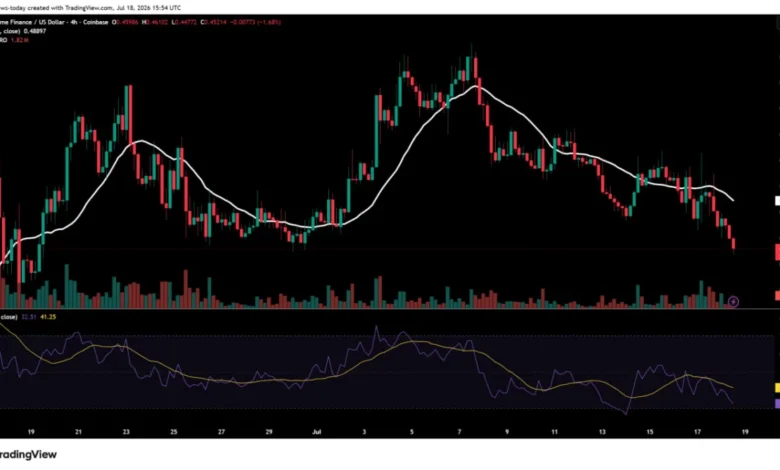
The decentralized finance (DeFi) sector witnessed a paradoxical market event this week as Aerodrome Finance’s native utility token, AERO, experienced a significant price correction despite securing a high-profile listing on Binance, the world’s largest cryptocurrency exchange by trading volume. On July 18, the AERO token plummeted to a local low of $0.4527, marking a continuation of a downward trajectory that has seen the asset shed more than 15 percent of its market value over a seven-day period. This bearish momentum comes at a time when many market participants expected a "listing pump," a phenomenon where a token’s price surges following its debut on a major global exchange. Instead, the AERO token encountered a "sell the news" event compounded by broader macroeconomic pressures and specific regulatory designations applied by the exchange.
The Binance listing, which was officially announced on July 17 and executed shortly thereafter, introduced spot trading pairs for AERO/USDT, AERO/USDC, and AERO/TRY. However, the listing was accompanied by a "Seed Tag" designation, a classification Binance utilizes for projects that are relatively new and exhibit higher levels of volatility and risk compared to established blue-chip assets. While the listing provides AERO with unprecedented access to global liquidity, the immediate market reaction was characterized by selling pressure rather than the anticipated influx of fresh capital. This divergence highlights the complex interplay between exchange accessibility, technical indicators, and the current risk-averse sentiment permeating the digital asset industry.
The Mechanics of the Binance Listing and the Seed Tag Barrier
The integration of AERO into the Binance ecosystem followed a structured rollout. The exchange published its listing notice at 07:30 UTC on July 17, originally scheduling the opening of spot trading for later that day. Although the exchange experienced a slight delay in the commencement of trading, the logistical transition allowed users on Binance Alpha—the exchange’s pre-listing platform—to migrate their holdings into standard spot accounts. To incentivize the listing and support future ecosystem growth, Binance waived the standard listing fee and committed an additional $100,000 in USDC specifically for marketing campaigns intended to bolster the token’s visibility.
Despite these supportive measures, the application of the Seed Tag served as a significant friction point for potential buyers. Assets under this designation are subject to strict monitoring and require users to undergo a mandatory risk-awareness quiz every 90 days to maintain trading privileges. Furthermore, a permanent warning banner is displayed on the trading interface, reminding investors of the speculative nature of the asset. While these measures are designed to protect retail investors from extreme volatility, they also act as a psychological and procedural barrier that can dampen the immediate buying frenzy often associated with new listings. In the case of AERO, the Seed Tag reinforced a cautious narrative, particularly as the token had already established a substantial presence on the Base network but remained unproven on a platform as massive as Binance.
Technical Breakdown: Indicators Signaling Sustained Bearish Momentum
From a technical perspective, AERO’s price action on the four-hour chart provides a clear illustration of the prevailing selling pressure. The token is currently trading well below its 20-period moving average (MA), which serves as a critical benchmark for short-term trend direction. With the 20-period MA hovering near $0.489, the gap between the current price of $0.452 and the average suggests that sellers have maintained control over multiple trading sessions. This is not a localized dip caused by a single large sell order, but rather a sustained trend where every minor recovery has been met with further distribution.

The Relative Strength Index (RSI), a momentum oscillator that measures the speed and change of price movements, further validates this bearish outlook. Currently sitting at 32.51, the RSI is approaching the "oversold" threshold of 30. While an RSI below 30 often signals that a reversal or a relief bounce may be imminent as selling exhaustion sets in, AERO has yet to confirm a bottom. The index’s position indicates that while the asset is historically cheap relative to its recent performance, the momentum remains firmly in favor of the bears. Historical data on the AERO chart shows that the token failed to breach the $0.58 to $0.60 resistance zone twice in the last month—once in late June and again in early July. This "double top" formation at the $0.60 level proved to be a formidable ceiling, and the subsequent failure to hold the $0.50 support level has opened the door for a retest of the lower $0.40 range.
Macroeconomic Context and Regulatory Headwinds
The poor performance of AERO cannot be viewed in isolation from the broader cryptocurrency market, which faced a tumultuous week. Risk appetite among global investors was dampened by a combination of geopolitical tensions and legislative developments in the United States. Specifically, the CLARITY Act hearing in Washington, which focuses on the regulatory framework for stablecoins and digital assets, introduced a fresh layer of uncertainty regarding the future of decentralized finance protocols.
As a primary liquidity hub on the Base network, Aerodrome Finance is particularly sensitive to regulatory shifts that could impact layer-2 scaling solutions or decentralized exchanges (DEXs). When the broader market, including Bitcoin and Ethereum, experiences a contraction, altcoins with lower liquidity—even those with strong fundamentals like AERO—often suffer disproportionate losses. The timing of the Binance listing coincided with a general flight to safety, where traders preferred to deleverage their positions rather than take on new exposure to high-volatility assets tagged with risk warnings.
Fundamental Strength: Aerodrome’s Dominance on the Base Network
While the price action remains disappointing for holders, the underlying fundamentals of the Aerodrome protocol remain robust. Aerodrome Finance currently stands as the dominant decentralized exchange on Base, the Ethereum layer-2 network incubated by Coinbase. The protocol accounts for approximately 61 percent of all DEX trading volume on the network, a testament to its deep liquidity and efficient incentive structures. Since its inception, Aerodrome has generated over $520 million in cumulative fees, a figure that rivals some of the most established protocols on Ethereum mainnet.
The protocol utilizes a "veAERO" (vote-escrowed AERO) model, where users lock their tokens for a specified period to gain governance rights and a share of the protocol’s revenue. This model is designed to align the interests of liquidity providers, traders, and long-term holders. In May, Aerodrome introduced MEV-resistant (Maximum Extractable Value) pools, a technological upgrade aimed at protecting retail swappers from front-running bots. Despite the token’s price decline, the protocol’s usage metrics—including total value locked (TVL) and daily active users—have remained resilient, suggesting a disconnect between the utility of the platform and the market valuation of its native token.
Strategic Evolution: The Merger and the "Aero" Cross-Chain Vision
Looking ahead, the team behind Aerodrome, Dromos Labs, is preparing for a significant strategic pivot. Plans are currently underway to merge Aerodrome with its sister protocol, Velodrome, which operates on the Optimism network. This merger will result in a unified cross-chain ecosystem under the "Aero" brand. The rollout, targeted for the latter half of the year, is expected to extend the protocol’s reach to the Ethereum mainnet and Circle’s Arc chain.

One of the most anticipated features of this expansion is "Predictive Allocation." Unlike the current system, which relies on weekly voting cycles by veAERO holders to distribute rewards, Predictive Allocation utilizes algorithms to assign incentives based on expected future demand. This shift is intended to make the protocol more responsive to market shifts and reduce the "lag" associated with manual governance. For AERO holders, this evolution represents a transition from a network-specific utility token to a multi-chain governance asset.
Future Outlook and Market Implications
The current price action of AERO serves as a case study in the modern "listing cycle." The era where a Binance listing guaranteed an immediate and sustained price increase appears to have evolved into a more nuanced reality where market conditions and exchange-imposed risk labels play a decisive role. For AERO to regain its bullish momentum, it will likely need to find a stable support floor near the $0.40 mark and wait for a stabilization of the broader crypto market.
Furthermore, the removal of the Seed Tag will be a crucial milestone for the asset. As AERO matures and its liquidity deepens on Binance, the exchange may eventually lift the designation, thereby removing the quiz requirements and warning banners. This would open the token to a broader segment of Binance’s user base who are currently deterred by the "high-risk" classification.
In the interim, the success of the merger with Velodrome and the implementation of Predictive Allocation will be the primary catalysts to watch. If Aerodrome can successfully translate its dominance on the Base network to other chains while maintaining its fee-generation capabilities, the current price dip may eventually be viewed as a period of market consolidation rather than a fundamental decline. However, in the immediate term, the technical indicators suggest that caution remains the prudent approach for investors navigating the AERO market.