The Hidden Cost of Market Overactivity and the Erosion of Retail Investor Wealth

The landscape of modern finance has undergone a radical transformation over the past decade, shifting from a realm dominated by institutional gatekeepers to an environment characterized by total accessibility. Today, a retail investor can execute complex derivative trades from a smartphone while commuting, fueled by zero-commission structures and real-time social media sentiment. However, a growing body of empirical evidence suggests that this frictionless infrastructure is not a gateway to prosperity but rather a high-speed lane toward wealth destruction. Decades of data across global markets have reached a singular, undeniable verdict: the more frequently retail traders engage with the market, the worse their portfolios perform.

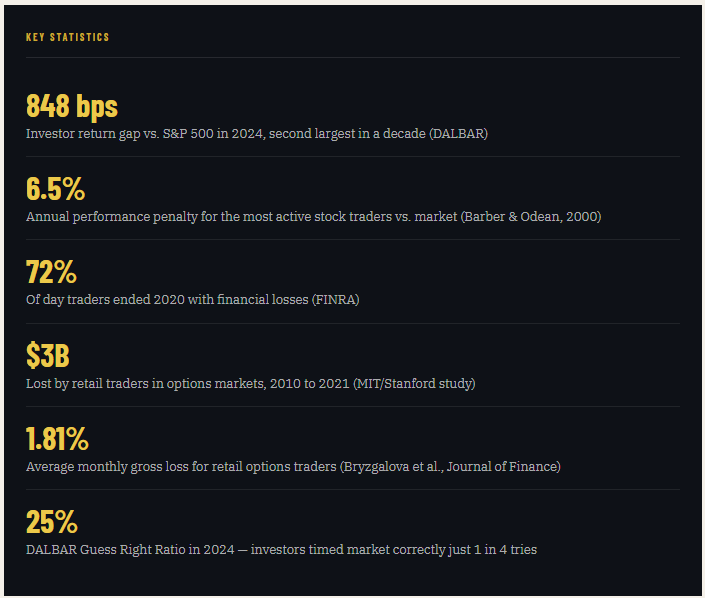
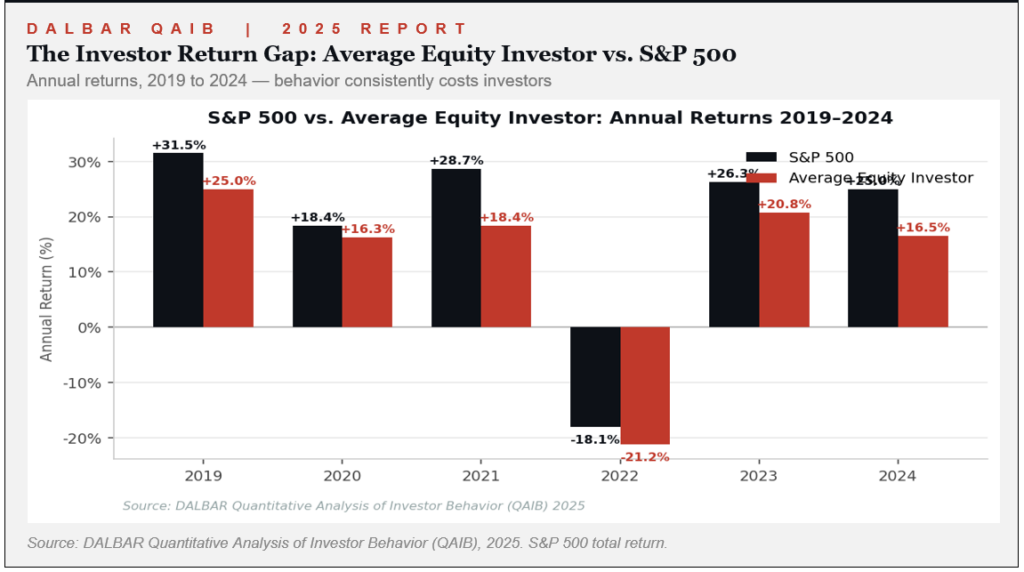
This phenomenon is not a matter of marginal underperformance or statistical noise. According to the 2025 Quantitative Analysis of Investor Behavior (QAIB) report by DALBAR, the performance gap between the average retail investor and the broader market has reached historic proportions. In 2024, a year characterized by a robust bull market, the average equity investor earned a return of 16.54%. During the same period, the S&P 500 returned 25.02%. This 848-basis-point shortfall represents the second-largest performance gap of the last decade, indicating that in one of the strongest market environments in recent memory, retail participants forfeited nearly one-third of available returns through poorly timed entries and exits.
A Fifteen-Year Trend of Underperformance
The 2024 data is part of a much larger and more troubling trend. Retail traders have now underperformed the S&P 500 for 15 consecutive years. This persistent lag is often driven by what DALBAR calls the "Guess Right Ratio," a metric that tracks how frequently investors correctly time their market movements. In 2024, this ratio fell to a record low of 25%, meaning retail traders correctly anticipated market direction only once out of every four attempts.
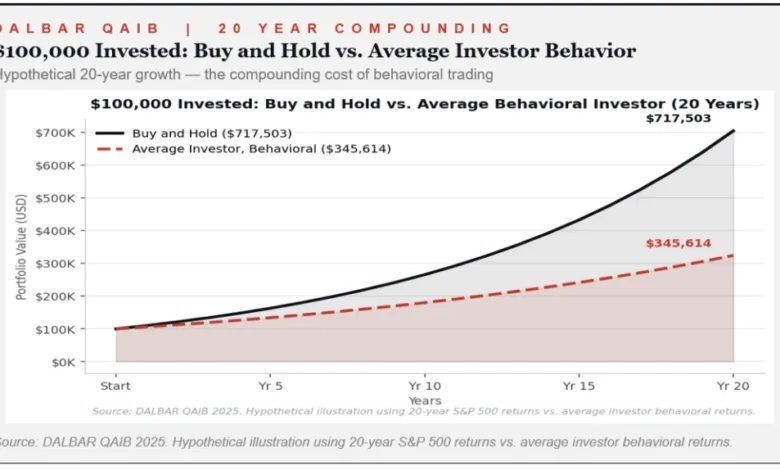
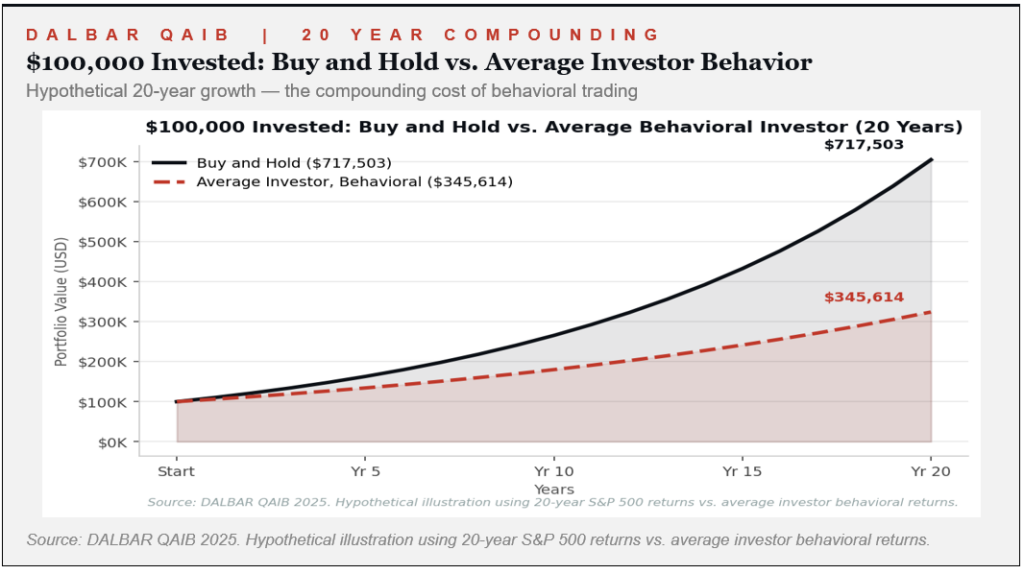
The long-term consequences of this behavioral gap are staggering. Financial analysts often point to a hypothetical scenario to illustrate the compounding damage: an investor who placed $100,000 in an S&P 500 index fund at the start of 2024 and remained inactive would have finished the year with $125,020. Conversely, the average behavioral investor, attempting to "trade the headlines," would have ended with approximately $112,774. Over a twenty-year horizon, the disparity becomes even more dramatic. A passive $100,000 investment would grow to over $717,000, while the average active retail investor would likely see only $345,614—forfeiting more than half of their potential wealth to the costs of their own decisions.
The Evolution of the Retail Trading Trap
To understand the current crisis of retail underperformance, one must look at the chronology of market accessibility. The barriers to entry have been dismantled systematically over the last 50 years:
- 1975: The "May Day" deregulation of brokerage commissions allowed for the rise of discount brokers.
- 1990s: The advent of the internet birthed E-Trade and Ameritrade, moving trading from telephone lines to desktop computers.
- 2013: The launch of Robinhood introduced a "mobile-first" philosophy and pioneered the zero-commission model.
- 2019-2020: Major legacy brokerages like Charles Schwab and Fidelity were forced to eliminate commissions to compete, just as the COVID-19 pandemic triggered a surge in retail participation.
- 2021: The "Meme Stock" era, exemplified by the GameStop short squeeze, solidified the role of social media platforms like Reddit and TikTok as primary sources of financial advice for a new generation.
While these milestones were celebrated as the "democratization of finance," they also removed the natural "speed bumps" that once forced investors to pause and reflect before executing a trade. Without the friction of commissions or the need to speak with a professional, the psychological impulse to act has become nearly impossible for many to resist.
Academic Foundations: Why Trading is Hazardous to Wealth
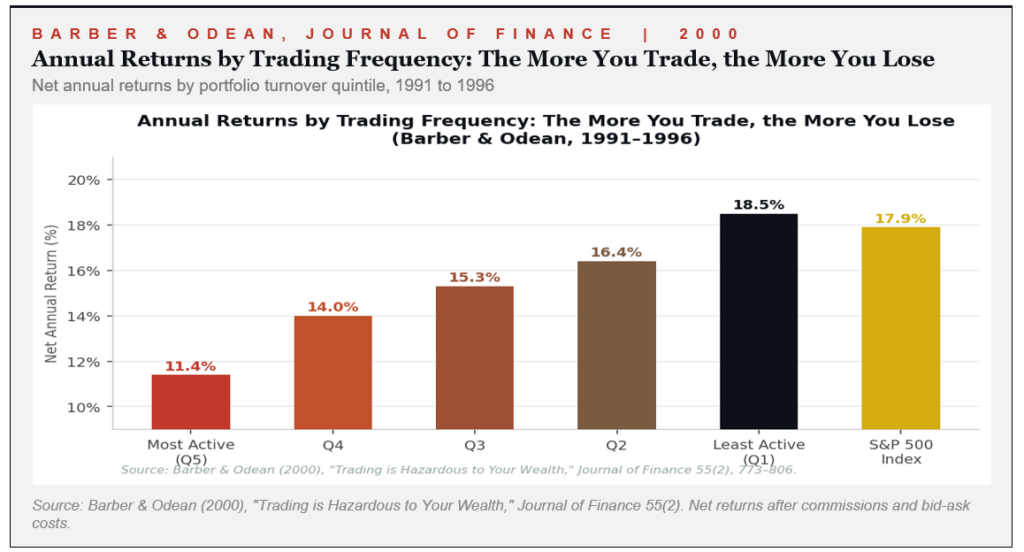
The hazards of frequent trading were documented long before the era of smartphone apps. In a landmark 2000 study titled "Trading is Hazardous to Your Wealth," published in the Journal of Finance, Professors Brad Barber and Terrance Odean analyzed over 66,000 household brokerage accounts from the early 1990s. Their findings were revolutionary: the most active group of traders earned an annual return of 11.4%, while the market returned 17.9%. This 6.5% annual performance drag was attributed entirely to excessive turnover.

Barber and Odean identified overconfidence as the primary driver of this behavior. Retail traders frequently overestimate the quality of their information and their ability to interpret it. Subsequent global research has confirmed these findings in diverse markets. A ten-year study of the Colombian Stock Exchange (2006–2016) found that retail investors generated negative abnormal returns of over 4% annually. In every instance, the most active participants suffered the greatest losses, proving that the problem is not merely the cost of trading, but the flawed logic behind the trades themselves.
Day Trading and the Illusion of Professionalism
If standard active trading is detrimental, day trading—the practice of buying and selling securities within a single session—is catastrophic for the vast majority of participants. Data from the Financial Industry Regulatory Authority (FINRA) suggests that 72% of day traders end their first year with net financial losses. Even among those who attempt to treat it as a professional endeavor, the success rate is dismal. Only 16% of proprietary traders are profitable in any given year, and a mere 1% maintain consistency over a five-year period.
The survival statistics provide a grim outlook for those hoping to "beat the system." Approximately 40% of day traders quit within one month, and 80% exit the market within two years. A 2020 study of the Brazilian equity futures market followed traders for 300 days and found that 97% lost money. Only 1.1% of the participants earned more than the national minimum wage, and even those individuals faced extreme volatility that made their "income" unsustainable.
Options: The Structural Disadvantage
The recent explosion in retail options trading has added a new layer of risk to the retail landscape. Research from MIT Sloan and Stanford University ("Losing is Optional," 2022) revealed that retail traders lost an estimated $3 billion in options trades between 2010 and 2021. The study highlighted that market makers—the institutional entities providing liquidity—were the primary beneficiaries of these losses.

Options are particularly dangerous for retail investors due to three structural factors:
- Bid-Ask Spreads: Retail traders often face spreads that average 8% of the option’s value. This means an investor is effectively down 8% the moment they enter a trade.
- Implied Volatility Crushes: Retail traders frequently buy options ahead of high-probability events like earnings reports. When the event passes, the "volatility" premium collapses, causing the option’s value to plummet even if the trader correctly guessed the stock’s direction.
- Time Decay (Theta): Unlike stocks, options are wasting assets. Retail traders often hold losing positions in the hope of a rebound, only to watch the value erode to zero as the expiration date approaches.
Industry Perspectives and Regulatory Concerns
The surge in retail losses has not gone unnoticed by regulators and industry veterans. While brokerage firms argue that they provide the tools for financial independence, consumer advocates point to "gamification" features—such as digital confetti, push notifications, and tiered rewards—as predatory tactics designed to encourage overtrading.
Market analysts suggest that the current environment creates a "predator-prey" dynamic. For every retail trader making a move based on a social media tip, there is a sophisticated, algorithmically driven institutional counterparty on the other side of the trade. In the zero-sum game of short-term trading, the retail participant is almost always at an informational and technological disadvantage.
Analysis of Implications: The Path Forward
The evidence suggests that the "democratization of finance" has, in practice, become the democratization of risk. As retail participation continues to grow, the wealth gap between those who "play the market" and those who "invest in the market" is likely to widen. The data indicates that the only reliable way for a retail investor to achieve market-matching returns is to adopt a philosophy of radical patience.

To navigate this environment, financial experts recommend a return to fundamental principles:
- Reduced Turnover: Lowering the frequency of trades to minimize transaction costs and timing errors.
- Long-Term Horizon: Shifting the focus from daily fluctuations to multi-year growth.
- Cost Management: Utilizing low-cost index funds rather than speculative individual securities or derivatives.
- Behavioral Discipline: Recognizing that the urge to "do something" during market volatility is often the greatest threat to a portfolio’s health.
The market will always offer the allure of quick gains and the excitement of the trade. However, as decades of statistics show, the most successful investors are often those who do the least. In an era of infinite information and instant execution, the ultimate competitive advantage for the retail investor is no longer speed—it is the discipline to stand still.