Fiduciary Grade AI and the Transformation of Regulated Professional Workflows in Global Financial Services

The integration of artificial intelligence into regulated industries represents a paradigm shift characterized by a "zero tolerance" mandate for error, a standard that distinguishes these sectors from the broader consumer technology market. In fields such as financial services, legal counsel, taxation, and auditing, the margin for inaccuracy is non-existent. Within these frameworks, a partial success is categorized not as a minor technical glitch but as a catastrophic compliance failure, carrying the weight of severe regulatory penalties, massive financial losses, and irreparable reputational damage. This high-stakes environment has necessitated the emergence of "fiduciary-grade AI," a specialized subset of technology designed to meet the rigorous demands of licensed professionals who operate under legal and ethical obligations to provide accurate and secure advice.
The economic impetus for this transition is underscored by the immense costs associated with modern regulatory environments. Research published by the National Bureau of Economic Research (NBER) reveals that the average United States firm allocates between 1.3 and 3.3 percent of its total wage bill exclusively to regulatory compliance. This financial burden is not static; it has intensified over the last decade, with the complexity of global mandates varying significantly by industry and firm size. For global financial giants, these costs represent billions of dollars in annual overhead, creating a desperate need for automation solutions that do not compromise the integrity of the work.
The Accuracy Gap: General Purpose Models vs. Regulated Reality
The primary barrier to the adoption of mainstream artificial intelligence in professional services is the prevalence of "hallucinations"—instances where large language models (LLMs) generate factually incorrect but confident-sounding information. While a hallucination in a creative writing tool is a curiosity, in a legal or financial context, it is a liability.
Researchers at Stanford University recently conducted a comprehensive audit of general-purpose language models against verifiable legal inquiries. The results were stark, showing hallucination rates that ranged from 58 to 88 percent. These findings highlight why "off-the-shelf" AI systems remain fundamentally unfit for high-stakes professional work. Without purpose-built safeguards and grounding in authoritative primary sources, standard AI lacks the deterministic precision required for statutory interpretation or financial auditing.
This accuracy gap is further complicated by the National Institute of Standards and Technology (NIST) AI Risk Management Framework. NIST identifies privacy concerns and the security of a model’s training data as core risk categories. For financial institutions, this creates a non-negotiable requirement: AI vendors must prove that sensitive filings, private tax records, and confidential client data are never ingested into a model’s general training corpus. Most commercial AI systems, which rely on user data to iteratively improve, are fundamentally architected in a way that conflicts with these privacy mandates.
A Chronology of AI Integration in Professional Services
The journey toward fiduciary-grade AI has followed a distinct chronological progression. In the early 2010s, the focus was on digitization and basic robotic process automation (RPA) for repetitive data entry. By the late 2010s, machine learning began to assist in predictive analytics and fraud detection. However, the "Generative AI" era, which began in late 2022, introduced a new level of complexity.
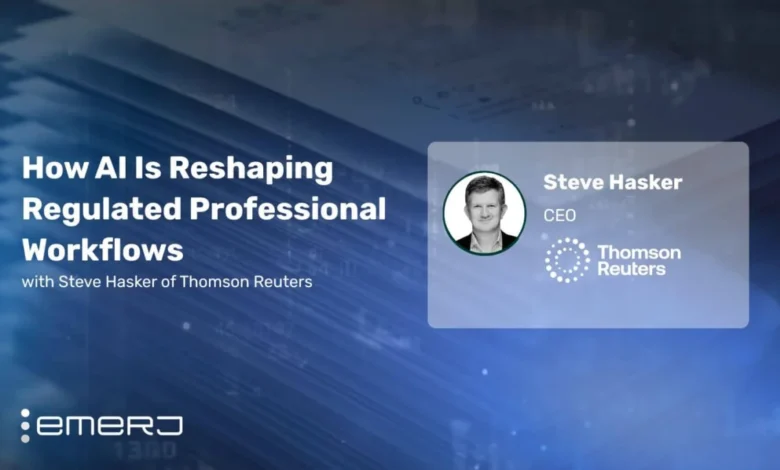
In early 2023, regulated firms entered a "pilot phase," experimenting with LLMs for low-stakes tasks like internal memo drafting. By mid-2023, the limitations—specifically hallucinations and data leakage—became apparent, leading to a temporary retrenchment. Currently, in 2024, the industry has moved into the "specialization phase." This is the era of the partnership between domain experts and technology providers, as exemplified by the recent collaboration between Emerj CEO Daniel Faggella and Thomson Reuters CEO Steve Hasker. Their discussion on the AI in Financial Services Podcast outlines the roadmap for how institutions can safely transition from experimentation to core workflow integration.
Core Insight 1: Establishing Fiduciary-Grade Accuracy Standards
Steve Hasker, CEO of Thomson Reuters, argues that the threshold for AI adoption must match the expectations placed on licensed human professionals. In legal, tax, and audit functions, an output is only useful if it is precise, verifiable, and consistent. General-purpose models are probabilistic—they predict the next most likely word in a sequence—which is the antithesis of the deterministic requirements of a tax code or a legal precedent.
To meet this standard, fiduciary-grade AI must be grounded in "authoritative content." This means the AI does not draw from the open internet, but rather from verified, proprietary databases of law, regulation, and financial history. Hasker notes that AI can only accelerate analysis and drafting if its machine-generated work aligns perfectly with the standards governing regulated submissions. To operationalize this, institutions are now demanding clarity on "confidence scores" for AI outputs and the ability to trace every machine-generated claim back to a specific, cited source.
Core Insight 2: Automating Labor-Intensive Regulatory Filings
One of the most immediate applications for AI in this sector is the preparation of regulatory filings. Financial institutions are currently buried under millions of pages of disclosures, audit inputs, and supporting documentation. This process is historically manual, repetitive, and prone to human fatigue-induced error.
Hasker highlights that expert-driven AI applications can now automate the investigative burden of these filings. By scanning vast internal and external datasets, AI can synthesize the necessary information for a CFO or General Counsel to review. However, Hasker is careful to note that while the process is automated, the accountability remains static. The "human-in-the-loop" is not just a safety feature; it is a legal requirement. AI reduces the manual load that precedes expert judgment, allowing professionals to shift their focus from document retrieval to high-level strategic analysis.
Core Insight 3: The Mandate for Data Isolation and Protection
Data protection is perhaps the most significant hurdle for AI adoption in global finance. Hasker emphasizes that for a regulated institution, data leakage is an existential risk. If a bank’s proprietary transaction data or a client’s sensitive tax history were to "leak" into a public model’s training set, it would constitute a breach of fiduciary duty and a violation of privacy laws like GDPR or the CCPA.
Consequently, the industry is moving toward a model of isolated AI environments. In this framework, the AI model is brought to the data, rather than the data being sent to the model. Hasker summarizes the requirement plainly: organizations must be certain that their data remains invisible to the model’s future outputs. This "zero-retention" policy is becoming a standard clause in vendor contracts, ensuring that the benefits of automation do not come at the cost of institutional security.
Core Insight 4: Explicit Sign-off and the Preservation of Accountability
The final pillar of fiduciary-grade AI is the preservation of human accountability. As AI systems become more capable of making complex "decisions," the line between machine assistance and machine autonomy becomes blurred. Hasker argues that in regulated environments, this line must be made explicit.
Responsibility for a legal opinion or a financial audit cannot be delegated to an algorithm. Therefore, AI workflows are being designed with "explicit sign-off" requirements. This ensures that every machine-assisted decision is reviewed and ratified by a licensed professional. This structure reinforces the role of senior leaders—CEOs, CFOs, and General Counsels—as the ultimate arbiters of truth. AI changes the speed at which work is prepared, but it does not change the identity of the person who carries the legal burden of its accuracy.
Analysis of Implications: The Future of Professional Work
The shift toward fiduciary-grade AI will likely lead to a "great decoupling" of professional labor from volume. Historically, the capacity of a law firm or an audit team was limited by the number of billable hours humans could provide. With AI handling the "investigative burden," the capacity for work increases exponentially while the cost per unit of work decreases.
However, this transition also suggests a shift in the value proposition of human professionals. As AI masters the technicalities of document review and data synthesis, the human element of "professional judgment" becomes more valuable. The ability to navigate nuance, ethical dilemmas, and complex client relationships remains a uniquely human domain.
Furthermore, we can expect a widening gap between "AI-enabled" firms and "legacy" firms. Those who successfully integrate fiduciary-grade AI will operate with significantly lower overhead and higher accuracy rates, likely leading to a consolidation of the professional services market. Regulators, too, will likely begin to use these same tools to monitor compliance, creating a technological "arms race" between the regulators and the regulated.
In conclusion, the adoption of AI in the financial and legal sectors is not a matter of if, but how. By adhering to the principles of fiduciary-grade accuracy, data isolation, and human accountability, the industry is setting a global standard for the responsible use of artificial intelligence. As Steve Hasker and other industry leaders suggest, the goal is not to replace the expert, but to empower the expert with a level of precision and efficiency that was previously unattainable.
Related posts: