USD/JPY Consolidates Amidst Yield Divergence and Shifting Fed Expectations

The USD/JPY currency pair is currently experiencing a period of consolidation following recent upward momentum, a trend largely underpinned by persistent yield differentials between the United States and Japan. US Treasury yields continue to hold a premium over their Japanese government bond counterparts, maintaining the attractiveness of carry trades and exerting upward pressure on the pair. This dynamic is further amplified by a recalibration of market expectations regarding the US Federal Reserve’s monetary policy path.
Market Reassessment of Federal Reserve Rate Cuts
Recent economic data from the United States has painted a picture of a resilient economy, prompting financial markets to scale back aggressive forecasts for imminent Federal Reserve interest rate cuts. Stronger-than-expected employment figures and persistent inflation in the services sector have signaled that the Fed may adopt a more cautious approach to easing monetary policy. Futures markets are now reflecting a slower and potentially shallower trajectory for rate reductions, a development that inherently bolsters the US dollar against other major currencies, including the Japanese yen. This shift in sentiment directly supports the USD component of the USD/JPY pair.
Adding to the supportive environment for the US dollar, a significant political development has emerged: an agreement between President Trump and the US Senate to avert a government shutdown. This resolution removes a layer of fiscal uncertainty, providing a more stable backdrop for economic activity and allowing market participants to focus on broader economic trends. The absence of a government shutdown frees up policymakers to concentrate on economic management, potentially giving proponents of a stronger dollar more room to operate without the immediate overhang of fiscal instability.
The Bank of Japan’s Evolving Stance and Yen Weakness
On the Japanese side of the equation, the Bank of Japan (BoJ) has signaled a departure from its long-standing policy of strict yield curve control (YCC). While this represents a notable shift, the overall monetary policy stance in Japan remains highly accommodative. Short-term interest rates in Japan are still anchored near zero, a stark contrast to the higher rates prevailing in the US. This policy divergence is a fundamental driver of the USD/JPY trend.
The comparative attractiveness of yields is a crucial factor influencing currency movements. When juxtaposed with the current interest rate environment in the United States, Japan’s real yields are perceived as low and consequently unappealing to international investors seeking returns. This low-yield environment makes it considerably more challenging for the Japanese yen to mount a sustained rally. Investors are less inclined to hold yen-denominated assets when they can achieve higher returns elsewhere, particularly in dollar-denominated assets.
The Specter of Verbal Intervention
Despite the underlying economic fundamentals favoring the USD/JPY pair, the risk of verbal intervention from Japanese authorities remains a significant consideration. Japanese officials have repeatedly articulated their readiness to intervene in the currency markets should the yen experience excessive depreciation. These statements, often referred to as "jawboning," are intended to temper speculative bets against the yen and can influence short-term market sentiment.
Historically, sharp movements in the USD/JPY pair, particularly breaches of key psychological levels, have prompted the Bank of Japan to take action. Such interventions, whether through direct market participation or strong verbal cues, have the potential to trigger abrupt, albeit often temporary, pullbacks in the USD/JPY. However, the effectiveness of intervention alone in fundamentally altering the prevailing trend is debatable. For sustained yen appreciation to materialize, a significant narrowing of the policy divergence between the US and Japan would likely be necessary. This would imply a more aggressive monetary policy tightening by the BoJ, a scenario that markets are not currently pricing in to a substantial degree.

Positioning and Risk Sentiment as Market Movers
Beyond macroeconomic fundamentals and central bank policies, investor positioning plays a pivotal role in shaping the USD/JPY narrative. A substantial number of market participants have established long positions in USD/JPY, often structured through carry trades that capitalize on the interest rate differential. The inherent risk in such positioning is that when market sentiment shifts, these trades can unwind rapidly, exacerbating price movements.
Adverse shifts in risk sentiment, such as a decline in US Treasury yields, a significant correction in global equity markets, or a resurgence of fears regarding a potential recession, could prompt investors to pare back their exposure to these carry trades. Such a deleveraging process would likely lead to a temporary strengthening of the Japanese yen as these positions are unwound. However, the duration and magnitude of any such yen appreciation would be contingent on the underlying catalyst and whether it signals a more fundamental shift in global economic prospects.
Forward-Looking Analysis and Key Catalysts
Looking ahead, the USD/JPY pair is expected to closely monitor the release of US Producer Price Index (PPI) data, which is a key indicator of inflationary pressures. Upside risks for the pair persist if US yields experience another upward surge and the Federal Reserve reiterates a "higher for longer" interest rate narrative. This would reinforce the yield differential advantage for the dollar.
Conversely, downside risks for USD/JPY could emerge if there are signs of a significant slowdown in US economic growth, a faster-than-anticipated decline in inflation, or if market participants begin to price in earlier and more substantial Fed rate cuts. Any indication of a more decisive move towards monetary policy normalization by the Bank of Japan would also provide significant support for the Japanese yen, potentially leading to a retracement of recent gains.
USD/JPY Technical Price Analysis: Navigating the W Pattern
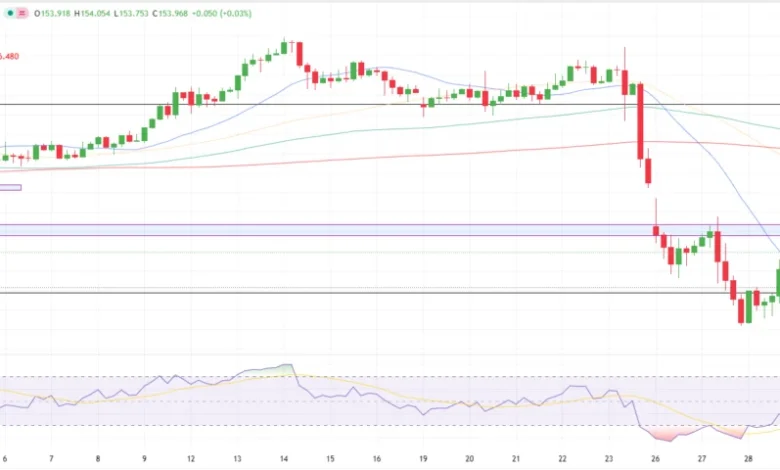
From a technical perspective, the USD/JPY 4-hour chart reveals a bullish reversal pattern, commonly referred to as a "W Pattern." This pattern suggests a potential shift in momentum from bearish to bullish. The pair has successfully moved above its 20-period moving average (MA), and the Relative Strength Index (RSI) has also shown an upward trajectory, crossing the 50.0 level, which is often interpreted as a sign of increasing bullish momentum.
A critical hurdle for the bulls currently lies within a central broken demand zone, situated around the 154.50 price level. A sustained break and hold above this zone could provide further impetus for the pair to ascend. Such a move might then lead to a retest of the 100-period moving average, located around 155.60. This level could potentially help fill a bearish gap that formed at the beginning of the current trading week.
On the downside, should the bullish momentum falter, the pair could retrace its steps and test the lows observed on Thursday, which hover around the 152.70 mark. Further support can be found at the weekly lows, approximately around 152.00. These levels represent potential areas where buying interest might emerge, offering some respite to the yen.
The interplay of these fundamental drivers and technical signals will be crucial in determining the future direction of the USD/JPY. While yield differentials and Fed policy expectations currently favor the dollar, the ever-present threat of Japanese intervention and shifts in global risk sentiment add layers of complexity to the outlook. Investors and traders will be keenly watching for further economic data releases and policy pronouncements from both the US and Japan to gauge the evolving landscape. The resilience of the US economy, the trajectory of inflation, and the BoJ’s gradual normalization steps will be key determinants in whether USD/JPY continues its ascent or experiences a more significant correction. The potential for a "W Pattern" breakout to materialize will hinge on the ability of buyers to overcome the immediate resistance levels and sustain upward momentum in the face of potential headwinds.