Federal Reserve Chair Kevin Warsh Sparks Hawkish Market Reassessment as Brent Oil Test and Treasury Yields Converge

Federal Reserve Chair Kevin Warsh has delivered a fresh analytical puzzle to global financial markets following the central bank’s latest policy announcement, setting off a chain reaction across fixed income, foreign exchange, and energy commodities. In the wake of a widely anticipated rate hike that brought the federal funds target range to 3.75%–4.00%, Chair Warsh characterized the adjustment not as a restrictive constraint on growth, but merely as the removal of “a dose of accommodation” from the broader United States economy.
This specific turn of phrase immediately triggered a sharp, hawkish reassessment among institutional investors, macroeconomists, and currency traders. By signaling that policy remains supportive even within a 3.75%–4.00% band, Warsh implied that the Federal Reserve’s terminal rate—the ultimate peak of the tightening cycle—may reside significantly higher than previously priced by futures markets. Yet, the subsequent market reaction was far from monolithic. While the short-end of the Treasury yield curve surged and the U.S. Dollar Index rallied aggressively, Fed funds futures hesitated to fully endorse a materially higher long-term destination for borrowing costs. This divergence has laid bare a complex web of cross-market tensions, where macroeconomic variables, technical resistance levels, and energy prices will ultimately dictate the path of global monetary policy.
Chronology of the FOMC Decision and Immediate Market Reactions
The sequence of events leading up to and immediately following the Federal Open Market Committee (FOMC) meeting revealed acute sensitivity to subtle shifts in central bank rhetoric. In the weeks preceding the announcement, market participants were largely divided over whether the central bank would pause its tightening cycle to evaluate the cumulative lagged effects of previous rate adjustments or continue moving incrementally higher to combat persistent inflation pressures.
When the FOMC ultimately elected to proceed with the rate hike, pushing the federal funds rate up to the 3.75%–4.00% range, attention quickly pivoted to the post-meeting press conference and the official statement text. Chair Warsh’s commentary regarding the removal of accommodation served as the catalyst for immediate portfolio reallocations.

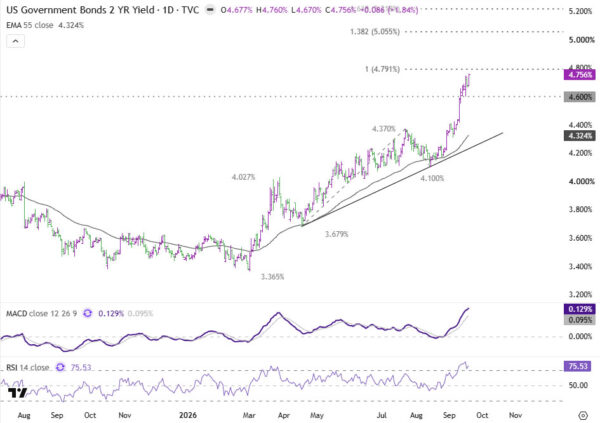
Within minutes of the remarks, the 2-year U.S. Treasury yield experienced a violent upward thrust, climbing 12.6 basis points to settle at 4.756%. This rapid repricing contrasted sharply with the more muted behavior of longer-dated maturities. The 10-year Treasury yield eked out a modest gain of just 3.1 basis points, while the 30-year Treasury yield actually declined by 2.9 basis points. This atypical curve steepening and front-end compression signaled that fixed-income investors were aggressively pricing in near-term policy adjustments without anticipating systemic, long-term economic damage or generalized fiscal-credibility shocks that typically impact the long end of the curve.
Concurrently, the foreign exchange market reacted swiftly to the shifting yield differentials. The U.S. Dollar Index (DXY), which had previously carved out a double bottom between 98.56 and 98.91, vaulted upward to test resistance near the 100.56 mark, tracking the aggressive momentum of short-term yields.
Decoding the Rhetoric: Warsh, Accommodation, and the Neutral Rate
To understand the profound market impact of Chair Warsh’s remarks, analysts turned to the semantic nuances of central banking language. Evercore macro strategist Krishna Guha noted that Warsh’s repeated deployment of the word “accommodation” appeared entirely deliberate rather than incidental. Complementing this view, BNP Paribas analyst James Egelhof argued that because traditional central bank lexicon defines accommodation as economic stimulus, describing a 3.75%–4.00% target range in such terms suggests that the current monetary policy stance remains meaningfully supportive of aggregate demand.
A literal interpretation of this stance introduces substantial hawkish implications. If the current interest rate environment is still accommodating, the threshold at which monetary policy transitions from supportive to actively restrictive—often referred to as the neutral rate, or $R^*$-star—must lie well above current levels. Consequently, if underlying inflation metrics fail to decelerate rapidly, the Federal Reserve may be compelled to extend its tightening cycle far beyond the baseline expectations held by commercial banks and institutional asset managers earlier in the year.
However, constructing a precise operational framework around the neutral rate remains notoriously difficult. Economists generally view the neutral rate not as a fixed, immutable destination, but rather as an ambiguous, shifting range influenced by productivity growth, demographic shifts, and global savings gluts. Addressing this theoretical challenge during his press conference, Chair Warsh dismissed strict academic comparisons to the neutral rate as “useful academically” for theoretical modeling, while consciously declining to grant the concept decisive operational weight in justifying the immediate policy shift.
This distinction successfully untangled what could have been interpreted as an internal contradiction in the Fed’s communication strategy. Warsh demonstrated that policymakers can confidently articulate the direction of travel—removing accommodation—without needing to pin down the exact terminal coordinate of neutral. Furthermore, UBS strategist Jonathan Pingle highlighted the practical asymmetry embedded in this communication strategy. Pingle observed that the Fed’s reaction function appears increasingly asymmetrical: it is demonstrating a diminished sensitivity to early signs of labor-market softening while maintaining an elevated threshold for declaring monetary policy genuinely restrictive. Pointing to the resilient 4.1% unemployment rate and robust job-openings data, Warsh underscored that the employment side of the dual mandate is currently offering no impediments to continued policy tightening.
Fed Funds Futures: Repricing the Pace, Not the Destination
Despite the aggressive hawkish interpretations adopted by equity and debt traders, the pricing behavior within Fed funds futures revealed a more nuanced underlying reality. While the market dramatically accelerated its timeline for imminent policy actions, it largely refused to lift the ultimate ceiling of the tightening cycle.
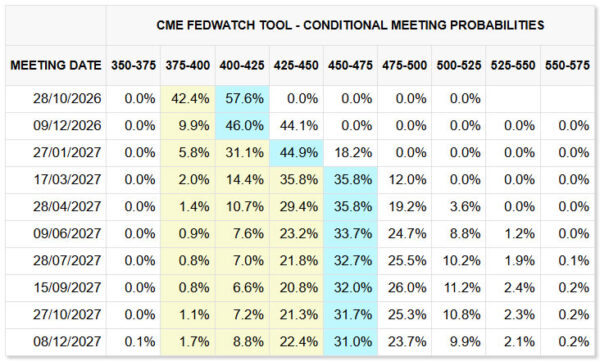
In the immediate wake of the FOMC gathering, the implied probability of another consecutive rate hike at the upcoming October 28 policy meeting jumped sharply from 44.0% to 57.6%. This statistical leap represented a decisive institutional shift toward a faster, more front-loaded sequence of tightening steps.
Yet, when examining the longer-term distribution of rate expectations across the multi-year forecast horizon, the shift was remarkably subdued. The modal probability bucket for December 2027 remained anchored within the 4.50%–4.75% range, shifting merely from 30.4% to 31.0%. Furthermore, calculating a duration-weighted average of expected policy rates across a 24-month horizon yielded a figure hovering tightly around 4.50% both before and after the FOMC announcement.
While the probability-weighted midpoint for December 2027 sits slightly higher at approximately 4.64%, the overarching conclusion for derivatives traders is definitive: the market aggressively repriced the timing and velocity of near-term tightening, but it fundamentally declined to revise its expectations regarding the ultimate destination of the policy rate cycle.
Treasury Yields and Technical Resistance at the Front End
The divergence between soaring short-term Treasury yields and stagnant long-term rate projections has created acute technical tension within the sovereign debt market. The 2-year Treasury yield’s surge to 4.756% places it approximately 26 basis points above the calculated 4.50% average expected policy rate over the corresponding two-year window.
While term premium dynamics and liquidity adjustments mean that Treasury yields and average Fed funds expectations do not need to trade in lockstep, the sheer velocity of the move has pushed technical indicators into extreme territory. Daily Relative Strength Index (RSI) readings for the 2-year yield climbed decisively above 75, signaling overbought conditions and warning that the front end of the curve is rapidly testing the outer limits of available policy confirmation.
From a technical standpoint, market participants are monitoring a critical resistance zone spanning 4.791% to 4.800%. A decisive rejection from this band, followed by a breakdown below support at 4.600%, would validate the futures market’s skepticism and trigger a meaningful mean-reversion toward the broader baseline policy path. Conversely, a sustained breakout above the 4.800% resistance ceiling would expose the next major projection target at 5.055%. Such a scenario would force one of two structural resolutions: either the 2-year yield is executing a stretched, unsustainable overshoot, or the Fed funds futures market will eventually be forced to capitulate and price in a significantly higher terminal rate.
Foreign Exchange Implications: The Dollar Index Tests Key Retracements
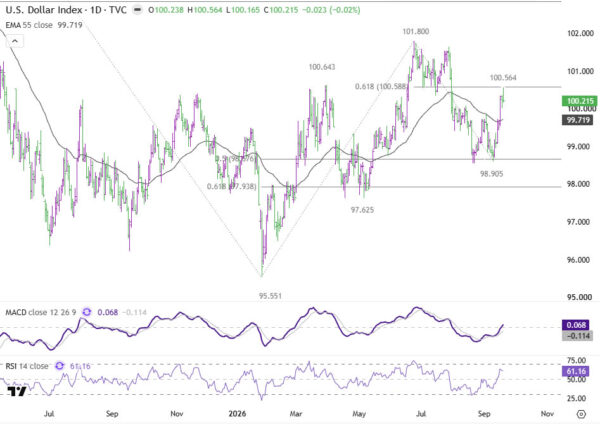
The foreign exchange complex has mirrored the turbulence observed in fixed-income markets, with the U.S. Dollar Index acting as a direct downstream beneficiary of rising front-end yields. Having successfully completed a double-bottom formation between 98.56 and 98.91, the DXY surged as high as 100.56, encountering formidable technical resistance almost precisely at the 61.8% Fibonacci retracement level of the preceding decline from 101.80 to 98.90, located at 100.58.
As long as the DXY maintains structural support above the 100.02 threshold, the immediate bias among currency strategists remains skewed to the upside. A clean, volume-backed break above the 100.58 resistance barrier would clear a pathway for the index to challenge its previous cyclical high at 101.80.
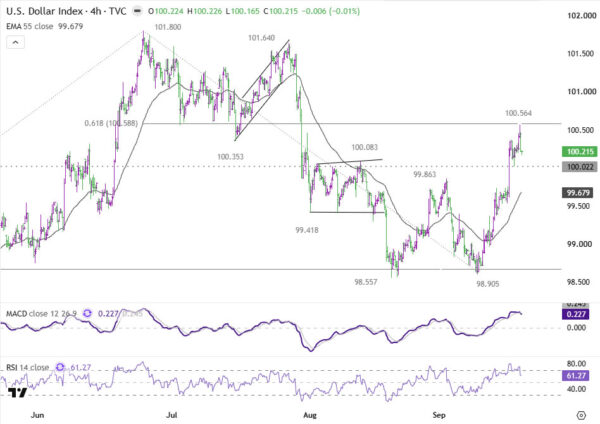
However, currency analysts emphasize that the sustainability of this dollar rally is inextricably linked to cross-asset validation. If the 2-year Treasury yield faces rejection at the 4.791%–4.800% resistance band and subsequently breaks support at 4.600%, the foundational yield support underpinning the dollar will evaporate. In that event, a simultaneous break of DXY support at 100.02 could precipitate a swift technical pullback toward the 4-hour 55 exponential moving average (EMA), currently positioned near 99.68. For a lasting dollar breakout to materialize, it must be accompanied by synchronized hawkish revisions from the futures market and ongoing currency weakness among G10 peers, particularly the Euro and the Japanese Yen.
Brent Crude Oil: The Upstream Variable Governing Global Inflation
While monetary policy communications and sovereign debt curves dominate immediate financial commentary, the ultimate upstream variable governing the entire macroeconomic cycle resides within the energy markets. Brent crude oil functions as the fundamental pricing input that will determine whether inflation pressures remain contained or escalate to a degree that forces the Federal Reserve into an uncompromising, aggressive stance.
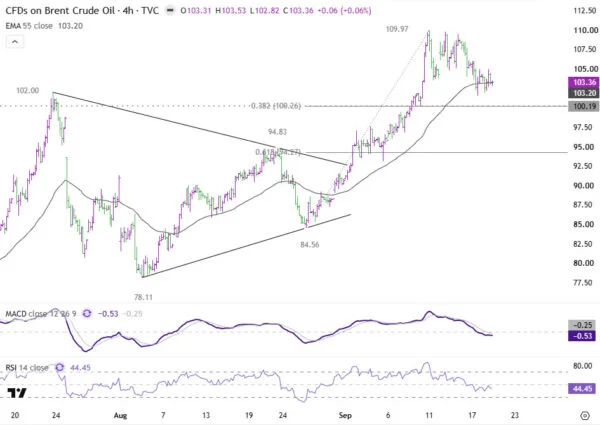
Brent crude recently retreated from a late-week peak of $109.97 per barrel, though the pullback has yet to construct a confirmed structural reversal. Market technicians have identified a formidable confluence of support surrounding the psychological $100 benchmark and the 38.2% Fibonacci retracement of the broader advance from $84.56 to $109.97, located at $100.26.
The convergence of a major round-number psychological milestone with a classical technical retracement level endows the $100.00–$100.26 zone with outsized market significance. As long as this demand pocket holds firm, the recent retracement from $109.97 will be classified merely as a healthy consolidation phase within the primary upward trend originating at $84.56. A subsequent renewed advance breaching the $109.97 swing high would instantly reactivate the bullish trajectory toward the cycle high of $119.50.
Conversely, a decisive, high-volume breakdown beneath the $100 threshold would provide the first definitive technical warning that the energy correction is morphing into a broader trend reversal. A subsequent breach of the 61.8% retracement level at $94.27 would supply conclusive evidence that the post-pandemic energy commodity supercycle has encountered a structural ceiling.
Macroeconomic Outlook and Systemic Implications
Financial markets currently find themselves locked in a highly disciplined, sequential decision-making loop. The immediate operational path forward depends entirely on how upstream commodities resolve their technical testing phases.
First, Brent crude must establish a definitive direction at its $100.00–$100.26 support floor. A successful defensive bounce by energy bulls would preserve the underlying import-price inflation pressures that could compel the Federal Reserve to elevate its terminal rate expectations rather than merely accelerating the timing of upcoming adjustments.
Second, this energy dynamic will dictate whether the 2-year Treasury yield possesses the fundamental macroeconomic backing to decisively clear its 4.791%–4.800% resistance ceiling, or whether it will ultimately succumb to gravity and revert toward the more conservative projections implied by derivative futures.
Finally, the U.S. Dollar Index stands at the end of this transmission belt, testing whether its technical advance toward 101.80 enjoys genuine cross-market synchronization or relies solely on fleeting front-end momentum.
Chair Kevin Warsh’s calculated framing of Wednesday’s rate hike as the removal of a “dose of accommodation” successfully provided financial markets with a clear, unambiguous hawkish heading. Yet, as bond yields test technical boundaries, currency traders monitor critical retracement levels, and energy markets grapple with the formidable $100 threshold, the ultimate destination of the global monetary tightening cycle remains entirely unwritten.