Alphabet and Intel Earnings to Test AI Investment Resilience Amid Market Breadth Concerns and Nike Turnaround Efforts

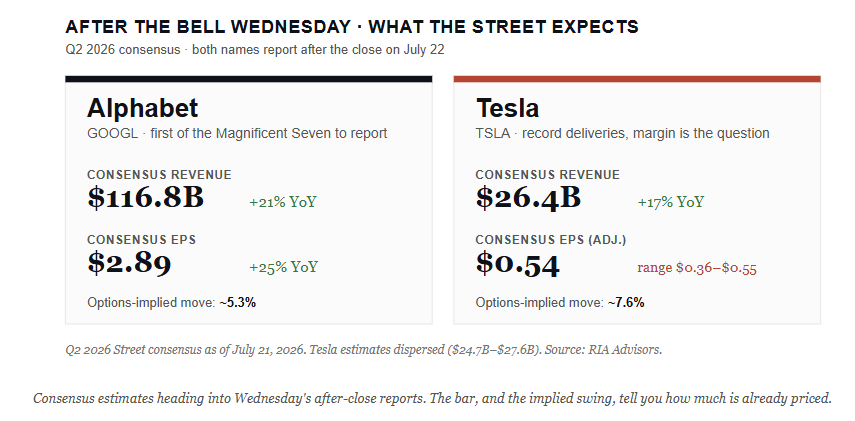
The global financial markets are entering a critical juncture this week as tech giants Alphabet and Intel prepare to release their quarterly earnings reports, providing the first definitive evidence of whether the aggressive pace of artificial intelligence investment remains sustainable. Alphabet, the parent company of Google, is scheduled to report its results after the closing bell today, while Intel is set to follow tomorrow. These two companies serve as the primary bookends for the AI sector: Alphabet represents the massive demand for AI models and infrastructure, while Intel serves as a key indicator for the supply side of the semiconductor and data center ecosystem.

The current reporting cycle comes at a time when investors are increasingly scrutinizing the "return on investment" for AI spending. While the previous four quarters were characterized by a "build it and they will come" mentality, the focus has shifted toward free cash flow generation and the long-term viability of massive capital expenditure (capex) programs. This tension is particularly evident in Alphabet’s financial profile. Last quarter, Google’s Cloud backlog nearly doubled sequentially to a record $462 billion, representing a 63% year-over-year increase—the fastest growth rate among major cloud providers, including Amazon Web Services and Microsoft Azure.
However, the sheer scale of this backlog necessitates unprecedented spending. Alphabet recently raised its 2026 capex guidance to a range of $180 billion to $190 billion and signaled to the market that 2027 spending would see a "significant increase." The primary concern for institutional investors is the resulting pressure on liquidity; Alphabet’s free cash flow plummeted 47% year-over-year in the first quarter to $10.1 billion. This divergence between record backlogs and shrinking cash reserves has created a cautious atmosphere among analysts who are watching for continued margin expansion within Google Cloud to offset these massive outlays.

The Supply-Side Perspective: Intel’s Strategic Positioning
While Alphabet navigates the demand side, Intel’s upcoming report will offer a window into the health of the hardware supply chain. In its previous quarter, Intel’s Data Center and AI (DCAI) division saw revenue growth of 22%, driven by a recovery in enterprise spending and improvements in chip efficiency. Intel is currently in the midst of a multi-year transformation under its IDM 2.0 strategy, aiming to regain its lead in process technology while expanding its foundry services.
Market participants are looking for signs of whether AI-related demand is broadening beyond the niche of high-end GPUs into the general-purpose CPU and accelerator markets where Intel competes. A key metric will be Intel’s forward guidance. If the company signals a slowdown in orders from hyperscalers, it could suggest that the declining free cash flow observed at companies like Alphabet is finally forcing a deceleration in capital investments. Conversely, if Intel maintains a bullish outlook, it would reinforce the thesis that the AI "arms race" remains the top priority for Big Tech, regardless of short-term cash flow volatility.
The "Bad Breadth" Phenomenon and Market Divergence
The earnings reports are arriving against a backdrop of significant internal market turmoil, which some analysts have labeled a "momentum meltdown." Despite the S&P 500 trading near record highs, the underlying health of the market has deteriorated. This phenomenon, often called "bad breadth," describes a scenario where a small handful of mega-cap stocks prop up the headline index while the majority of individual stocks struggle.
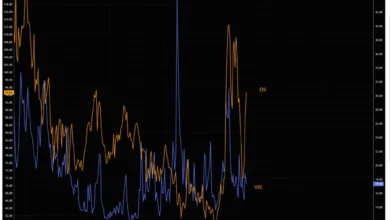
A striking metaphor for this market state is that of a duck: calm and gliding on the surface, but paddling furiously underneath. While the standard Volatility Index (VIX) remains below its long-term average at approximately 17.5, suggesting a placid environment, the VIXEQ—a measure of single-stock volatility—has surged above 50. The gap between these two measures has recently hit a record high. This indicates that while traders are not necessarily bracing for a total market crash, they are extremely fearful of volatility in specific names, particularly those within the AI momentum group.
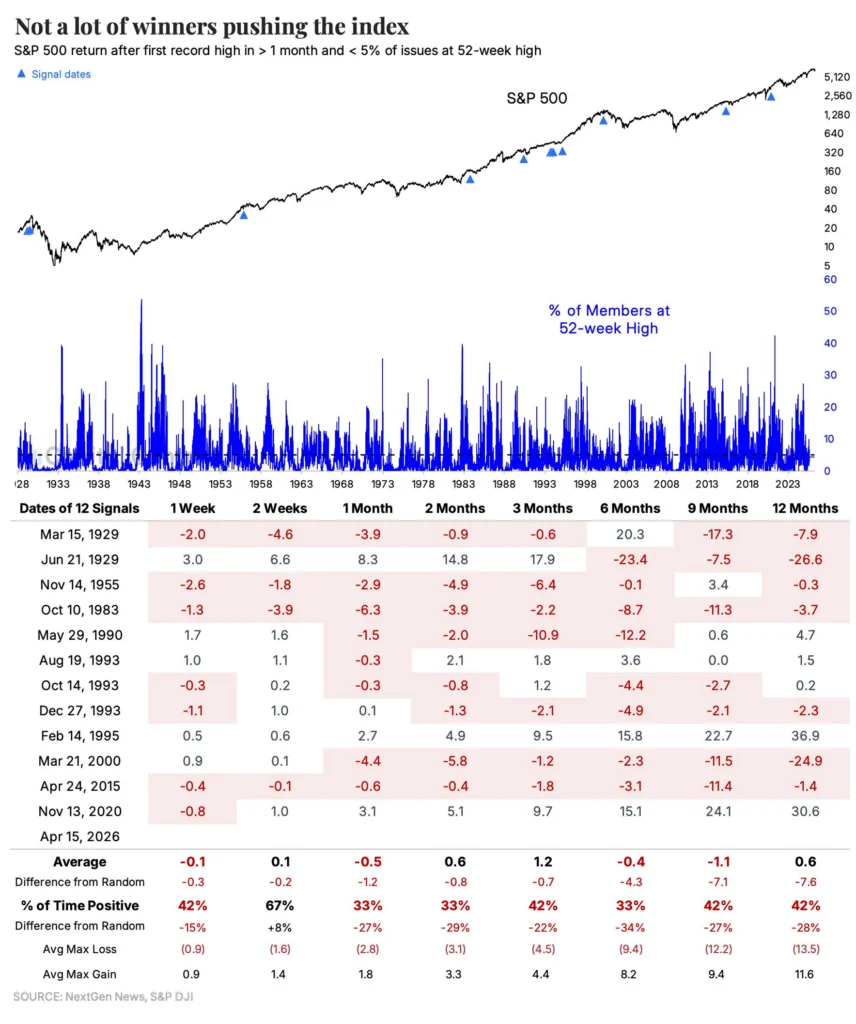
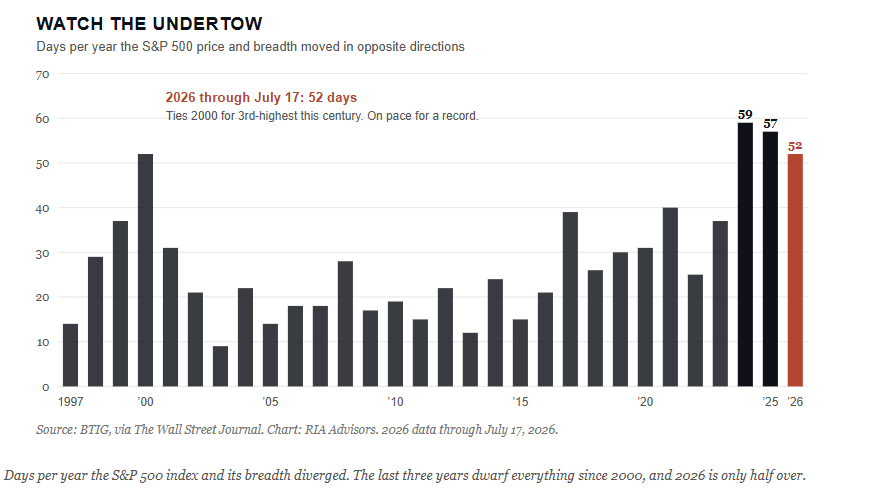
Statistical data supports this concern. According to analysis from BTIG, there have been 52 sessions this year in which the S&P 500 closed in one direction while the majority of its constituent stocks closed in the opposite direction. This ties the record set in the year 2000 for the third-highest count of such divergences in this century. With several months remaining in the year, 2026 is on track to break the all-time record for market divergence. This follows the logic of Bob Farrell’s Rule #7, which states that markets are strongest when they are broad and weakest when they narrow to a handful of leaders. Historically, when these relationships normalize, it often results in the leaders "catching down" to the laggards rather than the laggards rallying to meet the leaders.
Sector Rotations and the "Magnificent Seven" Lag
The technical setup of the market suggests that the "Magnificent Seven"—the group of tech titans that led the 2023-2024 rally—is beginning to lose its grip. Software stocks turned bearish earlier this year, and the semiconductor sector, once the engine of the market, has transitioned into a volatile trend. Notably, Oracle recently hit a multi-year low, dropping nearly 50% from its June highs.
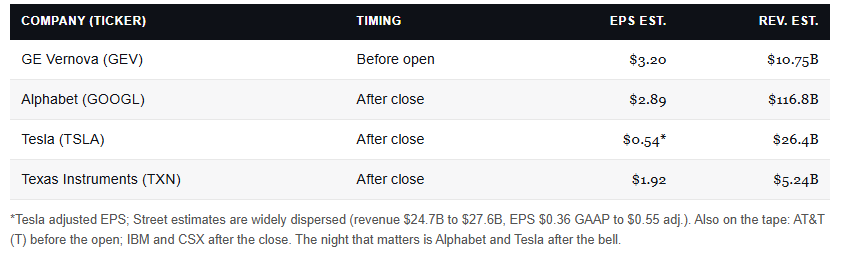
While Tuesday saw a reflexive bounce in semiconductor stocks, market veterans warn that sharp rallies are often a feature of downtrends rather than proof of a bottom. With the Federal Reserve currently in a "blackout period" ahead of its July 28-29 meeting, there will be no central bank commentary to influence market sentiment. This leaves the equity market to trade purely on earnings fundamentals. The Alphabet and Tesla reports tonight will be the ultimate test of whether the mega-cap bid can be sustained.
Nike: A SWOT Analysis of a Legacy Giant in Crisis
Outside of the technology sector, investors are closely monitoring Nike, which has become a symbol of the challenges facing legacy consumer brands. Nike has lost approximately 65% of its market value since its peak in November 2021. Now trading near a decade low with flat annual revenues of $46.4 billion, the company is at a strategic crossroads.
Strengths:
Nike remains the world’s most recognizable athletic brand with an unparalleled global distribution network. Its dividend has grown by an average of 11% annually over the last decade and remains well-covered by earnings. The return of veteran executive Elliott Hill as CEO has sparked some optimism. Hill is pivoting the company back toward wholesale partnerships and sport-focused marketing, a move away from the previous administration’s aggressive but ultimately flawed Direct-to-Consumer (DTC) focus. Early signs of success were visible in the 4% growth of wholesale revenues in the most recent quarter.
Weaknesses:
The transition has been painful. Nike Direct revenues fell 7% in the fourth quarter, and gross margins compressed by 1.3% to 40.2%. The company has been forced to use heavy discounting to clear excess inventory, which has eroded brand equity and profitability. Furthermore, the Chinese market, once a reliable engine of growth, continues to be a persistent drag on the balance sheet.

Opportunities:
Wall Street analysts remain somewhat divided, but the average price target of $59.58 implies a nearly 40% upside from current levels. Earnings per share (EPS) are forecasted to grow 60% over the next three years if the turnaround plan succeeds. The 2026 FIFA World Cup and other global sporting events provide Nike with a massive platform to reassert its brand dominance through its 12 national team sponsorships.
Threats:
The competitive landscape has shifted. Nimbler newcomers like On Holding and Hoka have successfully captured market share in the premium performance footwear sector, particularly among runners. Additionally, Nike faces external risks such as tariff uncertainties and the potential embarrassment of being removed from the Dow Jones Industrial Average. Such a removal would trigger significant selling from passive funds that track the index.

Strategic Implications for Portfolio Management
Given the high levels of concentration in AI-related names and the deteriorating market breadth, financial advisors are increasingly advocating for a "rebalance, don’t chase" strategy. Many equity models have begun trimming positions in extended semiconductor winners to return to target weights, shifting capital into higher-quality, less volatile assets.
The broader implication of the upcoming earnings reports is whether the AI narrative can transition from a speculative phase to an operational phase. If Alphabet and Intel can demonstrate that their massive investments are translating into sustainable margin expansion and eventually higher free cash flow, the market may find its footing. However, if the reports confirm that the "capex cliff" is approaching without a corresponding surge in revenue, the "catch-down" scenario for the broader market becomes increasingly likely.

As the week progresses, the focus will remain on whether the underlying "paddling" of the market eventually breaks the surface calm, or if the technology sector’s fundamentals are strong enough to carry the weight of an increasingly narrow market. Managing risk at the technical lines and waiting for breadth to confirm the next leg of the market will be essential for investors navigating this volatile earnings season.