Brent Crude Oil Surges Past $105 Per Barrel Amid Severe Middle East Escalation and Supply Choke Points

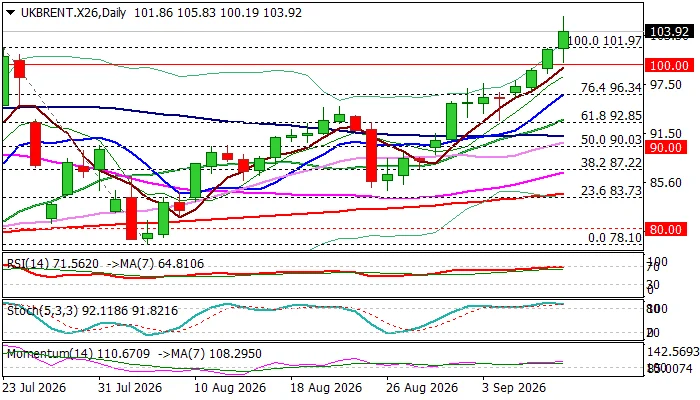
Global energy markets experienced a dramatic escalation on Thursday as Brent crude prices surged by more than $3, piercing through psychological barriers to trade near the $106 threshold—a valuation not witnessed since May 22. This aggressive upward trajectory follows a decisive mid-week break and daily close above the pivotal $100-per-barrel mark, a technical event that triggered widespread algorithmic and institutional buying. With prices having climbed over 30% from their early August lows, market participants are increasingly alarmed by the convergence of severe geopolitical flashpoints in the Middle East, structural supply chain bottlenecks, and the looming threat of an uncontrolled energy price spiral that could severely exacerbate global inflationary pressures.
The immediate catalyst for Thursday’s explosive market movement lies in a steep and dangerous deterioration of security dynamics in the Middle East. Recent days have seen direct kinetic engagements between United States forces and Iranian assets, highlighted by reported U.S. strikes targeting Iranian oil tankers. In retaliation, regional actors aligned with Tehran have launched coordinated attacks against U.S. military installations and naval assets stationed in the region. These military exchanges have instantly transformed latent geopolitical risks into acute supply shocks, dismantling any lingering market complacency regarding the security of regional crude flows.
Compounding the crisis is the near-total paralysis of key maritime energy arteries. The Strait of Hormuz, through which roughly a fifth of the world’s petroleum consumption passes, remains virtually closed to commercial tanker traffic due to extreme security hazards. Meanwhile, new threats articulated by Yemen’s Houthi movement to interdict and close another vital maritime choke point—the Bab el-Mandeb strait, which connects the Red Sea to the Gulf of Aden—have sent seismic shockwaves through global shipping and energy desks. The simultaneous vulnerability of these two critical trade routes threatens to sever international supply chains on a scale not seen in decades, forcing refiners and energy traders to aggressively reprice risk.
Chronology of the Current Oil Market Rally
To understand the magnitude of the current market distress, it is necessary to examine the swift trajectory that brought Brent crude from sub-$80 levels to the doorstep of $106.
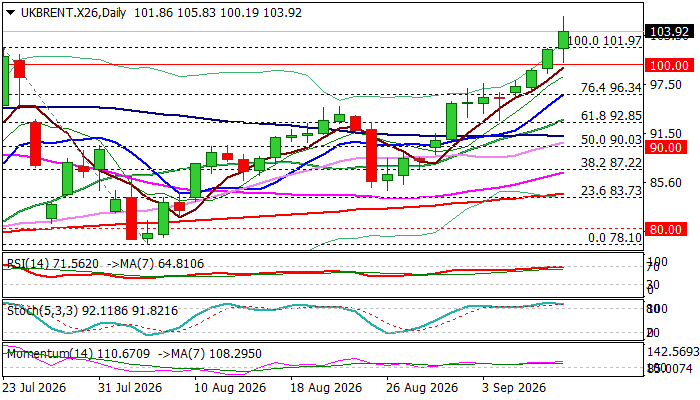
The origin of the current impulsive five-wave bullish cycle can be traced back to August 5, when Brent crude registered a local cyclical low of $78.10 per barrel. At that time, market sentiment was predominantly weighed down by macroeconomic concerns, including sluggish industrial demand in China and expectations of subdued global economic growth.
However, geopolitical undercurrents began to shift in mid-summer. Throughout July, persistent skirmishes and naval standoffs in the Persian Gulf and Red Sea steadily raised the risk premium embedded in futures contracts. By July 23, Brent reached a local peak of $101.97 before experiencing a brief, corrective consolidation phase.
As August progressed, diplomatic efforts to secure regional ceasefires stalled completely. The situation deteriorated past a tipping point in the final week of August, culminating in direct military engagements involving U.S. forces and Iranian maritime units. When Brent definitively broke and closed above the psychologically crucial $100 barrier on Wednesday, it invalidated the previous consolidation pattern and unleashed a wave of heavy buying. On Thursday, the market opened with strong upward momentum, rapidly tacking on another $3 to test the $106 resistance zone, driven by acute fears of impending physical supply shortages.

Underlying Market Data and Key Technical Levels
From a quantitative and technical standpoint, the energy market is exhibiting classic hallmarks of a strong, momentum-driven breakout. Analysts tracking the daily charts note that the decisive penetration of the $100 threshold, followed by the clearing of the former July 23 peak at $101.97, has established a formidable technical foundation.
The ongoing price action is currently interpreted as riding the third wave of a robust five-wave Elliott Wave cycle originating from the August 5 low of $78.10. Market technicians have identified the next major upside price target at $107.71, which corresponds to the 138.2% Fibonacci extension level. Beyond that, subsequent resistance zones are mapped out at $105.83, $108.42, and the highly psychological $110.00 milestone.
Conversely, market analysts point out that the speed and scale of the rally have pushed short-term technical indicators into overbought territory. This condition increases the likelihood of limited, tactical profit-taking as short-term speculators lock in gains. However, analysts emphasize that any potential pullbacks are expected to be shallow and well-supported. The newly converted resistance-turned-support level at $101.97 is projected to absorb selling pressure, acting alongside the broader $100 psychological floor to guard against deeper market corrections.
Immediate support levels are currently pegged at $103.45, followed by $101.97, $100.80, and the critical baseline of $100.00. As long as prices remain above these structural boundaries, the broader bullish market structure remains intact.
Industry and Official Responses
While formal diplomatic channels have entered crisis mode, initial statements from international energy bodies, shipping associations, and government officials reflect profound anxiety over the fragility of global supply lines.
Executives within the international shipping sector have expressed deep dismay over the viability of transit through the Red Sea and the Persian Gulf. Major container lines and independent tanker operators have increasingly ordered vessels to bypass regional waters entirely, opting for the vastly longer and more expensive route around Africa’s Cape of Good Hope. Industry representatives have warned that these mandated detours add weeks to transit times and exponentially increase freight, insurance, and fuel costs, which will inevitably be passed down to consumers.
Meanwhile, representatives from major energy importing nations have held emergency consultations to review strategic petroleum reserve (SPR) release options. Although no formal coordinated release has been announced by the International Energy Agency (IEA) or individual member states as of Thursday, policymakers are acutely aware that prolonged disruptions in the Strait of Hormuz cannot be fully offset by spare production capacity elsewhere in the world, particularly given that much of the remaining global spare capacity resides within the very region experiencing active military hostilities.
Economic Implications and Global Macroeconomic Fallout
The rapid ascension of crude oil prices past the $100-per-barrel threshold carries profound macroeconomic implications that extend far beyond energy markets. For months, central banks in advanced economies—including the U.S. Federal Reserve, the European Central Bank, and the Bank of England—have fought a grueling campaign to bring post-pandemic inflation back down toward their target rates of 2%.
A sustained oil price regime above $100 threatens to unravel much of that hard-won progress. Energy costs permeate every sector of the global economy, directly impacting transportation, manufacturing, agriculture, and retail distribution. As fuel and petrochemical feedstock prices surge, producers face mounting cost pressures that inevitably translate into higher consumer prices for goods and services.
This renewed inflationary impulse complicates the policy calculus for central bankers. Just as weakening economic growth in various regions was beginning to justify discussions of monetary policy easing and interest rate reductions, the oil shock introduces the terrifying prospect of stagflation—a macroeconomic environment characterized by stagnant economic growth coupled with persistently high inflation. Financial markets are already beginning to price in the likelihood that interest rates will need to remain higher for longer to anchor inflation expectations, a realization that has contributed to broader volatility across global equity and bond markets.
Furthermore, emerging market economies that are net energy importers face severe balance-of-payments pressures. A steep appreciation in the U.S. dollar, combined with historically expensive crude oil, threatens to drain foreign exchange reserves in developing nations, raising the risk of sovereign debt distress and domestic social unrest fueled by rising food and energy poverty.
Outlook and Future Risks
Looking ahead, the trajectory of the global oil market remains inextricably linked to the military and diplomatic developments unfolding in the Middle East. Absent a sudden de-escalation of hostilities and tangible security guarantees for commercial shipping in the Strait of Hormuz and the Bab el-Mandeb strait, the upward bias in energy prices is expected to persist.
Traders and macro strategists will be closely monitoring weekend diplomatic developments, statements from OPEC+ regarding potential output adjustments to compensate for shut-in volumes, and any further operational updates from naval forces patrolling the region. Until physical barrels begin moving reliably through these critical chokepoints once more, the shadow of supply scarcity will continue to dominate market psychology, keeping energy markets on high alert and threatening to push prices toward the upper bounds of current technical forecasts.