The New Era of Market Concentration and the S&P 500 Dominance

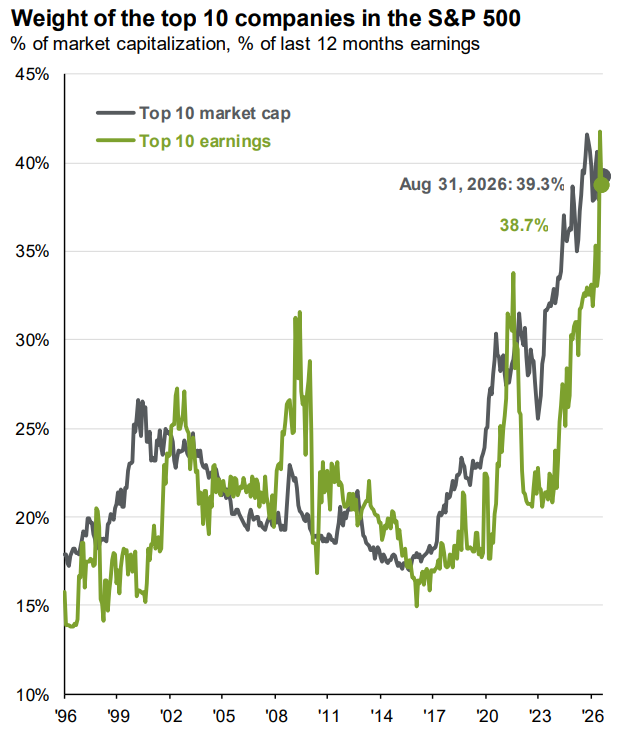
The United States equity market has reached an unprecedented level of concentration, with the top 10 companies now accounting for nearly 40% of the total weight of the S&P 500 index. As of September 2026, the threshold for joining the ranks of the market’s largest players has shifted dramatically; there are now 12 individual companies that each command a market capitalization exceeding $1 trillion. This phenomenon represents a seismic shift from historical norms, such as in 2015, when the top 10 companies comprised only 17% of the index. For institutional investors and retail participants alike, this structural evolution raises critical questions regarding portfolio risk, diversification, and the long-term sustainability of current market trends.
The Chronology of Market Expansion
To understand the current state of the S&P 500, one must view the trajectory of the last decade. Following the post-2008 recovery, the market began a slow but steady tilt toward technology-heavy, high-growth entities. By 2018, analysts began documenting an accelerating trend of concentration, which many feared would leave the index vulnerable to idiosyncratic shocks. However, instead of a market correction or a broad-based stagnation, the subsequent years—driven by breakthroughs in cloud computing, semiconductor demand, and the integration of artificial intelligence—solidified the dominance of a small cohort of mega-cap firms.
By the middle of 2026, the "four comma club"—companies with market caps over $1 trillion—expanded to include stalwarts such as Berkshire Hathaway and Eli Lilly, joining the traditional tech giants. This expansion underscores that concentration is no longer confined to software and digital platforms but has permeated healthcare, finance, and industrial conglomerates, suggesting that the "new normal" of market structure is a broad-based transformation of the American corporate landscape.
Analyzing the Bull Market Correlation
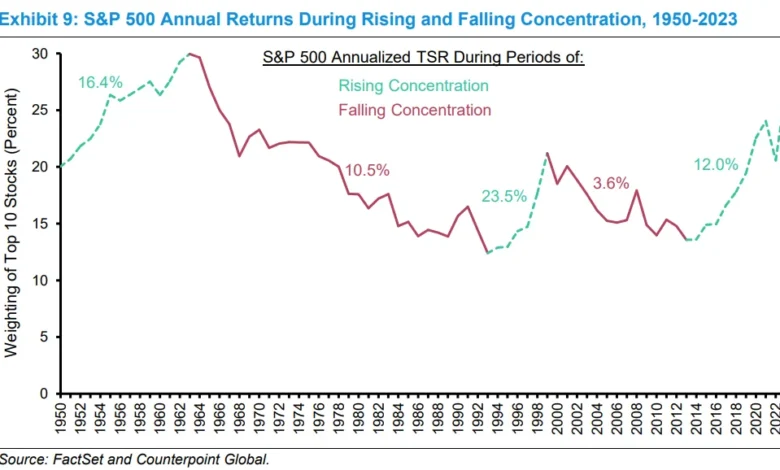
Historical data compiled by researchers at Morgan Stanley, including insights from Michael Mauboussin and Dan Callahan, suggests a paradoxical relationship between market concentration and index performance. Their findings indicate that S&P 500 returns have historically trended above average during periods of rising concentration, while periods of declining concentration often coincide with lackluster index performance.
This correlation challenges the conventional wisdom that a "narrow" market is inherently unstable. Instead, the data suggests that in modern capital markets, the largest companies are often the most efficient drivers of economic growth. When these firms capture an increasing share of index weight, it is frequently because they are capturing an increasing share of global corporate earnings. Consequently, the rise in market concentration is not necessarily a signal of an impending crash, but rather a reflection of the "winner-take-most" dynamics inherent in the digital age.
Global Context: The U.S. vs. The World
While domestic investors often express concern regarding the concentration of the S&P 500, international comparisons provide a sobering perspective. Global stock markets, by and large, exhibit significantly higher levels of concentration than their American counterpart. In many emerging and developed economies, the top 10 companies represent a majority of the entire market capitalization.
For example, the South Korean stock market stands as a case study in extreme concentration. In this ecosystem, the top 10 companies account for approximately 80% of the total market capitalization, with just two entities commanding nearly 50% of the market’s value. When viewed through this global lens, the S&P 500 remains relatively diversified. Among major developed nations, only India and Japan maintain lower levels of top-10 concentration than the United States. This structural reality suggests that the U.S. market’s current state is not an anomaly, but rather a alignment with the global trend toward corporate consolidation.
Fundamental Drivers and Earnings Power
The central question for market participants is whether the current market cap weights are supported by underlying business fundamentals. JPMorgan’s recent analytical reporting on index composition reveals a striking alignment between market capitalization and earnings contributions. The top 10 companies, which represent roughly 40% of the index’s market value, also contribute a commensurate share of the index’s total earnings.
This data serves as a vital counterpoint to the "bubble" narrative. If these companies were overvalued based purely on speculative fervor, one would expect a widening gap between their market weight and their share of net income. Instead, the data confirms that these entities are effectively acting as the engines of the modern economy. Their ability to generate substantial cash flow allows them to reinvest in R&D, maintain robust balance sheets, and outpace smaller competitors during periods of macroeconomic volatility.

The Artificial Intelligence Factor
Looking toward the near future, the integration of generative artificial intelligence is expected to further reshape the index. As companies like SpaceX, OpenAI, and Anthropic—and other burgeoning AI-native firms—prepare for potential public offerings or entry into the S&P 500, the landscape of "mega-cap" tech is likely to expand further.
This prospect has prompted a broader societal and economic debate. Figures such as Bill Gates have noted the dual-edged nature of this technological revolution: "In terms of equity, AI will either be the greatest equalizer ever invented, or the worst source of injustice." From an investment perspective, this reflects the potential for AI to either democratize opportunity by lowering the barriers to starting and scaling a business or to deepen the concentration of wealth and market power within a handful of dominant, data-rich corporations.
Implications for Long-Term Investors
For the average investor, the concentration of the S&P 500 necessitates a reassessment of passive strategies. While index funds remain the cornerstone of retirement planning, the reliance on a narrow cohort of stocks means that systemic risks associated with those specific industries—such as regulatory scrutiny, antitrust litigation, or sector-specific technology shifts—now have an outsized impact on overall portfolio performance.
However, historical patterns suggest that attempting to "time" this concentration or betting against the largest companies has historically been a losing proposition. The current system appears to reward scale, and as the global economy continues to prioritize efficiency and technological advancement, the largest corporations are positioned to maintain their dominance.
In conclusion, while the headline figures regarding S&P 500 concentration are indeed historic, they are supported by empirical fundamentals and global market trends. The challenge for investors is not to fear the size of these giants, but to understand the fundamental changes in the global economy that have necessitated their growth. As we look toward the remainder of the decade, the ability of these top-tier firms to sustain their earnings power will remain the primary determinant of whether this concentration is a sign of a healthy, evolving market or a precursor to a more rigid, consolidated economic future. Investors must remain cognizant that while the index may be narrow, the factors driving it are deeply rooted in the current reality of technological and financial acceleration.