Building Adaptive Trading Systems Through Machine Learning and Regime Detection

The failure of conventional trading strategies is frequently rooted in the assumption of market stationarity—the belief that the statistical properties of a financial time series remain constant over time. In reality, global markets are dynamic, shifting unpredictably between periods of low-volatility stability and high-volatility turbulence. A strategy optimized for a tranquil, trending environment often falters when confronted with sudden structural breaks or liquidity crises. To address this, quantitative researchers are increasingly turning to adaptive, regime-aware frameworks that utilize machine learning to calibrate decision-making processes in real-time. By segmenting market data into distinct "regimes," traders can deploy specialist models tailored to the specific behavioral characteristics of current market conditions.
The Evolution of Quantitative Market Analysis
Historically, algorithmic trading relied heavily on static technical indicators, such as moving averages or Relative Strength Index (RSI) thresholds. While effective in specific historical windows, these models lacked the elasticity to handle the complex, non-linear shifts inherent in assets like Bitcoin or equity indices. The introduction of Hidden Markov Models (HMM) into the financial toolkit has provided a robust method for unsupervised learning. HMMs allow analysts to infer unobserved market states—such as "bearish-volatile" or "bullish-calm"—based on observable data like price returns and volume.
The shift toward adaptive systems gained significant momentum following the 2008 global financial crisis, which highlighted the fragility of standard risk-parity models. Since 2010, the integration of Python-based libraries such as Pandas, Scikit-learn, and Statsmodels has democratized access to sophisticated modeling. Today, the industry standard for testing such adaptability is the walk-forward optimization (WFO) framework. Unlike standard backtesting, which uses a single training window, WFO continuously retrains models on rolling, forward-moving data subsets, effectively simulating the "learning" process an algorithm would undergo in a live, real-time environment.
Chronology of Strategy Development and Implementation
The development of an adaptive trading framework follows a systematic, multi-stage pipeline designed to minimize human bias and maximize predictive accuracy.
- Data Acquisition and Pre-processing: The initial phase involves the extraction of historical time-series data. High-frequency or daily returns are cleaned for outliers and missing values to ensure the integrity of the input features.
- Feature Engineering: Raw price data is insufficient for machine learning models. Researchers derive auxiliary features, including moving averages, volatility measures (e.g., GARCH models), and momentum oscillators, which serve as predictors for the target signal.
- Regime Identification: Using an HMM, the system categorizes the current market state. This acts as a classification layer that informs the subsequent model selection.
- Specialized Training: The system maintains a portfolio of predictive models. For instance, a Random Forest classifier may be deployed during high-volatility regimes, while a Logistic Regression model might be preferred during stable, trending periods.
- Backtesting and Execution: The strategy is executed across historical datasets using the walk-forward methodology, where the model’s performance is monitored, and parameters are adjusted as the "window" of time advances.
Empirical Performance Data and Comparative Analysis
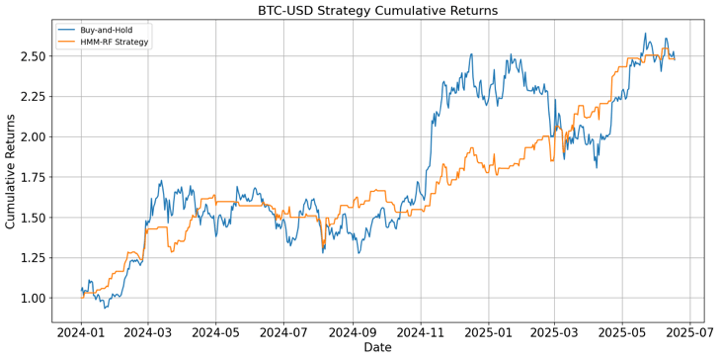
Recent simulations applying this adaptive methodology to Bitcoin (BTC/USD) highlight the stark difference between passive buy-and-hold strategies and adaptive machine-learning approaches. In a comparative backtest spanning from January 2024 to early 2025, the adaptive strategy exhibited a significant reduction in volatility while maintaining competitive returns.
| Metric | Buy & Hold | Adaptive Strategy |
|---|---|---|
| Annualized Return | 50.21% | 53.55% |
| Annual Volatility | 43.06% | 26.24% |
| Sharpe Ratio | 1.16 | 1.76 |
| Maximum Drawdown | -28.14% | -20.03% |
| Sortino Ratio | 1.83 | 3.03 |
The data indicates that while the adaptive strategy yields higher cumulative returns, the most critical advantage is the improvement in risk-adjusted performance. A Sharpe ratio of 1.76, compared to the market benchmark of 1.16, suggests that the strategy generates superior returns per unit of risk. The reduction in maximum drawdown—from -28.14% to -20.03%—demonstrates the effectiveness of regime-based filtering in mitigating exposure during chaotic market cycles.
Institutional Perspectives on Algorithmic Adaptability
Industry experts at institutions like QuantInsti emphasize that the move toward adaptive systems represents a fundamental shift in risk management. By treating the market as a shifting environment rather than a static system, firms are better positioned to protect capital during "black swan" events or prolonged liquidity droughts.
"The core of modern quantitative finance is not finding the single best model, but finding the right model for the current context," noted analysts in recent industry reviews. This sentiment is supported by the increasing adoption of ensemble methods, where multiple models—such as XGBoost for time-series forecasting or Neural Networks for pattern recognition—are combined to produce a more robust consensus signal. Furthermore, the inclusion of risk-management layers, such as position sizing based on model conviction, ensures that the system scales its exposure down during periods of high model uncertainty.
Implications for Future Market Dynamics
The maturation of these technologies carries significant implications for the broader financial ecosystem. First, the widespread use of automated, adaptive systems tends to tighten market efficiency, as mispricings are identified and exploited more rapidly. Second, it shifts the focus of algorithmic trading from "signal hunting" to "regime classification," placing a premium on data science capabilities and computational infrastructure.
However, challenges remain. Over-optimization, or "curve-fitting," remains a perennial risk in machine learning. If a model is too granular in its regime detection, it may begin to "noise-trade," reacting to random market fluctuations rather than genuine structural shifts. To counter this, practitioners emphasize the importance of robust cross-validation and the use of out-of-sample testing to ensure that the adaptive logic remains generalizable.
Strategic Recommendations for Implementation
For developers and quantitative traders seeking to implement similar frameworks, the path forward involves a structured, modular approach:
- Modular Architecture: Maintain separation between the data ingestion, regime detection, and signal generation modules to allow for rapid testing of new algorithms.
- Alternative Data Integration: Incorporate non-price data, such as sentiment analysis from news feeds or order-book depth, to enhance the regime detection capability.
- Risk-Centric Design: Prioritize capital preservation. Position sizing should be dynamically linked to the model’s confidence level and the current volatility regime.
- Continuous Learning: Markets evolve, and historical models may degrade. Implementing a mechanism for periodic re-training and performance monitoring is essential for long-term viability.
In conclusion, the integration of adaptive logic via machine learning signifies a necessary evolution in algorithmic trading. As financial markets become increasingly interconnected and reactive, the ability of a strategy to detect, adapt, and specialize based on the current regime will likely distinguish sustainable, high-performing funds from those susceptible to abrupt market shifts. The framework presented here serves as a foundational architecture, offering a pathway toward more resilient and intelligent market participation. By moving away from rigid, one-size-fits-all rules, traders can navigate the complexities of the modern financial landscape with greater precision and improved risk-adjusted outcomes.