The Taguchi Method and Robust Design in Algorithmic Trading

In the world of systematic trading, quantitative analysts and algorithmic developers have long grappled with a persistent paradox: a strategy can display a flawless backtest, generating stellar theoretical returns across historical datasets, only to experience catastrophic failure upon deployment in live markets. This phenomenon, widely recognized as curve-fitting or overfitting, remains the single greatest hurdle for retail and institutional traders alike. To solve this dilemma, modern quantitative platforms are increasingly borrowing industrial engineering frameworks from outside finance. Among the most influential of these is the Taguchi Method, an off-line quality control system originally engineered to manufacture durable physical products amidst chaotic real-world conditions.
By translating Genichi Taguchi’s decades-old quality engineering principles into the realm of modern algorithmic trading, quantitative platforms such as Build Alpha are reshaping how trading strategies are conceptualized, tested, and filtered. Rather than optimizing for historical optimization curves, this paradigm shift prioritizes structural resilience—ensuring that trading models can withstand the inherent noise, volatility shocks, and regime changes characteristic of modern financial markets.
Who Was Genichi Taguchi and What Is Robust Design?
Genichi Taguchi was a towering figure in twentieth-century quality engineering and experimental design. Emerging out of post-war Japan, Taguchi revolutionized manufacturing methodologies by shifting the corporate mindset away from traditional pass-fail inspection paradigms. Historically, quality control meant verifying whether a manufactured product fell within narrow specification limits. If a part met the criteria, it was approved; if it missed, it was discarded. Taguchi argued that this binary approach was deeply flawed.
Instead, Taguchi introduced the concept of "off-line quality control" and the "Taguchi Loss Function." He posited that any deviation from a targeted performance value creates a societal or economic loss, which grows exponentially the further the result drifts from the target. Crucially, Taguchi emphasized that a truly high-quality design is not merely one that performs well on average under ideal conditions, but one that minimizes performance variation when exposed to uncontrolled external disturbances—a philosophy he termed "robust design."
When mapped directly onto financial markets, Taguchi’s core philosophy offers a profound critique of standard backtesting. A trading strategy that performs exceptionally well during a specific, narrow historical window—such as a prolonged bull market or a low-volatility regime—but collapses under minor parameter adjustments or data perturbations is not a high-quality model. In Taguchi’s framework, such a strategy represents a fragile design that inevitably produces systemic financial loss upon encountering real-world friction.
Controllable Factors Versus Noise Factors in Quantitative Trading
At the heart of the Taguchi Method is the strategic bifurcation of variables into two distinct categories: controllable factors and noise factors. Understanding and segregating these variables allows quantitative developers to engineer systems that remain indifferent to external instability.
Controllable factors encompass the parameters and inputs that the designer can explicitly select and manipulate. In the context of algorithmic trading, these variables include entry and exit logic, technical indicator parameters, stop-loss and profit-target behaviors, holding periods, execution timeframes, portfolio weighting schemes, and position-sizing algorithms. These are the building blocks that a trader deliberately chooses to construct a systematic model.
Conversely, noise factors represent the variables that generate variation and cannot be fully controlled or predicted. In financial markets, noise factors are manifold: unexpected macroeconomic regime shifts, sudden liquidity crunches, structural volatility changes, variations in bid-ask spreads, execution slippage, historical start-date sensitivity, and incomplete sample windows. Furthermore, quantitative researchers often simulate artificial market paths—such as synthetic data or perturbed price series—to act as deliberate noise vectors.
The overarching objective of the Taguchi-inspired trading framework is to select and configure controllable factors so that the strategy’s output becomes inherently insensitive to these noise factors. Traders cannot control the macroeconomic landscape, nor can they dictate market liquidity; therefore, robust design dictates that a strategy must be built so that it does not require market noise to cooperate in order to generate alpha.
The Inner Array and Outer Array Testing Framework
To systematically evaluate designs against noise, Taguchi developed a matrix-based experimental structure known as the inner and outer array approach. In industrial engineering, the inner array houses the controllable design factors, while the outer array injects various combinations of environmental noise factors into the experiment. Every candidate design is consequently subjected to a battery of external stresses, allowing analysts to examine both the mean performance and the variance of the output simultaneously.
In modern algorithmic trading, this experimental blueprint translates directly into advanced robustness testing pipelines. Rather than evaluating a strategy based solely on a solitary, clean historical backtest, quantitative platforms implement stress-testing environments that deliberately disturb the underlying data and parameters.
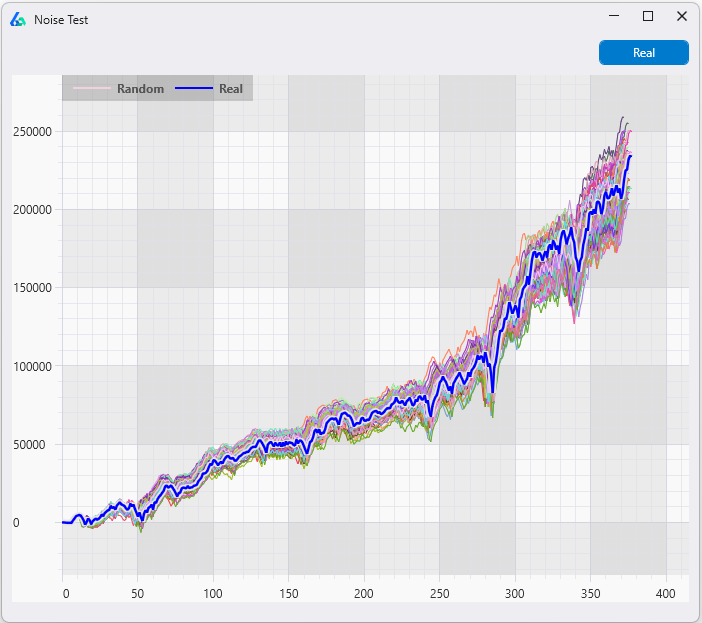
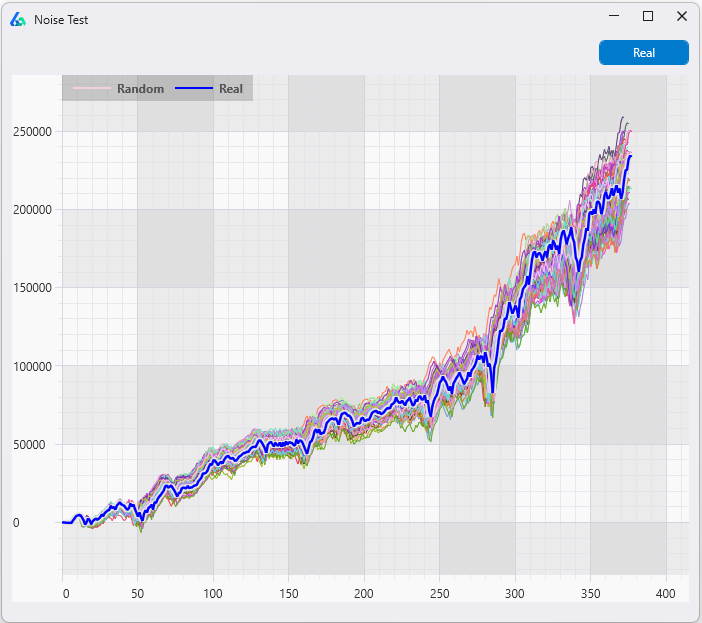
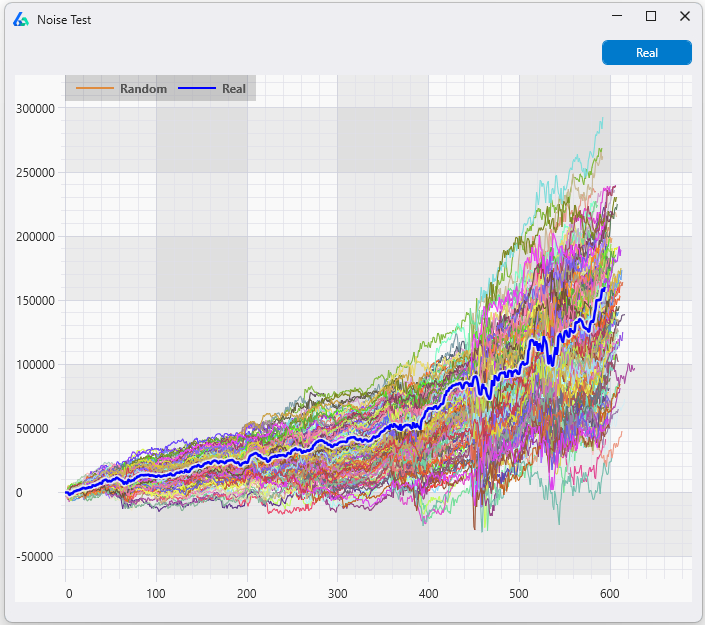
Modern equivalents of Taguchi’s outer array include Monte Carlo simulations, walk-forward optimizations, out-of-sample testing, and specialized noise tests. For instance, a noise test introduces controlled random perturbations into historical price series—shifting trade execution prices slightly or altering data streams—to observe whether the equity curve maintains its integrity or scatters wildly.
Through this lens, the traditional pursuit of the "highest net profit" backtest is revealed to be statistically perilous. A strategy yielding extraordinary returns under pristine historical conditions frequently exhibits extreme fragility when exposed to outer array noise testing. Conversely, a strategy with modest average returns but remarkably tight distribution bounds across thousands of perturbed noise iterations often proves to be the superior, safer choice for live capital deployment.
Translating Taguchi Concepts to Systematic Trading
To bridge the gap between industrial quality engineering and quantitative finance, practitioners have mapped Taguchi’s technical terminology directly to algorithmic development workflows:
| Taguchi Engineering Concept | Algorithmic Trading Equivalent |
|---|---|
| Controllable Factors | Entry/exit logic, stops, timeframes, filters, position sizing |
| Noise Factors | Regime shifts, volatility changes, slippage, date sensitivity |
| Inner Array | Strategy design space and rule combinations being tested |
| Outer Array | Stress environments, Monte Carlo paths, synthetic data, walk-forward windows |
| Signal-to-Noise Ratio (SNR) | Mean strategy performance relative to variance across noise tests |
| Robust Design | Strategies that successfully survive rigorous multi-factor stress tests |
| Loss Function | Drawdown depth, return variance, and performance degradation under stress |
By organizing quantitative research around these equivalents, developers can calculate a trading-specific Signal-to-Noise Ratio. This metric evaluates whether a strategy’s profitability stems from a genuine, persistent market edge (the signal) or merely from capturing historical data quirks and random noise (the artifact).
Practical Robustness Formulas and Automated Workflows
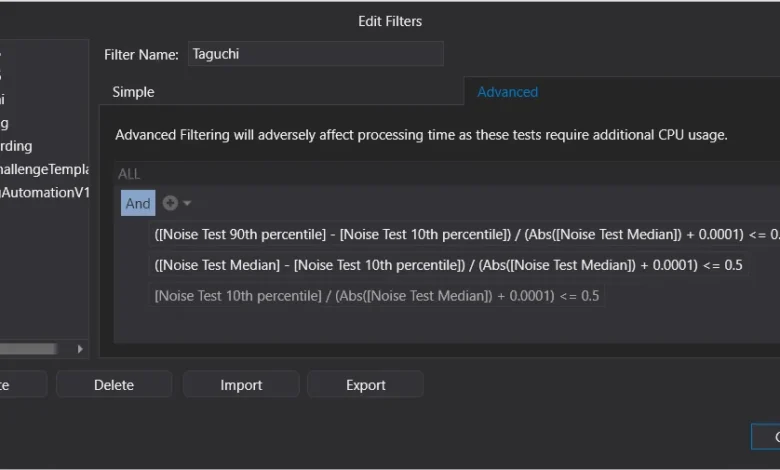
To operationalize the Taguchi philosophy within modern software architectures, quantitative platforms utilize mathematical formulas that reward consistent central performance while severely penalizing sensitivity to noise. Rather than relying on qualitative guesswork, developers implement automated algorithmic filters based on explicit statistical thresholds.
- Normalized Percentile Spread: This metric calculates the dispersion of performance outcomes across numerous noise-adjusted tests relative to the median result (P90 minus P10 divided by the absolute median). A lower spread indicates high stability, whereas a wider spread highlights dangerous parameter or data sensitivity.
- Downside Robustness Loss: By isolating the left tail of the performance distribution (Median minus P10 divided by the absolute median), this formula measures how severely the weaker scenarios fall below the central expected outcome. Because traders are inherently risk-averse, quantifying downside degradation is critical for capital preservation.
- Survival Ratio Under Stress: This calculation evaluates what proportion of the median performance remains intact during adverse lower-tail scenarios (P10 divided by the absolute median). It acts as an effective filter for eliminating strategies that appear viable on average but harbor catastrophic tail risks.
When integrated into an automated strategy generation pipeline—such as those deployed by Build Alpha—these formulas transform the development lifecycle. Instead of scanning historical databases solely for the highest backtest equity curve, the automated system runs thousands of candidate models through a gauntlet of noise tests, synthetic data variations, and randomized permutations. Only those strategies that satisfy strict central performance metrics and low-variance dispersion thresholds are returned to the user.
Case Studies: Tight Clustering Versus Wide Dispersion
Empirical evaluations of trading strategies subjected to noise testing vividly illustrate the practical value of Taguchi’s robust design principles. In comparative case studies examining models with nearly identical initial backtest profiles, the underlying structural differences become immediately apparent when artificial noise is introduced.
Strategies characterized by fragile designs display wide dispersion across equity curve iterations during noise testing. These models were fundamentally overfit to historical noise; minor perturbations in price data or execution timing cause the cumulative returns to scatter chaotically, signaling an absence of a true market edge.
Conversely, robustly designed strategies exhibit tight clustering of equity curves throughout identical noise test iterations. Despite deliberate data disturbance, the overall trajectory of the equity curve remains stable, proving that the strategy’s profitability relies on structural market inefficiencies rather than delicate, curve-fitted parameter values. In Taguchi’s terminology, both designs may have hit the target performance metric in the initial backtest, but only the tightly clustered strategy demonstrated true insensitivity to environmental noise.
Limitations and the Importance of a Comprehensive Pipeline
Despite its profound utility, industrial historians and statistical purists have noted that Taguchi’s original methodologies are not without valid criticism. Certain aspects of his experimental design—such as his heavy reliance on specific orthogonal arrays—can occasionally overlook complex interaction effects between multiple controllable factors.
In the context of algorithmic trading, ignoring factor interactions can be hazardous. A technical filter may successfully enhance performance only when paired with a specific exit mechanism; a volatility stop-loss may function efficiently on daily timeframes while failing completely on intraday execution; and a parameter set may appear stable simply because an unmeasured variable is masking underlying structural flaws.
Consequently, quantitative analysts agree that the Taguchi Method should be embraced as an overarching philosophy of robustness rather than an infallible, isolated tool. No single statistical test can guarantee future market performance. Instead, successful systematic trading relies on a comprehensive, multi-layered validation pipeline.
Broader Implications for Systematic Traders
The integration of industrial engineering principles into algorithmic trading marks a mature evolution in retail and institutional quantitative research. As computational power accelerates and strategy generation becomes increasingly automated, the primary challenge for traders has shifted from data scarcity to data abundance. With the capacity to generate thousands of algorithmic models in seconds, the risk of selecting a curve-fitted, overfit strategy has never been higher.
By adopting the Taguchi philosophy—shifting the focus from isolated optimization to noise-resistant, robust design—traders can fundamentally alter their development paradigm. Automated workflows that incorporate multi-layered stress testing, noise injection, and dispersion filtering enable market participants to break their strategies conceptually before the unpredictable realities of live markets do. Ultimately, the transition from building the best historical backtest to engineering the most robust trading system represents the definitive boundary between transient trading failures and long-term, scalable quantitative success.