Mastering Triangulated Statistical Arbitrage: A Comprehensive Framework for Independent Traders

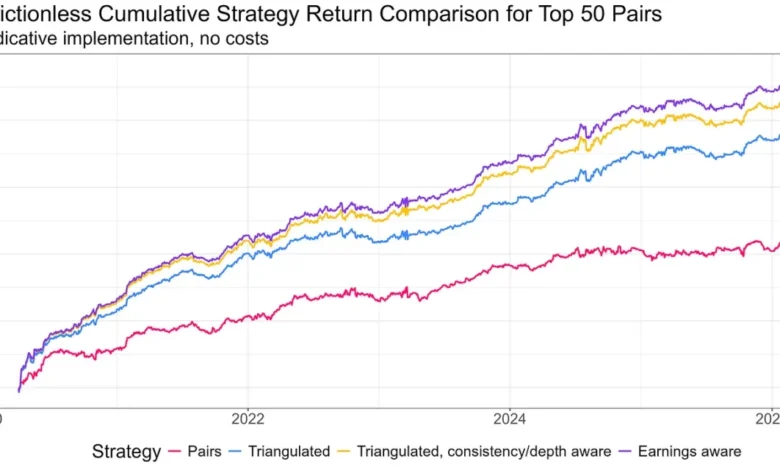
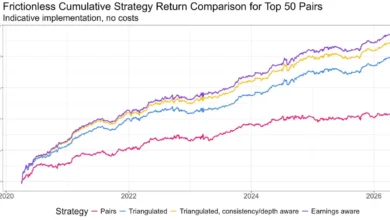
The landscape of quantitative trading for independent operators has long been constrained by the inherent limitations of traditional pairs trading. While classical statistical arbitrage relies heavily on the simple convergence bets of two related equities, such binary strategies frequently suffer from capital inefficiency, signal wastage, and vulnerability to structural divergence. Addressing these persistent industry challenges, quantitative research firm Robot Wealth has detailed the culmination of a six-month development cycle focused on Triangulated Statistical Arbitrage. This advanced methodology transitions individual traders away from isolated pair constructs and toward a sophisticated, portfolio-wide ticker aggregation framework designed to maximize risk-adjusted returns without demanding institutional-scale engineering infrastructure.
Background and Evolution of the Strategy
For decades, pairs trading has served as the canonical entry point for quantitative practitioners. At its simplest, the strategy identifies two correlated assets that drift apart, initiating a bet that market forces will eventually drive them back to their historical mean. However, for solo operators managing constrained capital, traditional pairs trading is profoundly inefficient. Capital is locked up in isolated pairs, and valuable signals generated across overlapping relationships are frequently ignored.
Recognizing these structural hurdles, Robot Wealth researchers embarked on an extensive multi-month initiative to overhaul statistical arbitrage for independent traders. The resulting live production system—currently deployed and actively traded by the firm’s principals—centers on a three-tier methodological architecture. This framework systematically addresses the core pain points of retail and boutique quant operations by shifting the analytical focus from isolated pairs to a unified, triangulated portfolio of individual tickers.
The Three-Pillar Architecture of Triangulated Stat Arb

The newly detailed methodology operates on a clear hierarchy of components, where each successive layer adds marginal performance improvements atop a robust foundation. According to the developers, the strategy relies on three distinct pillars: upstream pair selection, network triangulation, and external risk filtering.
Upstream Pair Selection as the Core Foundation
The primary driver of strategy performance is the upstream generation and ranking of the pair universe. Rather than relying on standard, computationally intensive cointegration tests—which often fail to capture practical trading dynamics—the framework evaluates pairs using unconventional, direct metrics over a trailing 24-month historical window.
Two critical metrics define pair quality within this system. The first measures frictionless returns achieved by trading mean-reversion on the spread over a specific lookback period, filtering out assets whose spreads diverge permanently rather than mean-reverting. The second metric assesses convergence consistency, ensuring that a spread reliably comes back together after diverging rather than randomly stabilizing only at the very end of a formation period.
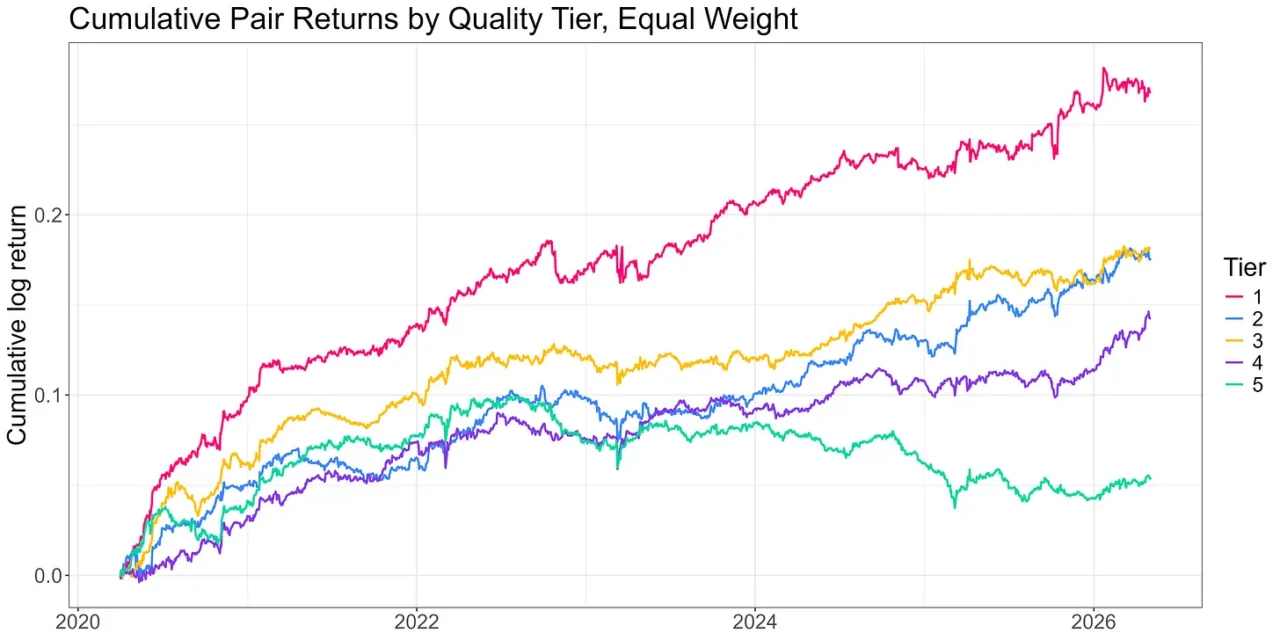
Every month, the top 10 percent of pairs that successfully clear these filters and satisfy fundamental economic risk-factor exposures are exported and divided into five distinct performance tiers. Empirical performance data released by the firm demonstrates a stark divergence in efficacy across these tiers. Tier 1 assets consistently deliver high risk-adjusted Sharpe ratios—exhibiting approximately a fourfold Sharpe spread between the top and bottom tiers—while lower tiers demonstrate severe performance degradation. This upstream curation accounts for an estimated 80 to 90 percent of the strategy’s total alpha generation, proving that subsequent signal adjustments offer only marginal enhancements if the foundational universe is flawed.
Triangulation and Ticker-Level Aggregation
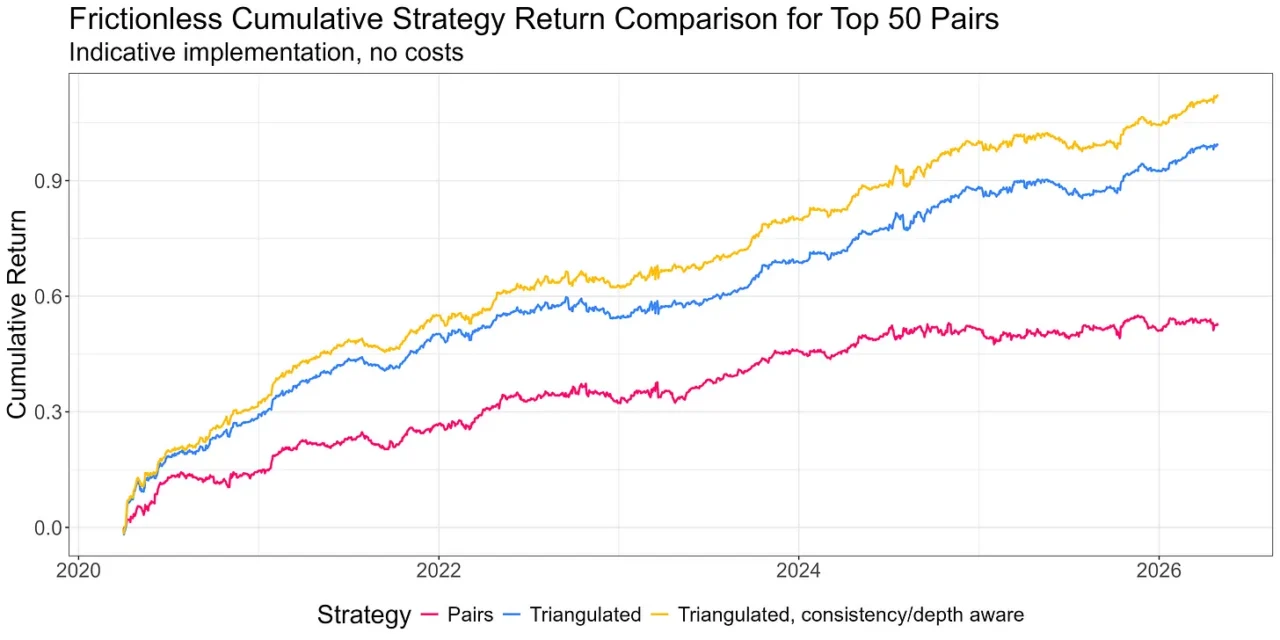
Once a clean universe of high-quality pairs is established, the methodology transitions from a pair-centric view to a per-ticker perspective. Because individual stocks frequently participate in multiple pairs simultaneously, each relationship generates a distinct z-score indicating how far a spread has deviated from its rolling mean.
By aggregating these per-ticker views across all associated pairs within the network, traders generate a comprehensive, consensus-driven signal. If multiple distinct pairs corroborate that a specific ticker is mispriced, the evidentiary weight far exceeds any signal derived from a single isolated pair. Furthermore, empirical testing confirms that restricting execution to the distribution tails—focusing capital on the most severely mispriced names rather than trading every asset in the universe—materially optimizes portfolio performance and capital efficiency for solo operators.
Filtering for Exogenous Shocks and Fundamental Re-pricing
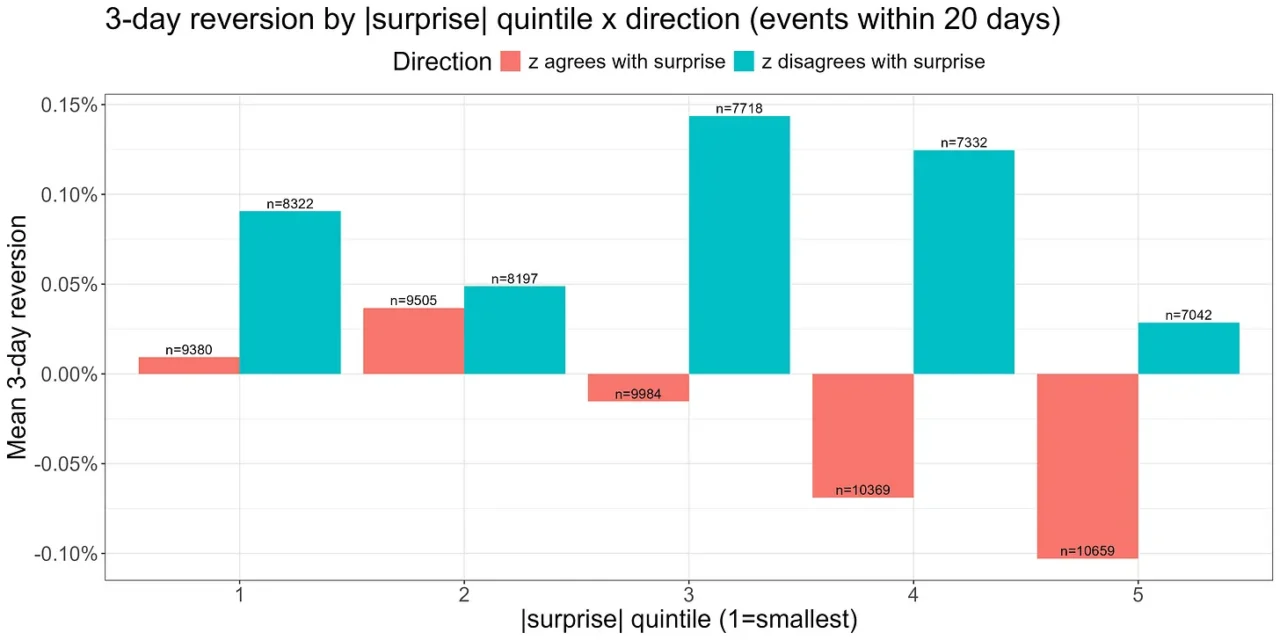
The third pillar of the framework addresses a fundamental limitation of statistical arbitrage: quantitative models can identify that a spread has diverged, but they cannot inherently determine why. A price divergence driven by transient, technical forced-flow is an ideal candidate for a mean-reversion trade, whereas a divergence resulting from genuine fundamental re-pricing—such as an unexpected earnings surprise or major corporate announcement—represents a permanent shift that renders fade strategies hazardous.
Initial research into volume-asymmetry indicators suggested that trade volume could help distinguish between technical and fundamental moves at the pair level. However, developers found that once data was aggregated to the ticker level within the triangulated framework, volume-based features added negligible alpha beyond what was already captured by upstream pair selection. Consequently, volume features were largely sidelined in the production model.
In contrast, implementing a rigorous earnings filter yielded measurable improvements. Historical analysis revealed that when a spread’s formation period coincides with a significant earnings surprise, the resulting price movement reflects fundamental new information. Fading these moves often results in trend continuation rather than mean reversion, a manifestation of post-earnings announcement drift. By explicitly filtering out or adjusting for these events, the live strategy successfully avoids catastrophic false signals. Ongoing research aims to broaden this defensive capability by incorporating general news and event data analytics.
Operational Resourcing and Infrastructure for Independent Traders
Building and maintaining the infrastructure required to execute Triangulated Statistical Arbitrage independently presents a formidable barrier to entry. Generating a monthly pair universe from thousands of candidate equities involves ingesting, cleaning, and processing historical data across hundreds of thousands of potential pairs—a computational overhead that would routinely exceed the annual subscription costs of commercial data feeds, alongside thousands of hours of custom software engineering.
To democratize access to institutional-grade methodology, Robot Wealth has integrated these operational pipelines into its RW Pro platform. The ecosystem provides subscribers with an API serving end-of-day and hourly intraday spread data, alongside robust historical feeds designed to facilitate ongoing quantitative research.
Rather than enforcing a rigid, one-size-fits-all signal that fails to account for individual trader constraints, the platform supplies fully transparent example implementation notebooks. Subscribers can dynamically adjust operational parameters—including universe sizing, weighting schemes, no-trade buffers, signal thresholds, and leverage configurations—tailoring the framework to their exact account sizes, risk tolerances, and cost structures.
Broader Industry Implications and Market Impact
The public release and community-driven refinement of Triangulated Statistical Arbitrage highlight a broader structural shift within quantitative finance. As computational tools become more advanced, retail and boutique independent traders are increasingly adopting sophisticated network-based portfolio models previously reserved for proprietary trading desks and institutional hedge funds.
Industry analysts note that while quantitative strategies are frequently guarded as proprietary secrets, open collaborative research environments—where community members actively pressure-test models, propose feature adjustments, and share empirical findings—accelerate strategy maturation. By focusing on conceptual transparency rather than closed-box execution, frameworks like Triangulated Stat Arb empower independent operators to build sustainable, autonomous trading operations.
Ultimately, the success of the methodology reinforces a core tenet of quantitative portfolio management: operational edge is derived less from complex intraday signal generation and far more from rigorous upstream data curation, robust risk filtering, and disciplined capital allocation. As independent traders increasingly deploy these multi-layered quantitative frameworks, the demarcation line between boutique operators and institutional market participants continues to narrow.