Redefining Algorithmic Risk Management through Large Language Model Integration and Adaptive Market Regimes

The pursuit of consistent alpha in liquid equity markets has long been defined by the struggle to predict future price directions. For decades, quantitative analysts have attempted to leverage statistical models, machine learning, and time-series analysis to forecast tomorrow’s returns, often with limited success in highly efficient markets. A recent strategic shift, championed by researchers and quantitative developers like José Carlos Gonzáles Tanaka, suggests that the primary failure of Large Language Model (LLM) trading strategies lies in the objective itself. By reframing the LLM’s role from a predictive "forecaster" to an adaptive "risk manager," developers are discovering that artificial intelligence can provide significant utility in navigating complex market regimes, even if it cannot reliably predict the next day’s price movement.
The Failure of Directional Prediction
The fundamental challenge in modern algorithmic trading remains the signal-to-noise ratio. As noted by quantitative finance expert Ernie Chan in his 2024 analysis, predicting the short-term returns of liquid, large-cap assets—such as Apple Inc. (AAPL)—is a task that remains notoriously difficult for any model, regardless of its underlying architecture. When LLMs are prompted to predict "up or down," they often succumb to the same pitfalls as traditional regression models: they produce noisy signals that fail to capture the underlying structural changes of the market.
This realization has led to a paradigm shift. Instead of asking a model to guess the direction of the market, this new approach utilizes the LLM’s capacity for nuanced judgment to distinguish between distinct market states. By processing historical data—mean returns, standard deviations, and Sharpe-like performance metrics—the LLM evaluates the current environment and dictates an appropriate level of exposure. This transforms the trading algorithm from a speculative tool into a dynamic risk-management engine.
Building the Architecture: A Three-Layered Approach
The implementation of an agentic AI trading strategy requires a robust, multi-layered framework designed to handle the unpredictability of financial markets. The architecture consists of three core components: feature engineering, LLM-driven policy generation, and hard risk guardrails.
The process begins with "Market Mood" feature engineering. By extracting technical signals from Open-High-Low-Close-Volume (OHLCV) data, the strategy discretizes continuous market signals into labeled states. For instance, a market environment might be labeled as "trending upward in a calm, overbought state." This discretization allows the LLM to apply its vast internal knowledge to interpret these states, effectively simulating the intuition of a seasoned risk manager.
The second layer is the LLM policy table, which is updated on a monthly, walk-forward basis. By feeding the LLM summarized historical statistics for each regime, the model outputs a predefined policy: full investment, partial exposure, or a defensive, reduced-exposure posture. This ensures that the strategy remains adaptive, shifting its stance as the historical data underlying the regimes evolves.
Finally, the system integrates "hard guardrails"—automated safety protocols that act independently of the LLM. These include volatility stops and drawdown limits. These mechanisms are crucial because they prevent the "deadlock" scenarios common in automated systems, where a model might be paralyzed by a sustained downturn. The inclusion of a forced re-entry mechanism ensures that the strategy does not remain sidelined indefinitely, allowing it to participate in market recoveries.
Chronology and Walk-Forward Validation
The effectiveness of this approach was verified using an out-of-sample (OOS) backtest spanning from January 2023 to the present. The walk-forward methodology is essential for maintaining integrity in quantitative research, as it prevents look-ahead bias by ensuring the model only utilizes data available at the specific moment of decision-making.
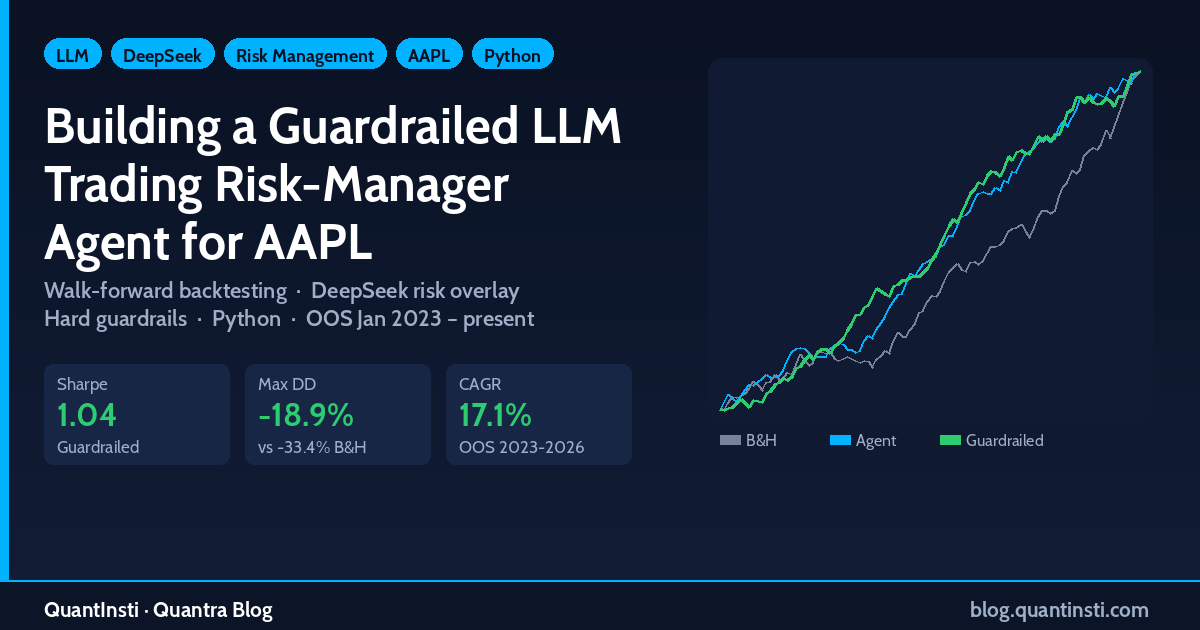
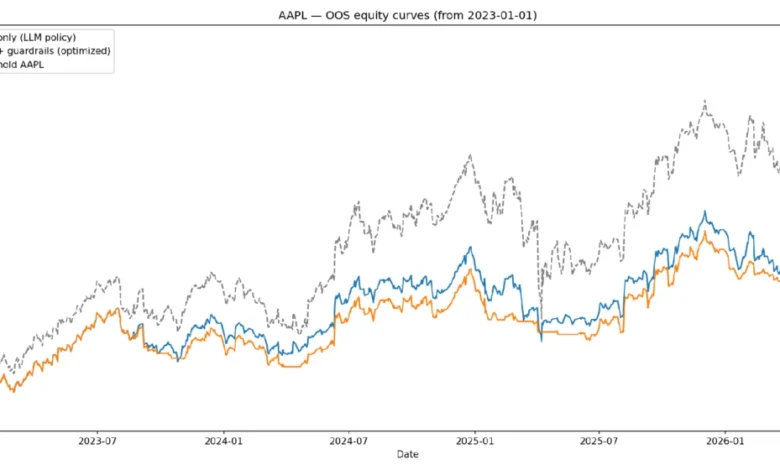
Throughout the 2023–2026 period, the strategy demonstrated the ability to participate in the strong uptrend of assets like AAPL while simultaneously providing significant downside protection. Data indicates that while the raw compound annual growth rate (CAGR) of a buy-and-hold strategy may exceed that of an LLM-managed approach during periods of uninterrupted growth, the risk-adjusted returns of the LLM-managed strategy often prove superior. By reducing maximum drawdown—in some cases by nearly 45% compared to passive holding—the LLM-driven strategy provides a smoother equity curve, which is often a priority for institutional portfolios and risk-conscious investors.
Data-Driven Insights and Performance Metrics
The performance of the system is measured through standard risk-adjusted metrics: the Sharpe ratio, Sortino ratio, and Calmar ratio. A critical finding in this research is that the LLM does not inherently generate "alpha" in the traditional sense; rather, it modulates risk. During periods of high market stress, the guardrails and the LLM’s risk-off signals detach the portfolio from the full extent of market corrections.
For example, when the strategy’s equity falls below a defined drawdown threshold, the system triggers a partial or full exit. The subsequent re-entry logic is designed to mitigate the "deadlock" problem, where a system stays at zero exposure for too long after a crash. By forcing a re-entry after a set number of days (e.g., 10 days), the strategy maintains participation in market drift, balancing the need for safety with the necessity of growth.
Implications for Future Financial Engineering
The implications of this research are broad. As LLMs become more integrated into financial infrastructure, the focus is likely to move away from "black box" prediction models toward "white box" frameworks where the LLM acts as an overseer of logic-based systems.
Key areas for further research include:
- Macro-Regime Filtering: Incorporating broad market indicators, such as the S&P 500’s relationship with its 200-day moving average, to provide the LLM with a wider context.
- Comparative Model Analysis: Running concurrent evaluations across multiple LLMs (e.g., GPT-4o, Claude, and DeepSeek) to identify systematic agreement, which can serve as a stronger indicator of signal quality than a single model output.
- Earnings Blackout Protocols: Implementing automated pauses around scheduled corporate events, which are known sources of gap risk that models struggle to manage effectively.
Expert Perspectives and Industry Stance
While the integration of LLMs in trading is still in its infancy, industry professionals emphasize the need for caution. The use of LLMs in finance is highly sensitive to the quality of the prompt and the structure of the input data. Experts warn that a poorly framed prompt—such as asking a model to "predict the market"—will almost certainly lead to sub-optimal outcomes. Instead, the consensus among quantitative developers is that LLMs should be restricted to tasks that require qualitative interpretation of quantitative data, effectively acting as an automated compliance and risk officer rather than a clairvoyant trader.
Furthermore, the operational cost of utilizing LLMs, while currently low for a monthly walk-forward cadence, remains a factor for high-frequency strategies. The implementation of caching mechanisms—where policy decisions are stored and reused—is standard practice to minimize latency and API expenses, ensuring that the model’s output remains efficient and scalable.
Conclusion: A Foundation for Resilient Trading
The framework developed by researchers in this space offers a template for the next generation of algorithmic risk management. By acknowledging the limitations of machine intelligence in forecasting price direction, and instead focusing on the model’s ability to interpret market conditions, developers have created a robust, risk-managed approach to equity participation.
The strategy does not attempt to outperform the market at all costs; rather, it aims to participate in the upside while systematically reducing exposure during periods of heightened volatility or structural decline. As demonstrated by the OOS testing from 2023 onward, this approach creates a more durable portfolio, characterized by lower drawdowns and more consistent risk-adjusted returns. While there is significant room for improvement—specifically in the granularity of state features and the sophistication of the LLM prompts—the fundamental design demonstrates that when handled with care, LLMs can play a vital role in the future of financial risk management. Investors and analysts looking to adopt these technologies would be well-served by adopting this "risk-manager" mindset, prioritizing the protection of capital as much as the pursuit of growth.