Global Markets Brace for Shift as Hawkish Fed Decision Sets Tone for Central Bank Watchers and US-China Summit

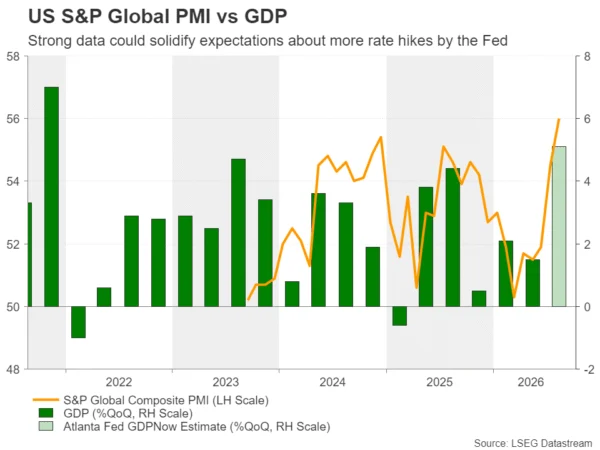
The United States dollar flexed its muscles across global foreign exchange markets this week, securing broad-based gains against all major currency peers as investors fully priced in a decisively hawkish pivot by the Federal Reserve. Anticipation of a firmer monetary stance built steadily through the early part of the week, culminating in an aggressive acceleration of the greenback’s advance immediately following the central bank’s definitive policy announcement.
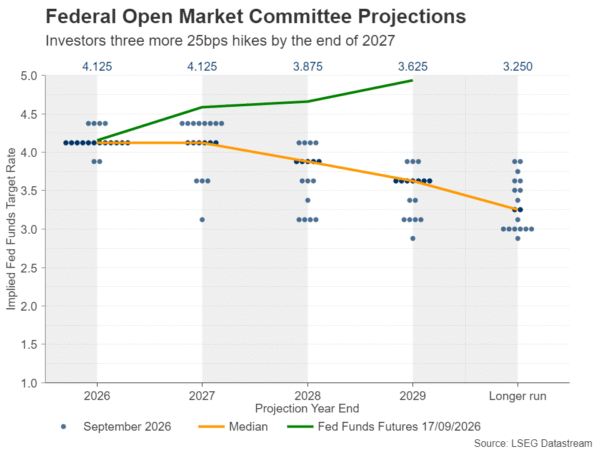
In a unanimous vote on Wednesday, the Federal Open Market Committee (FOMC) decided to push the benchmark interest rate hike button for the first time since 2023. Committee members pointed to persistently elevated domestic inflation, mounting upside price risks, and remarkably resilient domestic demand, employment, and business investment as the primary catalysts for the shift. Accompanying the rate decision, Federal Reserve officials upgraded their official gross domestic product (GDP) growth and inflation forecasts for 2026. Simultaneously, the newly released dot plot signaled anticipation of at least one additional rate hike before the conclusion of the calendar year, taking markets by surprise and reshaping fixed-income trading strategies globally.
Although the median projection for 2027 maintained a steady plateau without indicating immediate additional increases, internal divisions within the committee became strikingly apparent. Eight voting members explicitly penciled in another rate hike for next year, while one outlier expressed conviction that two consecutive increases would be warranted to tame price growth. This hawkish dispersion enabled market participants to maintain aggressive policy bets, currently assigning a roughly 50% probability to a back-to-back rate increase at the October policy meeting, while fully pricing in a subsequent hike for December. Looking further ahead to 2027, interest rate futures indicate that roughly two quarter-point rate hikes are already nearly fully priced into the yield curve.
Federal Reserve Chair Kevin Warsh, who did not submit individual rate or economic projections for this round, threw his full weight behind Wednesday’s tightening measure. During his post-meeting press conference, Warsh emphasized the structural necessity of maintaining higher interest rates to cool an accelerating economy. He noted that robust job creation is actively fueling domestic price pressures, cautioning that contemporary inflation is no longer driven exclusively by external shocks such as volatile oil prices or geopolitical import tariffs.
The policy shift immediately triggered political friction in Washington. Because President Donald Trump appointed Warsh under the widespread assumption that he would pursue a considerably more dovish monetary agenda than his predecessor, Jerome Powell, the administration reacted swiftly. President Trump publicly asserted that United States interest rates should instead be aggressively slashed down to approximately 1%. Financial markets are now intensely focused on whether this divergence will spark a protracted public confrontation between the White House and the Federal Reserve akin to the turbulence characterizing Trump’s tenure with Powell, or whether Chair Warsh will eventually find room to accommodate executive pressures.
Central Bank Communication Takes Center Stage Amid Upcoming Speeches and Flash PMIs
Despite the policy authority held by the Federal Reserve Chair, monetary policy direction remains a collective committee endeavor. Additional central bank officials must be persuaded that aggressive monetary easing is unwarranted under current economic conditions. Consequently, market participants are preparing to scrutinize a heavy slate of scheduled Federal Reserve speeches in the coming days. Chicago Fed President Austan Goolsbee is slated to deliver remarks on Monday, followed closely by Vice Chair Philip Jefferson and New York Fed President John Williams on Tuesday.
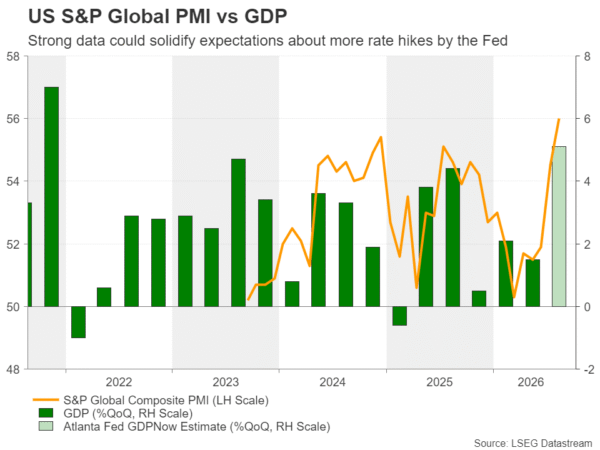
Should these key officials reiterate persistent concerns regarding elevated inflation metrics and the compounding upside risks stemming from ongoing conflicts in the Middle East, investors are expected to firmly maintain their hawkish rate hike expectations. This sentiment will likely find validation or challenge in the upcoming release of the September S&P flash Purchasing Managers’ Index (PMI) data for the United States. Given heightened market anxiety surrounding consumer price stability, foreign exchange and bond traders will likely focus heavily on the price subcomponents within the PMI reports. Following an unexpected acceleration in August Producer Price Index (PPI) figures, markets are eager to determine whether upstream corporate cost pressures are successfully being passed along to end consumers. Additionally, updated estimates from the Atlanta Fed’s GDPNow model for third-quarter economic growth, scheduled for release on Friday, will provide crucial benchmarks for overall macroeconomic health.
Global Monetary Policy Divergence: Eurozone and UK Economic Indicators in Focus
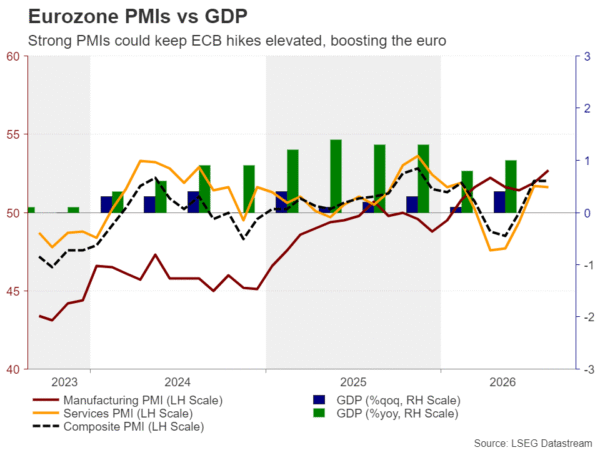
International central banking developments will run parallel to United States data releases next week, with the Eurozone and the United Kingdom publishing their respective September flash PMI reports on Wednesday.
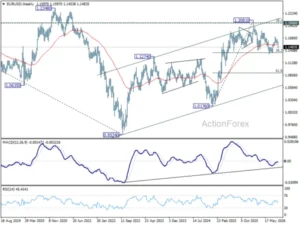
The European Central Bank (ECB) initiated its own tightening cycle on September 10, executing a 25-basis-point interest rate increase. Policymakers justified the move by citing renewed regional inflation pressures, while subsequent reports indicated that ECB officials believe further monetary tightening may become mandatory if escalating energy costs continue to generate inflation-linked disruptions. European money markets currently price in three additional quarter-point hikes by the end of next year, meaning robust PMI data will be vital for the euro to sustain upward momentum against rival currencies. As with the United States datasets, traders will closely analyze underlying input and output price metrics within the European reports.
Meanwhile, the Bank of England (BoE) opted to keep its benchmark interest rate unchanged following a contentious 6-3 policy vote, with three dissenting members favoring an immediate 25-basis-point increase. Although BoE officials assessed that secondary economic fallout from Iran-related energy shocks remains relatively contained for the time being, they warned that prolonged energy price volatility could destabilize long-term inflation expectations. Concurrently, policymakers acknowledged that domestic labor market conditions remain soft, pointing to a complex balancing act between curbing inflation and stimulating economic growth. Consequently, British pound traders will evaluate the upcoming UK PMI releases through a dual lens, monitoring both corporate pricing power and underlying employment indicators.
Swiss National Bank Prepares Policy Decision Amid Controlled Domestic Inflation
Shifting focus to continental Europe, the Swiss National Bank (SNB) is scheduled to announce its latest monetary policy decision on Thursday. Unlike many major global economies grappling with aggressive inflationary pressures, Switzerland has maintained remarkably stable and low price growth. Consumer price inflation accelerated to 0.8% year-on-year in August, marking its fastest pace in nearly two years, yet it remains comfortably situated within the central bank’s defined price stability target range of 0% to 2%.
Given this benign inflation environment, Swiss policymakers are widely expected to keep interest rates untouched at 0.0%. Analysts anticipate that the SNB will reiterate its standing readiness to intervene directly in foreign exchange markets should the Swiss franc experience excessive appreciation. While a strong franc effectively restrains imported inflation, it simultaneously damages domestic export competitiveness and broader economic growth. Despite entering a gradual downtrend against the euro, the franc remains historically elevated, reinforcing the likelihood that officials will maintain verbal warnings against runaway currency strength.
Market reaction to the SNB announcement will likely hinge on updated inflation forecasts. If policymakers incorporate noticeable upward revisions driven by Middle East geopolitical risks, traders may accelerate their timelines for an eventual SNB rate hike, providing technical support for a franc recovery. At present, interest rate swaps fully price in a 25-basis-point rate increase from the SNB by March of next year.
High-Stakes Diplomacy: Trump and Xi Set to Meet at the White House
On the geopolitical and macroeconomic front, upcoming labor market data from Australia will test whether Australian dollar traders are justified in pricing an 80% probability of an imminent rate hike later this month. Simultaneously, high-stakes political diplomacy will take center stage in Washington, where United States President Donald Trump is scheduled to host Chinese President Xi Jinping at the White House on Thursday.
The bilateral summit is expected to cover a wide array of contentious issues, including bilateral trade agreements, tariff structures, rare-earth mineral exports, and the global race for artificial intelligence (AI) dominance. Preparatory talks between United States Treasury Secretary Scott Bessent and Chinese Vice Premier He Lifeng will precede the formal presidential summit, potentially injecting market-moving headlines into global financial feeds ahead of the official meetings.
Financial markets will monitor whether the world’s two largest economies are prepared to extend their existing trade truce and potentially dismantle select retaliatory import tariffs. A de-escalation in trade tensions would likely boost global risk appetite, with trade-sensitive currencies such as the Australian and New Zealand dollars standing among the primary beneficiaries. Conversely, sharp disagreements regarding technological restrictions and AI competition will be closely scrutinized by equity investors seeking clarity on global supply chain stability and corporate earnings outlooks.