Industrial Service Leaders Tackle the Silver Tsunami and Equipment Complexity with AI and Remote Diagnostics

Industrial service teams across global manufacturing and discrete engineering sectors are confronting a compounding operational crisis characterized by rising equipment complexity, a rapidly retiring expert workforce, and fragmented service data. These intersecting pressures are systematically driving up the cost-to-serve, suppressing first-time fix rates, and forcing organizations to accelerate the deployment of artificial intelligence (AI) and remote diagnostics far faster than traditional operating models were originally designed to handle.
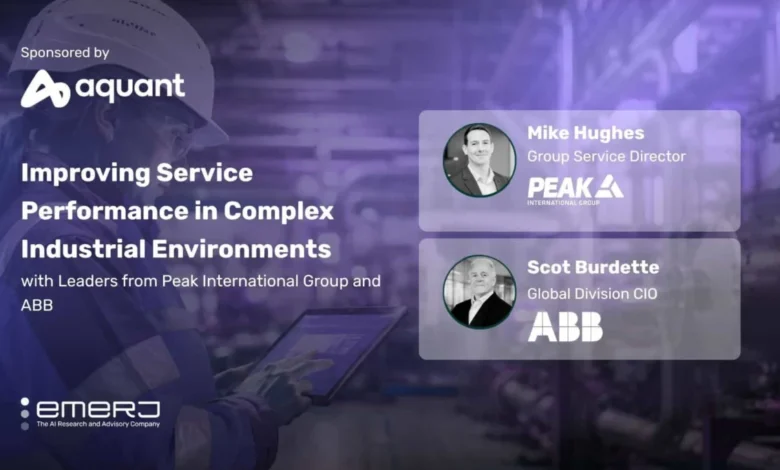
This critical inflection point in industrial operations was recently examined by Emerj on the AI in Business Podcast, featuring insights from Mike Hughes, Group Service Director at Peak International Group, and Scot Burdette, Global Division CIO at Measurement and Analytics at ABB. The discussions focused heavily on how modern industrial enterprises are actively restructuring technician enablement, establishing knowledge continuity workflows, and refining diagnostic decision-making to maintain baseline service performance despite severe labor constraints.
The urgency of this transformation is rooted in profound demographic shifts across the labor market. According to recent data from the U.S. Census Bureau, the share of manufacturing and wholesale trade employment concentrated within firms where at least 25% of the workforce is over the age of 55 nearly tripled between 2000 and 2022, surging from 14% to over 40%. This aging demographic baseline underpins a looming talent shortfall. Citing research from Deloitte and The Manufacturing Institute, the National Association of Manufacturers (NAM) projects that as many as 2.1 million manufacturing jobs could go unfilled by 2030, with a potential economic toll of $1 trillion in that single year. In highly technical, engineering-intensive trades, the U.S. Department of Energy has reported that up to 52% of skilled technicians and engineers may need to be replaced within a decade.
Compounding this human capital deficit is the sheer financial drag of equipment maintenance inefficiency. Research published through the National Institute of Standards and Technology (NIST) estimates that maintenance-related expenditures and preventable losses across United States discrete manufacturing alone total approximately $222 billion annually. The same NIST study underscored the protective value of advanced methodologies, finding that manufacturers relying more heavily on predictive and preventive maintenance experienced 52.7% less unplanned downtime compared to peers still reliant on traditional, reactive service models.
Against this backdrop, organizational adoption of artificial intelligence has surged. Stanford University’s 2026 AI Index reports that organizational AI adoption has reached 88%. However, this widespread deployment occurs alongside cautionary findings from the institute’s earlier reports, which highlighted a widening gap between what emerging technologies can technically execute and the operational discipline required to manage them effectively against real frontline challenges. To bridge this gap, industrial service executives are refocusing their digital transformation strategies on knowledge capture, unified data architectures, and diagnostic readiness.
The Chronology of Industrial Modernization
The evolution of industrial service operations over the past two decades has forced a fundamental departure from legacy maintenance paradigms. In the early 2000s, industrial service was predominantly reactive. Organizations relied heavily on on-site, experienced technicians who possessed decades of tribal knowledge regarding specific machinery lines. Maintenance schedules were strictly calendar-based, and troubleshooting was executed via hardcopy manuals and direct peer-to-peer consultation.
By the 2010s, the proliferation of the Industrial Internet of Things (IIoT) introduced basic telemetry and condition-monitoring capabilities. However, these early deployments often created data silos, inundating control rooms with uncoordinated alert streams without providing the contextual intelligence required for rapid resolution.
Entering the mid-2020s, the convergence of accelerated retirements—often termed the "silver tsunami"—and unprecedented machinery complexity forced a rapid pivot toward predictive analytics, cloud-based data unification, and generative AI tools. Today, industrial leaders are moving away from ad-hoc technology adoption, shifting instead toward structured, frontline-first sequencing to ensure that digital investments yield immediate, measurable returns on investment (ROI).
Knowledge Capture Workflows for Retiring Expertise
Opening the discussion on the AI in Business Podcast, Mike Hughes identified the loss of tacit, experience-based knowledge as the single most urgent operational risk facing industrial service providers. As long-tenured engineers retire, the troubleshooting intuition built over decades departs with them, creating immediate vulnerabilities in diagnostic accuracy.
"The one that stands out for me in conversations is the silver tsunami—the aging workforce," Hughes explained. "In field service in particular, it’s very common to have engineers who’ve been doing the job for twenty or thirty years, and there is more information in those people’s heads than there is in all of your manuals. The next generation is not going to spend twenty or thirty years with one company, so the question becomes: how do you preserve that tacit knowledge while you still have it, and how do you speed up onboarding so an engineer with two years of experience can get close to the results you’d get from someone with twenty?"
Complementing this perspective, Scot Burdette noted that the complexity of modern industrial machinery means that knowledge transfer cannot simply be compressed through accelerated classroom training. It demands intentional, prolonged mentorship pairs between veteran experts and incoming engineers to bridge the depth gap safely.
To maintain troubleshooting accuracy amidst workforce turnover, leading organizations are implementing structured knowledge capture frameworks, including digital standard operating procedures (SOPs), AI-assisted video documentation of complex repairs, and searchable knowledge repositories derived from historical service tickets.
Unified Diagnostic Data for Faster Fault Resolution
A recurring bottleneck identified by both manufacturing leaders is the fragmentation of enterprise data systems. Scot Burdette emphasized that effective remote diagnostics depend entirely on an engineer’s ability to access all relevant contextual information within a single interface. When historical case files, real-time sensor telemetry, and technical documentation reside in disparate, legacy databases, diagnostic interpretation slows down significantly.
Mike Hughes illustrated this operational friction with a concrete real-world example: "Before, when a technician needed to troubleshoot a unit, they’d review the case history in System A, refer to technical bulletins in System B, then move to System C to identify and locate the part they needed. On top of the technical debt of supporting a wide range of legacy and current products, they also have to jump across different platforms just to do their job. That fragmented experience hasn’t been great for them—we want to get to one place where everything a field engineer needs is at their fingertips."
By consolidating these information streams into unified diagnostic dashboards, enterprises can drastically reduce mean-time-to-resolution (MTTR), improve first-time fix rates, and empower remote support teams to make definitive escalation decisions before dispatching unnecessary field service technicians.
Remote Diagnostic Hubs for Scalable Expertise
As physical equipment becomes increasingly sophisticated, organizations are redefining how technical support is distributed across their networks. Scot Burdette outlined the structural evolution of remote diagnostic teams, emphasizing that remote troubleshooting requires an entirely distinct skillset compared to traditional hands-on field intervention.
"It is a different kind of expert," Burdette stated. "If you’re standing in front of the equipment, you can look at it and assess it hands-on—that’s very different from remote. You have to understand the right questions to ask, you have to understand what the data is telling you, and you have to be more prepared to provide that support on an ongoing basis. It’s also about having a team that can see the trending, step in when something isn’t going the way you expect, and make decisions very quickly before an issue becomes something bigger."
Establishing centralized remote diagnostic hubs allows industrial enterprises to scale their remaining expert talent across global operations. Rather than tying a senior engineer to a single geographical territory, centralized hubs enable subject matter experts to monitor, diagnose, and resolve anomalies across thousands of connected assets simultaneously.
Frontline-First Sequencing for Modernization ROI
Addressing the practical execution of digital transformation, Mike Hughes cautioned against technology-first strategies that begin with abstract platform evaluations rather than frontline observations. Sustainable modernization, according to industry leadership, must originate from direct engagement with the daily realities faced by field engineers.
"The strongest advice I can give is start with feedback from the frontline—understand what the pain points are at the crucial end of the business," Hughes advised. "Your engineers will tell you outright, or if you spend a day in the life of one of them, you’ll see clearly where the gaps and opportunities are. Then don’t try to do everything at once—be intentional about selecting one or two use cases, because it’s easy to relate something like an avoided truck roll straight to your P&L."
This sequencing principle ensures that capital allocation targets specific workflow breakdowns—such as recurring parts identification delays or repeated truck rolls—that directly impact operational profitability. By solving high-frequency pain points first, organizations build internal momentum, secure user adoption among frontline technicians, and establish a scalable foundation for broader artificial intelligence integration.