USD/JPY Market Analysis: Yen Halts Losing Streak as Tokyo and Washington Signal Vigilance Over Currency Weakness


The opening of the weekly trading session places the USD/JPY currency pair at 157.30, following a notable late-Friday shift that saw the Japanese yen pull back from two-week lows and decisively snap a five-session losing streak. The stabilization of the local currency comes at a critical juncture for foreign exchange markets, as traders weigh persistent macroeconomic pressures against renewed verbal interventions and political scrutiny from both Tokyo and Washington. The interaction between shifting monetary policy expectations in the United States and Japan, combined with high-level diplomatic discussions, has brought the vulnerability of the yen back to the forefront of global economic attention.
Background Context and Recent Macroeconomic Drivers
The persistent weakness of the Japanese yen over recent months has been fundamentally anchored in the wide interest rate differential between the United States and Japan. While the Bank of Japan (BoJ) has gradually initiated steps to exit its decades-long era of ultra-loose monetary policy and negative interest rates, the pace of its policy normalization remains cautious and heavily data-dependent. Conversely, the Federal Reserve has maintained a higher-for-longer interest rate stance, driven by resilient domestic economic data and stubborn inflationary pressures. This enduring divergence in borrowing costs has continuously incentivized investors to borrow in low-yielding yen to fund investments in higher-yielding dollar-denominated assets—a strategy widely known as the carry trade.
Furthermore, uncertainty regarding the future trajectory of the BoJ’s policy tightening has limited the currency’s ability to mount a sustained recovery. Market participants frequently question how aggressively Japanese monetary authorities can raise rates without destabilizing domestic bond markets and dampening fragile economic growth. As a result, structural headwinds have consistently kept the yen on the defensive, pushing USD/JPY progressively higher and closer to historical intervention thresholds.
Chronology of Recent Events and Political Interventions
The recent momentum shift in the currency market began to take shape following high-level diplomatic engagements earlier in the week. During a bilateral meeting between Japanese Prime Minister Sanae Takaichi and United States President Donald Trump, concerns regarding the rapid depreciation of the Japanese yen were formally raised. The acknowledgment of currency misalignment by the United States administration added substantial weight to Tokyo’s ongoing verbal defense of its national currency.

The political discourse was swiftly reinforced by Japanese Finance Minister Satsuki Katayama, whose public statements cautioned market participants against excessive speculative shorting of the yen. Minister Katayama confirmed that Japanese financial authorities are maintaining close and continuous coordination with United States Treasury Secretary Scott Bessent. This ongoing bilateral dialogue recalls the historic joint intervention conducted by Japan and the United States in late July—a decisive market operation that marked the first coordinated currency intervention between the two nations since 1998.
As spot exchange rates steadily approached the psychologically crucial threshold of 160.00, traders grew increasingly sensitive to the risk of direct market intervention by the Japanese Ministry of Finance (MoF). The 160.00 level is widely perceived by institutional analysts as a critical line in the sand, representing the point at which Tokyo may feel compelled to deploy its foreign exchange reserves to purchase yen and curb disorderly market movements.
Technical Analysis: H4 and H1 Chart Dynamics
From a technical perspective, the USD/JPY currency pair is exhibiting distinct corrective characteristics across multiple timeframes following its recent test of higher boundary levels.
On the 4-hour (H4) chart, the market recently completed a significant upward growth wave that peaked in the vicinity of 159.00. Following this peak, price action formed a sharp corrective impulse, breaking decisively below the lower boundary of the prevailing upward channel around the 157.96 mark. This structural breakdown preserves the near-term priority for a continued decline toward the primary reference level of 156.51. This level functions concurrently as a nearest downside target and a potential retest zone from above.
Should the pair descend to 156.51 and subsequently form a technical rebound, a corrective recovery could drive quotes back toward the 157.96 resistance area. A sustained break above 157.96 would subsequently invalidate the immediate corrective bias, opening the pathway for a resumption of the broader bull trend toward subsequent targets at 159.00 and 160.12. As long as quotes remain capped beneath the 157.96 resistance, the prevailing short-term outlook remains tilted toward corrective consolidation. Supporting this view, the Moving Average Convergence Divergence (MACD) indicator highlights a clear exhaustion of the previous upward momentum, evidenced by a contracting histogram and a signal line turning downward within positive territory.
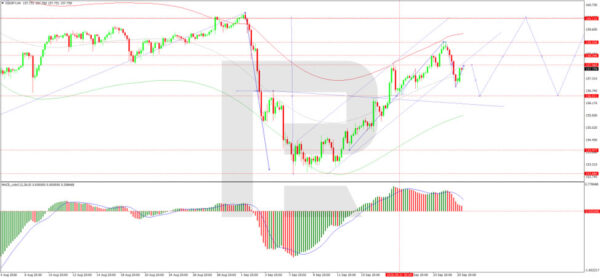
Analyzing the intraday structure on the 1-hour (H1) chart, the pair is currently reacting to a local recovery that unfolded from a swing low of 156.93 following the broader descent from 159.02. Price action has once again gravitated toward the 157.96 resistance zone, which marks the retest level of the previously violated growth structure. Early-session projections suggest that the current minor correction may finalize within the tight 157.90 to 157.96 price corridor, paving the way for a subsequent bearish wave toward interim support at 157.42, followed by the primary objective at 156.51.
A decisive breakdown beneath the 156.51 support floor would significantly amplify selling pressure, validating a deeper extension of the corrective cycle. Conversely, the Stochastic oscillator currently resides near the overbought territory and is displaying early signs of a downward crossover, aligning with the thesis that local upside momentum is reaching exhaustion. Intraday trading biases will remain strictly bearish as long as spot prices fail to establish a firm foothold above the 157.96 threshold. An alternative bullish scenario would require robust volume and confident price consolidation above 157.96, which would delay the anticipated downside correction and encourage renewed recovery toward 158.39 and 159.00.
Broader Economic Implications and Outlook
The intricate interplay between verbal intervention, monetary policy divergences, and technical market positioning underscores the delicate state of the USD/JPY pair. While Japanese fiscal and monetary authorities have demonstrated a heightened willingness to utilize both diplomatic channels and direct market operations to defend the national currency, structural macroeconomic realities continue to pose formidable challenges.
The persistent interest rate gap between the Federal Reserve and the Bank of Japan remains the primary anchor weighing on the yen. Unless incoming economic data forces a more aggressive pivot by the Federal Reserve toward monetary easing, or prompts the Bank of Japan to accelerate its normalization timeline, the underlying pressures driving capital out of the yen are unlikely to vanish entirely.
At the same time, the aggressive defense mounted by Finance Minister Katayama and the overt acknowledgment of currency concerns by Washington serve as a potent reminder to speculative market participants. The threat of coordinated intervention near the psychological 160.00 barrier creates an asymmetric risk profile for aggressive long positions in USD/JPY. Consequently, market participants are expected to navigate the upcoming trading sessions with heightened caution, closely monitoring official commentary from Tokyo and Washington alongside incoming tier-one macroeconomic releases from both economies.
Related posts: